
Busy but Not Booked? The 50\/50 Framework Every Sleep Consultant Needs
Split your working hours 50/50 between two types of work. Serve time is any hour spent in direct contact with a client or potential client: conversations, outreach, calls, and relationship building. Create time is any hour spent building something that works without you in the room: your website, email sequences, templates, and systems. Serve time brings income and clients now. Create time builds a business that can grow beyond your hours. Sleep Consultants who do both, every week, build sustainable and profitable businesses. Sleep Consultants who do only one stall.
In this guide
- What the Serve and Create framework is
- Why you need both, every single week
- What counts as Serve time and what counts as Create time
- How to apply the 50/50 split to your week
- Common time management mistakes Sleep Consultants make
- Frequently asked questions
I remember when I just got certified and had a to-do list with forty things on it. Website, Instagram, pricing, contracts, a logo, outreach, a freebie. Every item felt urgent, and every item felt like the one thing standing between me and a proper business. I didn't know where to start, so I started with what felt safest. I opened my laptop and worked on my website.
Weeks went by. The pages looked better every day, and I went to bed feeling productive. Then one evening it hit me: I hadn't spoken to a single parent. Not one conversation. I had been building a beautiful front door to a business no one was walking toward.
If you're in your first year, you might recognise this. Your hours are the most limited resource you have, and where you put them decides whether you build a business or a well-designed hobby. The uncomfortable work gets postponed, the comfortable work expands to fill the week, and months can pass before you notice.
The Serve and Create framework came out of that period. It's a simple way to sort every task into one of two buckets and make sure both get fed, no matter how many hours you have.
What the Serve and Create Framework Is
Every working hour in your sleep consulting business falls into one of two categories.
Serve time is any hour you spend in direct contact with a client or potential client. Conversations. Replying to DMs. Reaching out to a pediatrician about referrals. Running a Sleep Assessment Call. Supporting a family through their plan. Following up with a parent who asked about your services three weeks ago. If there's a person on the other end, it's Serve.
Create time is any hour you spend building something that works without you in the room. Your website. Your email welcome sequence. Your intake forms and contracts. Your sleep plan templates. A blog post that ranks on Google two years from now. If it keeps working while you sleep, it's Create.
The framework itself is one sentence: whatever your available hours are, split them 50/50 between the two. Ten hours a week? Five Serve, five Create. Full time? Half your week in front of people, half your week building assets. The ratio holds at any scale, which is exactly why it works for Sleep Consultants building around a day job, small children, or both.
My natural pull is toward Create. Give me a system to build or a template to perfect and I'm happy for days. Which meant early on I could go two weeks without a single conversation with a potential client and still feel productive. I wasn't. Busy and productive are two different things, and the 50/50 split is what kept me honest about the difference.
Why You Need Both, Every Single Week
Serve and Create feed different parts of your business, on different timelines.
Serve builds the short term. Clients come from conversations, and conversations only happen when you show up for them. Almost every first client in this industry comes from a direct human interaction: a referral, a DM turning into a call, a friend of a friend. If you want income in the next 30 to 90 days, Serve time is the only lever moving it.
Create builds the long term. Every conversation you have disappears the moment it ends. A booking page, a welcome sequence, a client onboarding system, a well-written article: these keep working for months or years after you build them. Create time is how you stop starting every month at zero. It's also how you protect your energy, because systems handle the repetitive work so your Serve hours go to humans instead of admin.
Now look at what happens when you drop one side.
| Pattern | What it looks like | Where it leads |
|---|---|---|
| All Serve, no Create | Constant outreach, calls, and client work. No website, no systems, everything done manually and from scratch. | Income now, exhaustion later. Every client requires the same effort as the first. Nothing compounds, and growth stops the moment you stop hustling. |
| All Create, no Serve | Months on the website, the logo, the perfect welcome sequence. Few conversations with potential clients. | A beautiful business with no clients in it. Feels productive, earns nothing. Often this is perfectionism wearing a work outfit. |
| 50/50 Serve and Create | Conversations and relationship building every week, plus steady progress on systems and assets every week. | Clients now and a business getting easier to run every month. Each week adds both income potential and a permanent asset. |
The two buckets also feed each other, and this is why the framework is so freaking powerful. Your Serve conversations tell you exactly what to Create. The question a parent asks on every single call becomes your FAQ page. The objection you hear over and over becomes the email in your nurture sequence. And what you Create makes your Serve time better, because a parent who read your article and went through your welcome sequence arrives at the call already trusting you. Drop either side and you starve the other.
What Counts as Serve Time and What Counts as Create Time
The test is simple. Ask: is there a person on the other end of this hour, or am I building something that works without me in the room?
| Serve time (people) | Create time (assets) |
|---|---|
| Sleep Assessment Calls and client consultations | Building your website and posting on Instagram |
| Replying to DMs, comments, and emails from parents | Writing email sequences running automatically |
| Reaching out to pediatricians, doulas, and lactation consultants for referral relationships | Creating contracts, intake forms, and sleep plan templates |
| Supporting current clients through their plan | Writing blog articles bringing search traffic long term |
| Showing up live: local events, mom groups, workshops, lives on Instagram | Setting up automations for booking, reminders, and onboarding |
| Asking past clients for testimonials and referrals, personally | Building a freebie or digital product selling while you're offline |
Scrolling Instagram, tweaking your logo for the fourth time, and researching tools you already own belong in neither bucket. An hour that doesn't put you in front of a person or leave a working asset behind is avoidance, and avoidance needs a different fix than a schedule.
How to Apply the 50/50 Split to Your Week
Step 1: Count the hours you have.
Look at your week, after the day job, the kids, and life, and write down the number of hours left for your business. The framework works with 6 hours or 40, but it needs an honest number to split.
Step 2: Divide them in two.
Half goes to Serve, half goes to Create. With 10 hours, that's 5 and 5. A single week landing at 60/40 won't hurt you, but 90/10 for a month straight is a warning sign.
Step 3: Put Serve time in your calendar first.
Serve is the half most Sleep Consultants avoid, because reaching out to strangers feels scarier than editing a website. That's why it goes in the calendar FIRST, at specific times. "Tuesday 9 to 10: follow up with warm leads and send two outreach messages." Vague intentions lose to concrete appointments every time.
Step 4: Give your Create time one project at a time.
Don't spread five Create hours across six half-finished projects. Pick the asset removing your biggest bottleneck right now, finish it, then move to the next. No booking system yet? It comes before the blog. If you're unsure what to build first, start with the three systems every sleep consulting business needs.
Step 5: Review the split at the end of each week.
Two minutes on Friday. Where did the hours go? You'll drift toward whichever bucket feels more comfortable to you. The review is what pulls you back before one starved bucket costs you a month.
And the framework keeps working as you grow. If your weeks get so full of client work that your Create hours disappear, your business is telling you it's time to automate and outsource. The Create work at that stage changes shape: instead of building your first booking page, you're setting up automations for what you've been doing manually and handing off the tasks that don't need you. The 50/50 split works as a signal system here. When Serve swallows everything, the next Create project is always the same: get hours back.
Common Time Management Mistakes Sleep Consultants Make
Hiding in Create because Serve feels uncomfortable
This is the most common one by far. Building a website feels safe. Sending a message to a pediatrician you've never met does not. So the website gets a fifth revision and the outreach never happens. I've seen this with almost every Sleep Consultant I've worked with, and yes, I know it feels uncomfortable. Do the Serve work anyway, in small scheduled doses. Confidence follows action.
Counting content creation as Serve time
Posting on Instagram feels like reaching people, but making the post is Create. Serve starts when you reply to the comments, answer the DMs, and start conversations with the parents who engaged. A Sleep Consultant who posts daily but never talks to anyone is doing 100% Create and wondering why nobody books.
Dropping all Create time the moment clients arrive
Three clients come in, the calendar fills, and every system project stops. Then those clients finish, the pipeline is empty, and you're back at zero. Sound familiar? Keeping even two Create hours a week during busy periods is what smooths out the feast-and-famine cycle.
Building assets nobody asked for
Create time should solve problems your Serve time revealed. If you haven't had enough conversations to know what parents in your niche struggle with, you're guessing what to build. Talk first, build second. Your best Create ideas come out of your Serve hours.
Treating admin as Create time
Organising your inbox, renaming files, and updating your task list feel like building. They aren't. Create time leaves behind an asset working without you: a page, a sequence, a template, an article. If nothing exists at the end of the hour that didn't exist before, it wasn't Create.
Frequently Asked Questions
Does the 50/50 split apply if I only have a few hours a week?
Yes, and that's the point of a ratio instead of a fixed number. With 6 hours a week, spend 3 in conversations and outreach and 3 building your systems. Progress will be slower than with 40 hours, but it will be balanced, which matters more. A small business built on both sides beats a bigger one built on only one.
Should new Sleep Consultants lean more toward Serve or Create at the start?
No. Stay at 50/50 from day one, and expect the Serve half to feel uncomfortable at the start. The discomfort is normal, and it's exactly why the framework exists: without it, most new Sleep Consultants shrink their Serve hours and hide in Create. Conversations get you your first clients, so the Serve half is non-negotiable even when, especially when, it feels hard. The discomfort fades with repetition.
Is client work Serve time or does Serve only mean marketing?
Client work is Serve time. Serve covers every hour with a person on the other end, paid or unpaid: sales conversations, outreach, and delivering support to current families. When paid client hours grow so much that they push out both your unpaid Serve work and your Create hours, that's the signal to automate and outsource. Your business has outgrown doing everything manually, and the 50/50 split is what makes it visible.
How long does it take before Create time starts paying off?
It depends on the asset. A booking system pays off with the very next inquiry. An email sequence starts working as soon as the first parent joins your list. Blog content built for search typically takes 3 to 6 months to gain traction. This delay is exactly why Create time needs protecting: the payoff arrives after the work, sometimes long after, and businesses skipping it feel the gap a year later.
What if I genuinely enjoy one side and dread the other?
Then you've found your drift direction, and knowing it is half the solution. Schedule the side you dread first, in short blocks, and pair it with something specific rather than open-ended. "Send three messages to warm leads" is easier to start than "do outreach". Over time you can also design around your preference: someone who dreads live conversations can build a Serve routine around one-to-one voice notes and email instead of calls.
Key Takeaways
- Sort every hour into two buckets: Serve (direct contact with a client or potential client) or Create (building something that works without you in the room).
- Split your hours 50/50 between the two, whatever your total hours are. Serve pays this month, Create pays every month after.
- Schedule your uncomfortable bucket first. Everyone drifts toward the side feeling safer, and for most new Sleep Consultants that means hiding in Create.
- Let the buckets feed each other. Conversations tell you what to build. Assets make your conversations easier and warmer.
- Review the split every Friday. Two minutes of honesty about where the hours went keeps a whole month from disappearing into one bucket.
If your Serve hours are ready but your Create list feels endless, start with the three systems every sleep consulting business needs and build from there.
Disclaimer: The information shared in these articles is for educational and informational purposes only. It does not constitute legal, financial, or professional advice. Always consult with a qualified professional regarding your specific situation.

Rianna Hijlkema
Certified Pediatric Sleep Consultant, Certified Postpartum Doula, Former Teacher & School Director, Founder of Sleep Consultant Design & Sleep Consultant Business and the author of The Sleep Consultant Playbook (available on Amazon).
The Sleep Consultant Newsletter
Weekly tips, strategies and marketing ideas for sleep consultants written by a fellow sleep consultant. 1500+ active subscribers!
I’ll only send helpful emails, and you can unsubscribe anytime with one click.
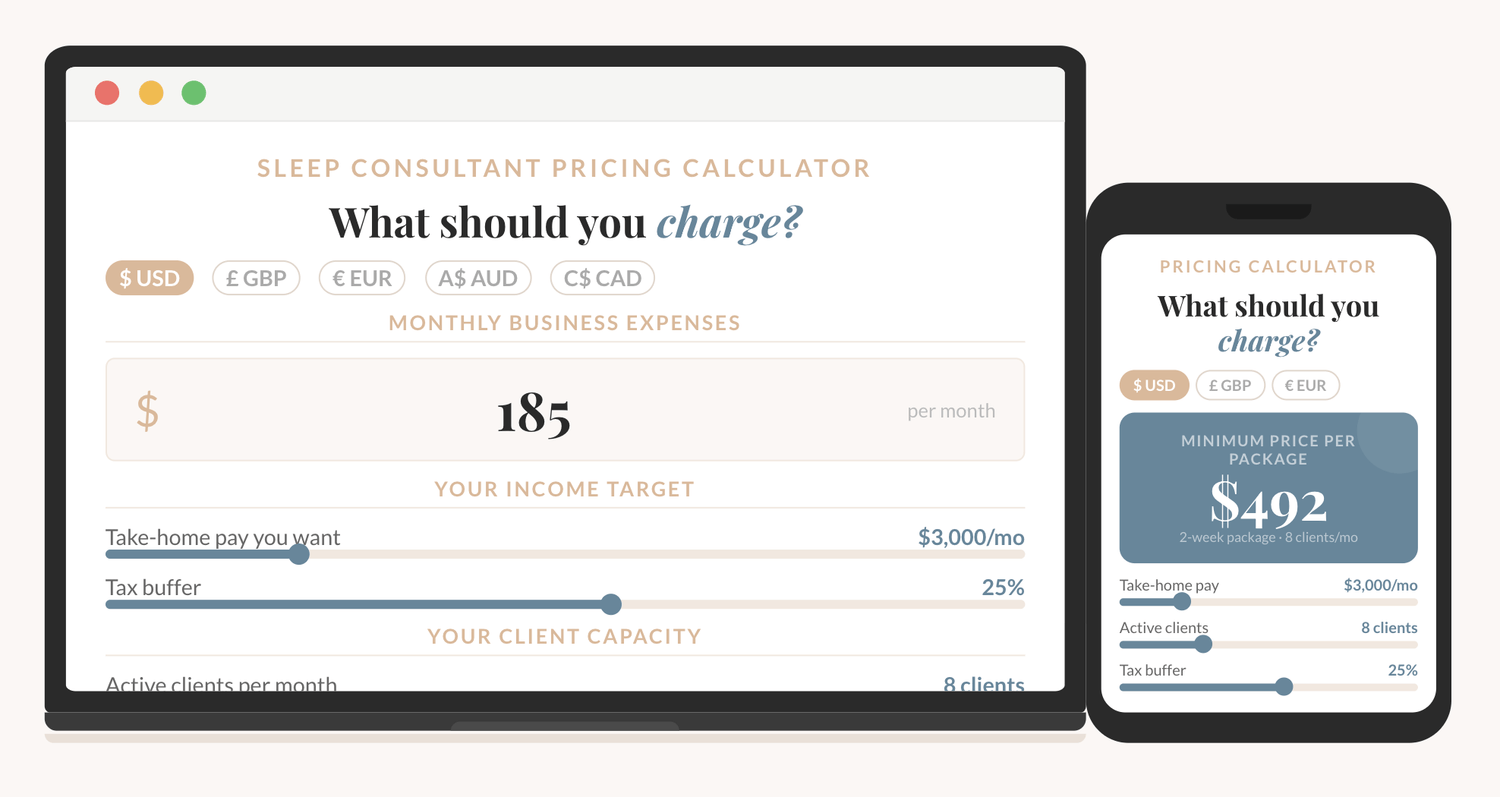
How to price your sleep consulting services?
The Sleep Consultant Pricing Calculator shows you exactly what to charge, based on your real expenses, your income goal, and how many clients you want to take on.
I'm thrilled to offer you an exclusive preview of what’s inside!
You can read the first 22 pages of The Sleep Consultant Playbook and get a taste of the value, insights, and actionable strategies that are waiting for you.
Other articles you might be interested in:
© 2021-2026 Sleep Consultant Business. All Rights Reserved.