
How to Set Goals That Actually Get You Sleep Consulting Clients
Most sleep consultants set goals around outcomes they can't directly control: revenue targets, client numbers, booking rates. These are lag metrics. They measure results after the fact. The goal that actually drives those outcomes is the one you set one step earlier: how many people you reach out to. That is your lead metric. It is the only number in your business that you can control every single day, and it is the most direct driver of every client you will ever book.
In this guide
- Lag metrics vs lead metrics: what's the difference
- The goal that actually moves the needle
- Warm audience vs cold audience: why it changes everything
- Realistic conversion benchmarks for sleep consultants
- How to set your outreach goal
- Common goal-setting mistakes sleep consultants make
- Frequently asked questions
You sit down at the start of the month and write "get 3 clients this month" at the top of your notebook. Sounds clear. Sounds like a real goal. But here's the problem: you can't make anyone become a client. You can't control whether someone books. You can't will a conversion rate into existence.
What you can control is how many people you talk to, reach out to, and start conversations with. That number is in your hands every single day. And it is the only goal that actually puts clients on your calendar.
Lag Metrics vs Lead Metrics: What's the Difference
A lag metric is an outcome. It's the result of everything that happened before it. Revenue, number of clients, bookings: these are all lag metrics. They tell you how you did. But they can't tell you what to do tomorrow, because by the time you see them, the actions that produced them are already in the past.
A lead metric is an activity. It's the thing you do that causes the outcome. It happens before the result and directly influences it. Lead metrics are what you can actually control on any given day.
| Lag metric (outcome) | Lead metric (activity) |
|---|---|
| Book 3 clients this month | Reach out to 10 warm contacts this week |
| Earn $3,000 in revenue | Send 5 personalised DMs per day |
| Grow my audience to 1,000 followers | Start 3 new conversations today |
| Get 10 Sleep Assessment Call bookings | Follow up with 5 people who haven't replied yet |
Lag metrics are not useless. You absolutely need to track revenue and bookings to understand how your business is doing. But they are terrible as daily goals, because you can stare at "3 clients this month" all you want and it won't tell you what to do at 9am on a Tuesday. Your lead metric does.
The Goal That Actually Moves the Needle
For a sleep consultant, the lead metric that drives everything else is outreach. How many people did you reach out to today? How many genuine conversations did you start this week? How many follow-ups did you send?
Clients don't appear because you wanted them. They appear because you talked to enough people. That's it. Every other explanation for why some sleep consultants have full calendars and others don't comes back to this one variable: volume of genuine outreach, done consistently, to the right people.
When I work with sleep consultants who aren't booking clients, the first thing I'd look at is not their website, not their packages, not their prices. I ask: how many people did you reach out to last week? Almost every time, the answer is some version of "not many" or "I posted a few things on Instagram." Posting is not outreach. Outreach is a direct conversation with a real person. The moment we shift focus to that number, to tracking actual conversations started rather than followers gained, things are moving.
Think about it like working out. Thinking about lifting weights doesn't build muscle. Doing one rep doesn't either. But showing up every day and doing the reps? That's where the result comes from. Outreach is the rep. Revenue is the muscle. You don't get the muscle by staring at it and hoping.
Warm Audience vs Cold Audience: Why It Changes Everything
Not all outreach is equal. Who you're reaching out to changes the conversion rate dramatically, which changes how many conversations you need to start to reach your actual goal.
Your warm audience
Your warm audience is everyone who already knows, likes, and trusts you to some degree. Friends, family, former colleagues, acquaintances, neighbours, people from your community. Basically anyone who wouldn't ignore your text message or pretend not to see you at the school gates.
Because trust already exists, warm outreach converts faster, requires fewer touchpoints, and is far less intimidating to do. It's also where almost every sleep consultant's first clients come from, not from Instagram, not from ads, but from someone they already knew, or someone that person referred them to.
Your warm audience is also a referral engine. Even if someone doesn't need your services personally, they might know someone who does. Your former colleague mentions you to a friend. Your neighbour passes your name to someone in her mother's group. A ripple effect that reaches people you've never met, carried by someone who already trusts you.
Your cold audience
Your cold audience is everyone who doesn't know you yet. Parents who find you through social media, search engines, directories, ads, or partnerships. They might be exactly the right people, but there's no existing trust to lean on. They need to go through a full journey from discovering you exist to feeling confident enough to book.
Cold outreach isn't wrong. It just requires more of everything: more touchpoints, more content, more social proof, more time. A cold lead who found you on Instagram typically needs to see you multiple times, read your content, maybe check your testimonials, and have a Sleep Assessment Call before they commit. A warm contact might book after one conversation.
This is why the advice to "just grow on social media" for sleep consultants bothers me. I know that many of you are investing enormous effort into a cold channel before you've built the testimonials, confidence, and portfolio that make that channel effective. Warm outreach first. Always. You can add cold channels once the warm channel is working.
| Warm audience | Cold audience | |
|---|---|---|
| Trust level | Already exists | Has to be built from scratch |
| Touchpoints to convert | 1 to 3 | 5 to 12+ |
| Conversion rate | Higher (approx 2% of list) | Lower (varies widely) |
| Examples | Friends, former colleagues, acquaintances, referrals | Instagram followers, Google searchers, ad traffic |
| Best for | First clients, early momentum, testimonials | Scaling after you have proof of results |
Realistic Conversion Benchmarks for Sleep Consultants
Knowing the approximate conversion rate for each type of outreach is what lets you work backwards from a client goal to an outreach goal. Without a benchmark, you're guessing.
Warm audience outreach
Statistically, around 2% of your warm contacts will turn into clients. That means a list of 50 warm contacts typically produces 1 client. Not every warm contact needs your service personally. Some will refer someone who does. The 2% figure accounts for both direct bookings and referrals.
So if your goal is 3 clients from warm outreach, you need to be reaching out to roughly 150 people in your warm network. No need to panic. It's a reason to map out your network properly. Most sleep consultants significantly underestimate how many warm contacts they actually have once they sit down and list them properly.
Sleep Assessment Call conversion
From a booked Sleep Assessment Call, a confident, well-structured call should convert somewhere between 30% and 60% depending on how well the call is run, how aligned the prospect is, and how clearly the offer is presented. If your conversion rate from calls is lower than this, the problem is usually in the call itself, not in your outreach volume. See How to Run a Sleep Assessment Call for the full framework.
Cold audience (social media, content, search)
Cold conversion rates vary enormously depending on your content quality, audience size, niche clarity, and how long you've been building trust with that audience. A new account with no testimonials and a small following converting cold leads is hard. The same account 12 months later with 20 testimonials and consistent valuable content will convert far better. For this reason, setting a specific cold outreach number as a daily goal is more difficult, but tracking new conversations started each week is still useful.
How to Set Your Outreach Goal
Start from the client goal and work backwards.
- Decide how many clients you want this month. Be specific. Not "more clients." An actual number. Let's say 2.
- Work backwards from your conversion rate. If 2% of warm contacts become clients, you need 100 warm outreach conversations to get 2 clients. If your call conversion rate is 50%, you need 4 booked calls to get 2 clients. Those calls come from outreach conversations, not from posting and hoping.
- Break it down into a weekly number. 100 warm conversations in a month is 25 a week. 25 a week is 5 a day. That's a manageable daily target. You know exactly what to do at 9am on Tuesday.
- Track the input, not just the output. Every day, note how many outreach conversations you started. Not how many people replied. Not how many booked. Just: did you start the conversations? That is the only number you can control.
- Review weekly and adjust. If you hit your outreach number but aren't getting bookings, look at what you're saying in the conversations. If you're getting bookings but not converting on calls, look at the call. The outreach number tells you the inputs are right. Everything else is about quality of execution.
Five genuine conversations a day with people who already know you. That's your goal. Not "get 2 clients." That's the result. Five conversations a day is the action you control, and it's the one that produces the result (and often within a couple of days!).
Common Goal-Setting Mistakes Sleep Consultants Make
Counting social media activity as outreach
Posting on Instagram is not outreach. It's content. Content is valuable and important, but it is a passive channel. Someone might see it and eventually reach out. Outreach is you initiating a direct, personal conversation with a specific human being. Both have their place, but confusing one for the other is one of the most expensive mistakes a new sleep consultant can make. You can post every day for six months and book zero clients if nobody on your account is having a conversation with you.
Skipping warm outreach and going straight to cold
It feels very productive to build an Instagram following than to message your old colleagues, but for sleep consultants with no testimonials and a small following, cold outreach requires far more effort for far less return. Start where trust already exists. Your warm network is the fastest path to your first clients, first testimonials, and the confidence to go broader.
Setting revenue goals without an activity plan to match
"I want to earn $5,000 this month" is not a goal you can act on. Break it down. What's your package price? How many clients does that require? How many conversations does that require, at your conversion rate? How many conversations per day does that mean? Now you have a goal you can actually do something with at 9am on a Monday.
Giving up after one follow-up
Most opportunities are found in the second or third message, not the first. Someone who didn't reply doesn't necessarily mean no. It usually means their life got in the way. A warm, low-pressure follow-up a few days later opens conversations that a one-message-and-done approach closes permanently. Factor follow-ups into your outreach count. They're not pushy. They're how real business works.
Underestimating your warm network
"I don't know 50 people." You do. You really do. Former colleagues, classmates, neighbours, the people from your gym, the parents you've chatted to at pickup. The barista at your regular coffee shop. Your dentist. None of them need to be parents of young babies themselves. They just need to know you exist and what you do, because any of them might know exactly the family who needs you right now.
Frequently Asked Questions
What counts as an outreach conversation?
A direct, personal message or conversation where you've initiated contact and the topic of your work or someone's sleep challenges has come up. It doesn't have to be a sales conversation. It starts as a genuine check-in, a catch-up, or a response to something they shared. The goal is to get into a real dialogue, not to pitch on contact number one. A comment on someone's Instagram post does not count. A DM does, if it's personal and direct.
Is a 2% conversion rate from warm outreach typical for everyone?
It's a working benchmark, not a guarantee. Conversion varies based on how well you communicate your offer, how warm the relationship actually is, how relevant your service is to the person's situation right now, and how you follow up. Some sleep consultants convert at higher rates with a smaller, more targeted warm list. Use 2% as a starting point to plan your outreach volume, and adjust as you collect your own data.
When should I shift focus from warm to cold outreach?
When you have at least 3 to 5 testimonials, a clear niche, consistent content going out, and your warm network has been fully activated. At that point, cold channels (social media content, SEO, directories, referral partnerships) become much more effective because you have proof of results to show. Before that, warm outreach is almost always the faster path.
How do I track my outreach without it feeling like a chore?
Keep it simple. A column in your pipeline tracker with the person's name, the date you reached out, and where the conversation is. Five minutes at the end of each day. You don't need a CRM for this at the start. A note on your phone or a sticky note on your desk works fine. What matters is that you look at it daily, so the conversations don't get lost and the follow-ups don't get forgotten.
My warm network feels exhausted. What do I do next?
Expand it before you go cold. Ask existing clients for referrals. Reach out to professionals who serve the same families you do: postpartum doulas, lactation consultants, midwives, paediatric physios, GPs. These people have warm relationships with exactly the families you want to work with. A partnership or referral arrangement with even one of these professionals can fill your warm outreach list faster than starting from scratch on social media.
Key Takeaways
- Lag metrics (revenue, clients) are outcomes. You can't set your alarm for a lag metric. Set your goals around lead metrics, the activities you control.
- Your lead metric is outreach. How many genuine conversations did you start today? That number is in your hands every single morning.
- Warm outreach converts faster than cold. Start with people who already know, like, and trust you. They need fewer touchpoints, refer others, and build your confidence faster than any social media channel.
- Use the 2% benchmark to work backwards. Want 2 clients? Aim for 100 warm conversations. Break that into a weekly number. Break that into a daily number. Now you have something to act on.
- Posting is not outreach. Content and outreach both matter, but confusing one for the other is one of the most expensive mistakes in early-stage sleep consulting.
- Follow up. Most opportunities are in the second or third message. One follow-up is not pushy. It's professional.
Before you set your next monthly goal, work backwards from the client number to the outreach number. Write the outreach number at the top of your notebook. That's your real goal, and every conversation you start is a tick against it.
Disclaimer: The information shared in these articles is for educational and informational purposes only. It does not constitute legal, financial, or professional advice. Always consult with a qualified professional regarding your specific situation.

Rianna Hijlkema
Certified Pediatric Sleep Consultant, Certified Postpartum Doula, Former Teacher & School Director, Founder of Sleep Consultant Design & Sleep Consultant Business and the author of The Sleep Consultant Playbook (available on Amazon).
The Sleep Consultant Newsletter
Weekly tips, strategies and marketing ideas for sleep consultants written by a fellow sleep consultant. 1500+ active subscribers!
I’ll only send helpful emails, and you can unsubscribe anytime with one click.
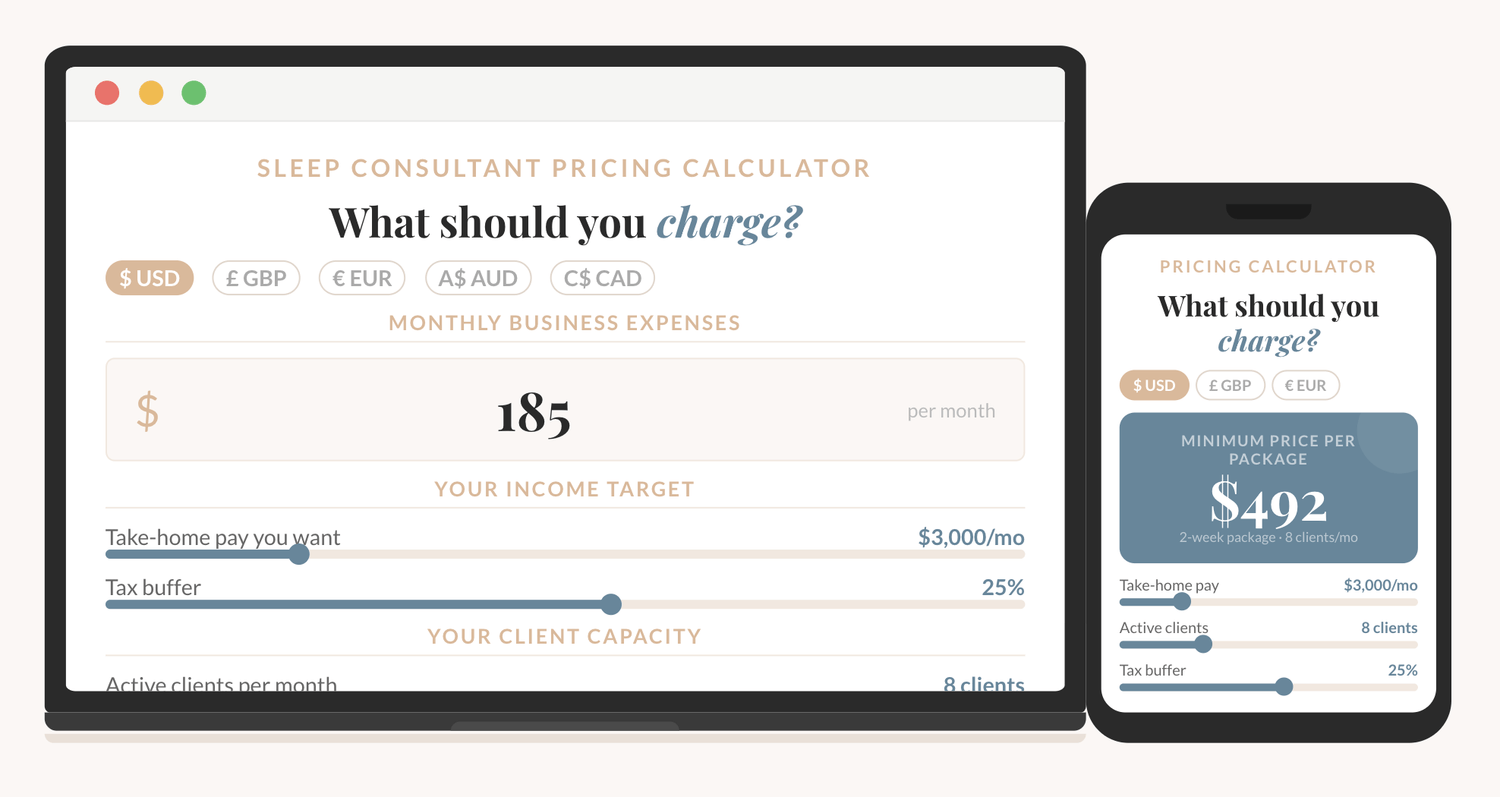
How to price your sleep consulting services?
The Sleep Consultant Pricing Calculator shows you exactly what to charge, based on your real expenses, your income goal, and how many clients you want to take on.
I'm thrilled to offer you an exclusive preview of what’s inside!
You can read the first 22 pages of The Sleep Consultant Playbook and get a taste of the value, insights, and actionable strategies that are waiting for you.
Other articles you might be interested in:
© 2021-2026 Sleep Consultant Business. All Rights Reserved.