
5 Mistakes Sleep Consultants Make in the First Month After Certification
The five most common first-month mistakes: spending weeks on a website and logo instead of reaching out to people who already trust you; ignoring your warm audience and going straight to social media; charging too little (or offering free sessions) out of fear; waiting to feel ready before starting; and skipping the business foundation entirely. Every single one of these feels justified in the moment. None of them move you forward.
You just finished your certification. You're excited, a little nervous, and ready to start helping families. And then the overwhelm hits. There's so much to do. Where do you even begin?
Here's what happens next for most newly certified sleep consultants: they go in exactly the wrong direction, because the actions that feel productive and safe are usually not the ones that actually build a business. Meanwhile, the actions that would actually work feel too scary, too vulnerable, or too soon.
Three months from now, you'll either have three months of progress or three months of excuses. The difference often comes down to avoiding these five mistakes in the first month.
Mistake 1: Building Instead of Reaching Out
The logo. The website. The perfectly curated Instagram grid. These are where most new sleep consultants pour their energy in month one. And they feel good to work on: visual, tangible, shareable. There's something satisfying about changing the font on your "About Me" page for the tenth time.
But here's the truth: these tasks will not bring you clients right now. Not because they don't matter eventually, but because a family who doesn't know you exists won't be scrolling to your website. And the families who would hire you right now are not strangers. They're people who already know you, like you, and trust you.
Tweaking a website feels safer than sending a personal message. Designing a logo feels more professional than calling a friend. But those building tasks are often just distractions dressed up as productivity. They keep you busy without making you vulnerable, and being vulnerable (reaching out, putting yourself forward, starting conversations) is exactly what's required to get your first clients.
Get a simple, functioning one-page website or landing page up and then step away from it. Your time and energy in month one belongs to reaching out: to your warm connections, to local parent communities, to anyone who might know a family in need of sleep support. A $200 client from a personal conversation will always beat a perfectly designed website that nobody has seen yet.
Mistake 2: Going Straight to Social Media and Ignoring Your Warm Audience
Every sleep consultant on Instagram seems to be growing their business there. So that must be where you start, right? Actually, no. Not in month one.
Building a social media following from scratch takes months, sometimes years. Without testimonials or a track record, convincing a cold audience (people who have never heard of you) to trust you with their baby's sleep is genuinely hard. The return on that effort (especially in the early weeks) is far lower than focusing on the people who already know, like, and trust you.
Your warm audience is your fastest path to your first client. Friends, family, former colleagues, neighbours, acquaintances: anyone who wouldn't ignore your message. These people already trust your character and your values. They're far more likely to say yes themselves, or to pass your name along to someone who needs you. Even one person from your warm network who says "my sister-in-law was just complaining about this last week" can become your first booking.
A lot of new sleep consultants skip their warm audience entirely. They feel awkward approaching people they know. They worry about being judged, or about mixing their personal and professional worlds. So instead they spend hours creating content for strangers, while the people most likely to help them are right there waiting.
Write a list of 50 people from your personal network. Not 50 potential clients. 50 connections. Your aunt, your former colleague, your neighbour, your yoga instructor. Anyone who might know a young family, or who might be a young family themselves. Then reach out personally, not with a mass announcement, but with a genuine, warm message. This list is where your first clients almost always come from. Don't skip it in favour of Instagram.
Mistake 3: Undercharging (or Offering Free Sessions) to "Build Experience"
The logic feels reasonable: I'm new, I don't have testimonials yet, I'll charge less to attract clients and build confidence. Some new sleep consultants go even further and offer free sessions to get their first case studies.
The problem with this approach is threefold. First, it immediately signals lower value. The way something is priced is part of how clients perceive it. A sleep consulting package at $50 is psychologically read as a $50 service, regardless of the quality of what's delivered. Second, working for free or near-free attracts clients who are not fully invested. They haven't committed financially, so they're less likely to commit behaviourally to the process, which means worse outcomes and worse testimonials. Third, it sets a precedent in your own mind about what your work is worth that can be very hard to shift later. Not sure what to charge? Use this Free Pricing Calculator for Sleep Consultants to get clarity on your pricing and capacity.
If raising your prices feels uncomfortable, the issue usually isn't about the numbers. It's a mindset challenge around valuing your own expertise. You were trained. You completed a rigorous certification. You have something genuinely valuable to offer. The families who come to you are desperate and exhausted. They will pay for real help.
Set your real prices from day one. If it helps, use a tiered discount approach for your first few clients: offer a meaningful discount in exchange for a detailed testimonial. Something like "I'm offering a discounted rate to my first five clients in exchange for honest feedback" is transparent, professional, and sets a clear expectation. Offer the first five clients a $200 discount, the next five a $100 discount, and move to full price from there. Practice saying your full price so it stops feeling enormous the more you say it.
Mistake 4: Waiting Until You Feel Ready
Sound familiar? "I need to take one more course first." "I'm not quite ready to start taking clients." "What if a parent asks me something I wasn't trained on?" "I want to feel more confident before I put myself out there."
Here's the hard truth: you will never feel fully ready. That feeling of readiness doesn't come before you take action. It comes after. Confidence is built by doing, not by waiting. The sleep consultants with full schedules and glowing testimonials didn't start because they felt ready. They started because they decided to start anyway, and readiness built from there.
What's actually underneath the "I'm not ready" feeling is usually one of two things. Sometimes it's genuine imposter syndrome: that sneaky voice saying you're not qualified enough, not experienced enough, not good enough. The reframe for that: you don't need to know everything to help families. They're not hiring encyclopedic knowledge. They're hiring someone who listens, empathises, and can guide them with the tools they already have. You have those tools. You just completed a certification to prove it.
Other times "I'm not ready" is what's called a competing commitment. You say you want clients, but underneath that is a quiet fear: what if I get overwhelmed and let them down? What if I succeed and the pressure becomes constant? These fears are normal, and they're worth naming. But they can't be solved by taking another course or waiting another month. They're solved by starting, stumbling, getting better, and building genuine confidence from real experience.
Start a Wins Folder right now. Every time a client shares a success, leaves positive feedback, or even thanks you for listening, save it. Read it on the days you doubt yourself. It builds the proof that your skills are already making a difference. No extra training required. Then decide today: I'm ready now, and I'll grow as I go. Because that's the only version of ready that ever actually arrives.
Mistake 5: Skipping the Business Foundation
This one is sneaky because it's the opposite of mistakes 1 through 4. While some new sleep consultants hide in busy-work, others go straight to getting clients without putting any proper foundation in place: no registered business, no contract, no clear pricing, no boundaries around how they work. And for a while, it seems fine. Then a client dispute happens, or tax time arrives, or a grey area comes up and there's nothing in writing to refer back to.
A business foundation isn't paperwork for its own sake. It's the structure that protects you and your clients. A registered business. A clear contract that sets out your scope, your payment terms, and your cancellation policy. Pricing that reflects the real value of your work. Packages that are clear and simple enough that parents can say yes without confusion. A basic system for tracking income and setting aside tax.
None of this takes weeks. It takes a few focused days, once. The sleep consultants who skip it because it feels like admin end up paying for it later, usually in chaos, compromised boundaries, or avoidable legal and financial headaches. You can find more detailed information in this article: How to Register a Sleep Consulting Business
There's also a less visible part of this mistake: launching without being clear on your own values, strengths, and the kind of business you actually want to build. Without that clarity, you end up with scattered messaging, offering services you don't love, taking on clients who aren't right for you, and making decisions that feel like guesswork. The article about the A.L.I.G.N. framework (Authenticity, Leverage, Impact, Growth, Non-Negotiables) exists specifically to prevent this. It's the foundation under the foundation.
Before you take your first paid client, get these five things in place: your business registered (or at minimum understood), a client contract ready to send, your pricing and packages clear and written down, a business bank account open, and your A.L.I.G.N. framework worked through so you know how you want to show up. This isn't weeks of work. It's a focused few days. Treat it as seriously as you'd treat the clinical side of your certification, because it's equally important.
The Pattern Behind All Five Mistakes
Look at all five mistakes and you'll notice the same thing running through each one. Fear. Not laziness, not incompetence. Fear dressed up in different costumes.
Tweaking the website instead of reaching out is fear of rejection. Going to strangers on social media instead of warm connections is fear of awkwardness. Undercharging is fear of being turned down. Waiting to feel ready is fear of failure. Skipping the foundation is fear of the admin, or sometimes fear of what becomes real when you make it official.
Fear doesn't go away when you feel more ready or more prepared. It gets smaller when you take action. The sleep consultants who build thriving businesses aren't the ones who never felt scared. They're the ones who started conversations and sent messages and charged their real prices even when it felt uncomfortable, and discovered that the discomfort was survivable. Every time.
When I started my first business I was full of passion and had no idea what I was doing. I spent more time second-guessing myself than taking action. Each stage of growth brought its own fears and challenges. I constantly wondered: am I good enough? Will I ever find clients? What if this doesn't work? Success didn't come from having it all figured out. It came from consistently taking the next step, even when I was scared and unsure. That's the only path through. Not around. Through.
Key Takeaways
- Stop building, start reaching out. A functioning basic website is enough. Your first client will come from a conversation, not a perfect logo.
- Your warm audience is your fastest path to your first client. Write the 50-person list. Reach out personally. Don't ignore the people who already trust you in favour of strangers on Instagram.
- Charge real prices from day one. If early confidence is the issue, use a transparent discount for your first few clients in exchange for testimonials, but don't offer free sessions or prices that don't reflect your actual value.
- Stop waiting to feel ready. Readiness is built by doing, not waiting. Start a Wins Folder. Decide you're ready now and you'll grow as you go.
- Get the foundation in place before your first client, not after. Registered business, contract, pricing, bank account, and your A.L.I.G.N. framework. A focused few days now prevents chaos later.
- All five mistakes are driven by fear. Fear doesn't go away with more preparation. It shrinks when you take action. The only way forward is through.
Three months from now you'll either have three months of progress or three months of excuses. You've already made the hardest decision by completing your certification. Now start.
Disclaimer: The information shared in these articles is for educational and informational purposes only. It does not constitute legal, financial, or professional advice. Always consult with a qualified professional regarding your specific situation.

Rianna Hijlkema
Certified Pediatric Sleep Consultant, Certified Postpartum Doula, Former Teacher & School Director, Founder of Sleep Consultant Design & Sleep Consultant Business and the author of The Sleep Consultant Playbook (available on Amazon).
The Sleep Consultant Newsletter
Weekly tips, strategies and marketing ideas for sleep consultants written by a fellow sleep consultant. 1500+ active subscribers!
I’ll only send helpful emails, and you can unsubscribe anytime with one click.
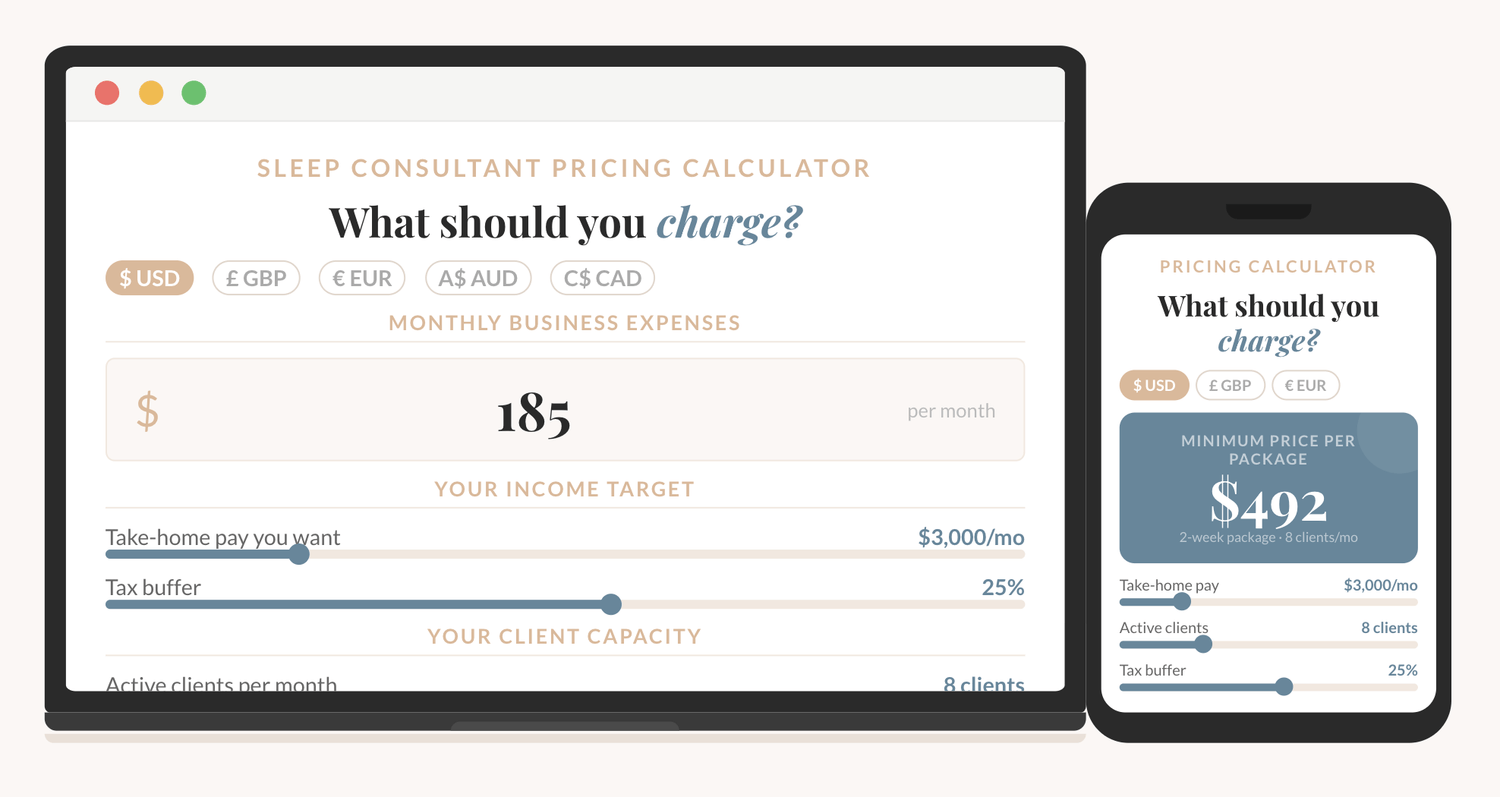
How to price your sleep consulting services?
The Sleep Consultant Pricing Calculator shows you exactly what to charge, based on your real expenses, your income goal, and how many clients you want to take on.
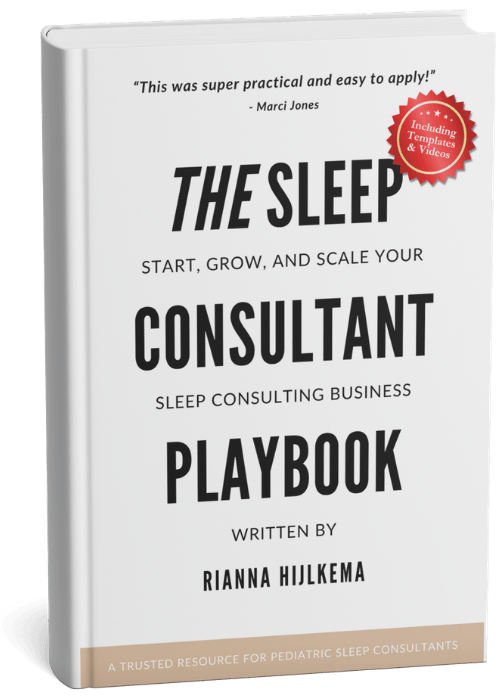
I'm thrilled to offer you an exclusive preview of what’s inside!
You can read the first 22 pages of The Sleep Consultant Playbook and get a taste of the value, insights, and actionable strategies that are waiting for you.
Other articles you might be interested in:
© 2021-2026 Sleep Consultant Business. All Rights Reserved.