
Why Only 3% of Your Audience Is Ready to Book: The Five Stages of Awareness for Sleep Consultants
Most Sleep Consultants write content aimed at parents who are ready to book right now, and that's the smallest group in any audience. The five stages of awareness, first described by advertising writer Eugene Schwartz, explain where everyone else is sitting: unaware, problem aware, solution aware, product aware, and most aware. A parent searching "why does my 8 month old wake every hour" is at a completely different stage than one comparing Sleep Consultant prices, and they need completely different content. Write for all five stages and you build a steady flow of parents moving toward you, instead of waiting on the few who are ready today.
In this guide
- Why your content reaches such a small slice of your audience
- The five stages of awareness
- What each stage sounds like for a tired parent
- What to write for each stage
- How to move a parent one stage forward
- Common mistakes to avoid
- Frequently asked questions
You post about your packages. You share a testimonial. You announce that you have two spots left this month. The post gets a few likes and nothing else happens.
It's tempting to read that as proof your content doesn't work, or that your audience is too small, or that you need to post more often. Usually it's none of those. The content is speaking to parents who've already decided they want a Sleep Consultant, already decided they want you, and are sitting there with a credit card in hand. That group exists, but it's tiny.
Everyone else in your audience is somewhere further back. Some don't know a Sleep Consultant is a thing. Some think what they're going through is normal and untreatable. Some are deep in free advice from Facebook groups and haven't worked out why none of it works. Every one of those parents could become a client, and none of them will respond to "book a call." This guide covers the five stages of awareness, exactly what each stage sounds like for an exhausted parent, and what to write so you're reaching all of them rather than the few percent who happen to be ready today.
Why Your Content Reaches Such a Small Slice of Your Audience
Sales trainer Chet Holmes described any market as a pyramid in his book The Ultimate Sales Machine. His estimate: around 3 percent of people are actively looking to buy right now, another 7 percent are open to the idea, about 30 percent aren't thinking about it at all, 30 percent believe they aren't interested, and 30 percent know they aren't. Treat those numbers as a working model rather than measured research, because that's what they are. The shape holds up in practice even where the exact percentages don't.
Apply that to your Instagram following or your email list. If you have 500 followers, the group actively searching for a Sleep Consultant this week might be fifteen people. Write only for them and you've built your entire marketing strategy around three percent of the room while the other 97 percent scroll past.
The Five Stages of Awareness
The framework comes from Eugene Schwartz, an advertising writer who published Breakthrough Advertising in 1966. He argued that you can't write to a person until you know how much they already understand about their own problem. Sixty years later it still explains more about why content works or doesn't than almost anything else you'll read.
Here's the model mapped onto the parents you serve.
| Stage | What the parent believes | What they need from you |
|---|---|---|
| Unaware | Nothing is wrong. This is what babies do. | Recognition. A description of their nights that makes them stop scrolling. |
| Problem aware | Something's wrong and it might be my fault. I don't know if it's fixable. | A name for what's happening, and reassurance it can change. |
| Solution aware | Solutions exist. I've tried a few. None of them stuck. | Why the free advice keeps failing, and what personalised support changes. |
| Product aware | Sleep Consultants exist. I'm not sure about the cost, or about you specifically. | Proof, method, and answers to the objections they haven't said out loud. |
| Most aware | I want to work with you. I need the details. | The offer, the price, the next step, and an easy way to take it. |
What Each Stage Sounds Like for a Tired Parent
Below is what parents at each stage type into Google, say in comments, and tell their friends.
Stage 1: Unaware
This parent doesn't think they have a problem. They're exhausted, but they've absorbed the idea that exhaustion is the price of a baby. Nobody around them has suggested otherwise.
What they say: "No sleep here, but that's newborn life." "All babies wake up, right?" "We're surviving on coffee." "My mum says I was the same and I turned out fine."
What they search: Not much related to sleep support. They may search symptoms without connecting them, like "baby fussy in the evening" or "toddler tantrums at bedtime normal."
Stage 2: Problem aware
Something has tipped. They've realised this isn't working and it's affecting their health, their relationship, or their capacity to go back to work. They don't know it's solvable and they often believe it's their own fault.
What they say: "I can't do this anymore." "I don't recognise myself." "She was sleeping fine and now she's up every 45 minutes." "I think I've ruined his sleep by rocking him."
What they search: "why does my 8 month old wake every hour", "4 month old suddenly waking all night", "is it normal for a toddler to fight bedtime", "how much sleep does a 10 month old need". This is the largest and most reachable group for most new Sleep Consultants.
Stage 3: Solution aware
They know the problem has a name and that people fix it. They're now knee-deep in free advice, contradictory Facebook groups, a book someone recommended, and three different wake window charts that disagree. They've tried things. Something worked for four days and then stopped.
What they say: "We tried sleep training and it didn't work for us." "I don't want to leave her to cry." "Everyone says something different." "I've read all the books and I'm still up at 3am."
What they search: "gentle sleep training methods", "wake windows by age", "how to drop the third nap", "sleep training without crying". They're comparing approaches, not providers.
Stage 4: Product aware
They now know Sleep Consultants exist and they're weighing it up. They may already follow you. What's holding them is cost, doubt about whether it works for their particular child, or a partner who thinks it's an unnecessary expense.
What they say: "Are Sleep Consultants worth the money?" "My husband thinks we should be able to figure this out ourselves." "Would it even work for a baby who's this stubborn?" "I don't want to be told to let her cry it out."
What they search: "sleep consultant cost", "is a sleep consultant worth it", "sleep consultant near me", "[your name] reviews", "sleep consultant vs sleep training book".
Stage 5: Most aware
They've decided. They want you. Everything now is logistics and reassurance that booking is simple.
What they say: "Do you have space this month?" "What's included in the package?" "Do you offer payment plans?" "How soon could we start?"
What they search: Your name, your booking page, your packages page. This is the 3 percent, and it's the group nearly all Sleep Consultant content is written for.
What to Write for Each Stage
Once you can hear the stages, matching content to them is straightforward. The rule is simple: use the language of the stage the parent is in, not the stage you wish they were in.
| Stage | Content that works | The one job of that content |
|---|---|---|
| Unaware | Relatable descriptions of hard nights, myth-busting on what's normal by age, day-in-the-life posts | Make them think "wait, that's us" |
| Problem aware | Blog posts answering their exact search, age-specific explainers, "why this is happening" content | Name the problem and remove the blame |
| Solution aware | Comparisons of approaches, why generic advice stalls, your philosophy and method, free tools | Show why tailored beats generic |
| Product aware | Case studies, before and after stories, what working together looks like, cost and objection content | Make choosing you the obvious call |
| Most aware | Package details, availability, booking links, payment options, calls to action | Remove friction and ask |
Look at the last row. That's the content most new Sleep Consultants publish almost exclusively, and it only works on people who already arrived at stage five under their own steam. The other four rows are what brings people to stage five in the first place.
How to Move a Parent One Stage Forward
A single post can't carry someone from unaware to booked. Trying to do it in one go is where a lot of content falls down, opening with an empathetic line about exhaustion and closing with a booking link three sentences later. The jump is too big and the parent feels sold to.
Give each piece of content one job: move the reader one stage. A blog post answering "why does my 8 month old wake every hour" takes a problem aware parent and makes them solution aware, because now they know sleep patterns follow rules and those rules can be worked with. That's a complete job. The booking link isn't the point of that post.
What carries them through the remaining stages is staying in contact. A parent who reads one blog post and leaves is gone. A parent who downloads something useful and lands on your email list can be walked from stage two to stage five over a few weeks while their child's sleep gets worse and their tolerance for it runs out. Timing matters more than persuasion here. Your job is to be the person they're already listening to when they finally decide they want help.
Something that helped me was checking my last ten posts and marking which stage each one spoke to. Mine were eight fives and two fours. No wonder the same few people engaged and nobody new ever came through. Do that audit on your own content before you change anything.
Common Mistakes to Avoid
Writing only for stage five
Packages, availability, and testimonials on repeat. It reaches the small group who already decided and looks like noise to everyone else. If your feed is mostly offers, your reach problem is a stage problem.
Living at stage two and never asking
The opposite trap, and it's as common as the first. Endless helpful education, warm engagement, no offer anywhere. Parents assume you're a free information account and never realise they can hire you. Content at every stage still needs a clear path forward.
Using your vocabulary instead of theirs
Writing about sleep pressure, sleep associations, and circadian rhythm to a stage two parent who's typing "why won't my baby stay asleep" in tears at 4am. Your certification vocabulary belongs in your plans, not your hooks. Use the words the parent uses and save the terminology for once they're in.
Treating the audience as one group
Your followers are spread across all five stages at once. Content aimed at a single average reader lands properly with almost nobody. Plan deliberately across stages rather than posting whatever comes to mind that week.
Judging content by likes
Stage two content often gets saves and shares from parents who aren't ready to speak up. Stage four content might get almost no visible engagement and produce a booking a fortnight later. Measure inquiries and email signups, not applause.
Frequently Asked Questions
What are the five stages of awareness?
Unaware, problem aware, solution aware, product aware, and most aware. The model comes from Eugene Schwartz's 1966 book Breakthrough Advertising. It describes how much a person understands about their own problem and the available solutions, which determines what kind of message will reach them.
Which stage should a new Sleep Consultant focus on first?
Problem aware, stage two. It's the biggest reachable group, it's where search traffic sits, and those parents are motivated because their nights are already hard. Answering the questions they type into Google brings new people in, which is what a small audience needs most.
How do I know what stage a parent is in?
Listen to their words. "Is this normal?" is stage two. "We tried sleep training and it didn't work" is stage three. "Are Sleep Consultants worth the money?" is stage four. "Do you have space this month?" is stage five. Their question tells you exactly where they are and what to say next.
Is it true only 3 percent of people are ready to buy?
The figure comes from Chet Holmes' buyer's pyramid and it's a working estimate, not measured research. The precise number matters less than the shape it describes: the group ready to buy today is always far smaller than the group who could become clients later. Plan your content around that reality.
How much of my content should be selling?
There's no fixed ratio worth quoting as fact. A practical approach is to weight your content toward stages two and three, where most of your audience sits, while making sure your offer appears often enough that nobody has to hunt for it. Every piece of content can still point somewhere, even if that somewhere is a free download rather than a booking page.
Do I need to write for unaware parents at all?
It's the hardest stage to reach and the slowest to pay off, so it shouldn't be your priority in year one. When you do write for it, relatable content describing what hard nights feel like works better than education, because the goal is recognition rather than information.
Key Takeaways
- The group ready to book today is small, so content written only for them reaches a fraction of your audience.
- Parents sit across five stages of awareness, from not knowing anything is wrong to knowing they want to hire you.
- Their words tell you their stage. "Is this normal" and "are Sleep Consultants worth it" call for completely different responses.
- Give each piece of content one job: move the reader one stage forward, not from stranger to booked in a single post.
- Start at problem aware. It's the biggest reachable group and where search traffic lives, so it brings new people in fastest.
Once parents at stage four and five start reaching out, the next thing to get right is the conversation itself, so read How to Run a Sleep Assessment Call before your next inquiry lands.
Disclaimer: The information shared in these articles is for educational and informational purposes only. It does not constitute legal, financial, or professional advice. Always consult with a qualified professional regarding your specific situation.

Rianna Hijlkema
Certified Pediatric Sleep Consultant, Certified Postpartum Doula, Former Teacher & School Director, Founder of Sleep Consultant Design & Sleep Consultant Business and the author of The Sleep Consultant Playbook (available on Amazon).
The Sleep Consultant Newsletter
Weekly tips, strategies and marketing ideas for sleep consultants written by a fellow sleep consultant. 1500+ active subscribers!
I’ll only send helpful emails, and you can unsubscribe anytime with one click.
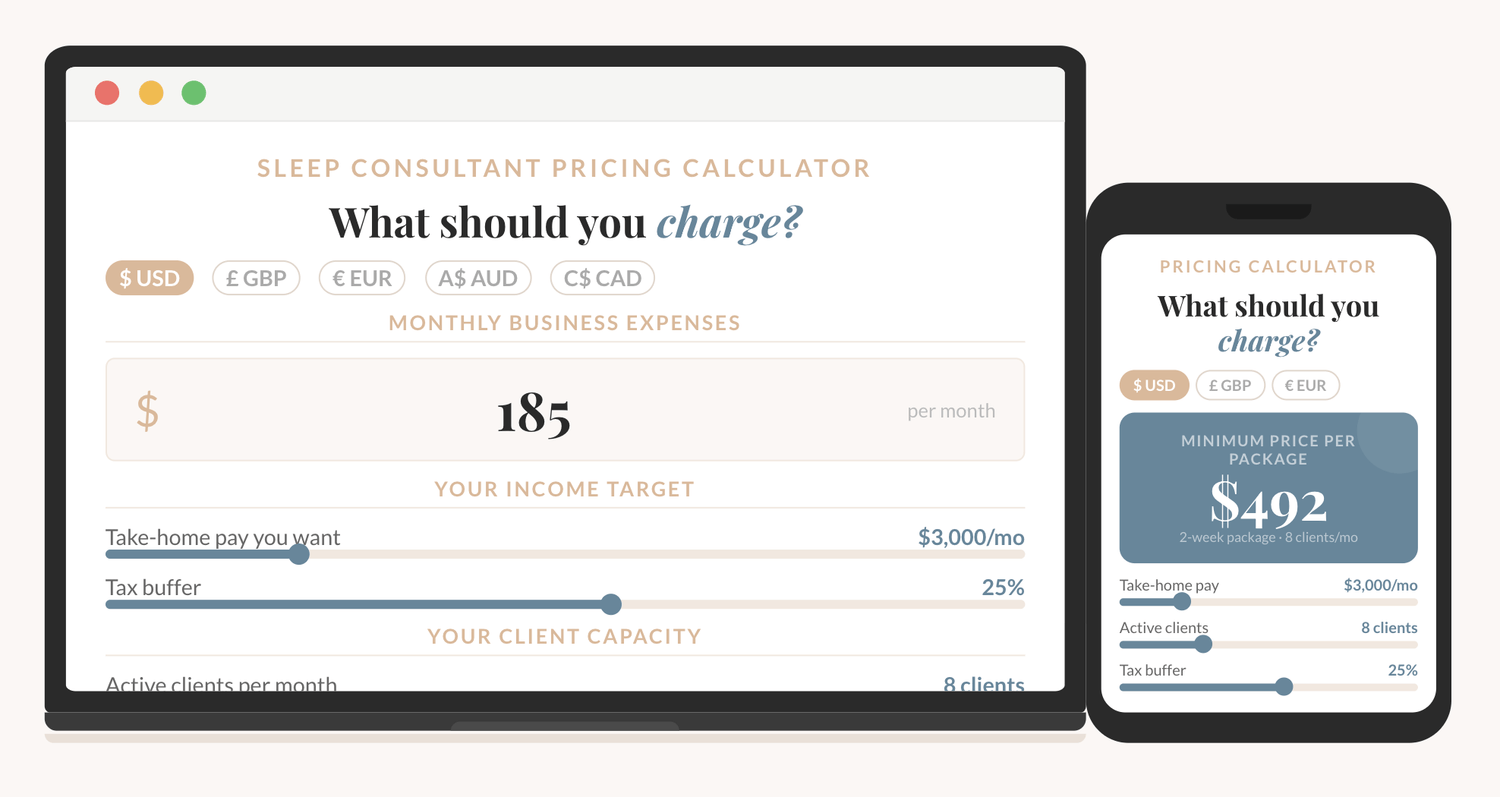
How to price your sleep consulting services?
The Sleep Consultant Pricing Calculator shows you exactly what to charge, based on your real expenses, your income goal, and how many clients you want to take on.
I'm thrilled to offer you an exclusive preview of what’s inside!
You can read the first 22 pages of The Sleep Consultant Playbook and get a taste of the value, insights, and actionable strategies that are waiting for you.
Other articles you might be interested in:
© 2021-2026 Sleep Consultant Business. All Rights Reserved.