
The Feast and Famine Cycle: Why Sleep Consultants Get Stuck In It and How to Break Out
The feast and famine cycle is the swing between fully booked months and empty ones. For Sleep Consultants it happens because marketing stops the moment client work starts, and there's a delay of several weeks between marketing and the booking it produces. By the time the busy month ends, the pipeline behind it is already empty. Breaking the cycle means marketing at a small, steady volume even when you're full, capping your capacity and holding overflow on a waiting list, extending your packages so revenue lasts longer per client, and watching your pipeline weeks ahead instead of your bank balance on the first of the month.
In this guide
- What the feast and famine cycle is
- How the cycle starts and why it repeats
- Why Sleep Consultants are especially exposed
- Seven ways to break the cycle
- What to do if you're in a famine month right now
- Mistakes that make the cycle worse
- Frequently asked questions
March was your best month yet. Four families, back to back, every one of them thrilled. You were tired in a good way and you finally felt like you had a real business. Then April arrived and your calendar was empty. Nothing changed about your skills or your pricing or your website. The inquiries stopped.
Most Sleep Consultants read that empty month as evidence something's wrong with them. It isn't. April was decided in February, by what you did or didn't do while you were busy with March's clients. The cycle has a specific cause and a delay built into it, and once you can see the delay the whole thing stops feeling random.
This guide covers what the feast and famine cycle is, the mechanics of how it forms, why the structure of sleep consulting makes it more likely than in most service businesses, and the practical changes that flatten it out. None of them require you to work more hours.
What the Feast and Famine Cycle Is
The feast and famine cycle is a repeating pattern where income swings hard between months instead of being steady. A feast month is full: several clients, more work than time, good money. A famine month is the opposite: barely an inquiry, nothing on the calendar, and a slow creep of doubt about whether the business works at all.
The damage isn't only financial. The famine months are where Sleep Consultants drop their prices, take clients who aren't a fit, offer free help to feel useful, and start browsing job listings. Decisions made in a scarcity month tend to cost more than the empty month itself did. Plenty of Sleep Consultants leave the profession during a famine stretch believing there's no demand, when what they had was a timing problem.
I had a month early on where I took four families at once and felt untouchable. I posted nothing the whole time. I was up at night with client check-ins and told myself the marketing could wait until things calmed down. Six weeks later I had one inquiry and I convinced myself the market had dried up. The market was fine. I'd stopped feeding it and forgotten there was a delay before I'd feel the effect.
How the Cycle Starts and Why It Repeats
The engine is a lag. Marketing you do this week rarely produces a booking this week. A parent finds you, reads a few things, follows you, waits until their situation gets bad enough, and books somewhere between two weeks and three months later. That gap is normal and it's covered in more depth in the five stages of awareness. The important part is that the effect of your marketing arrives long after the effort.
Now add the fact that client delivery is demanding. Nights, check-ins, plan writing, emotional support. When you're full, marketing is the first thing to go, and it goes without any immediate consequence, which is exactly what makes it so easy to drop. Here's how a typical cycle plays out.
| Month | What's happening | What it does to the pipeline |
|---|---|---|
| Month 1 | Marketing is working, inquiries come in, you book several families | Pipeline healthy |
| Month 2 (feast) | Delivery takes everything you have, marketing stops completely | Pipeline stops filling, but you can't see it yet |
| Month 3 | Clients finish, calendar clears, a few stragglers book from earlier work | Pipeline running on fumes |
| Month 4 (famine) | Almost no inquiries, panic marketing begins, discounts appear | Pipeline empty, refilling starts from zero |
| Month 5 to 6 | Panic marketing lands, bookings arrive together, another feast begins | Cycle restarts |
Notice that the famine in month four was created in month two. That's the whole point I'm trying to make here. Because the consequence shows up two months after the cause, it never feels connected, so most Sleep Consultants keep treating the empty month as a marketing emergency rather than a scheduling problem they created while busy.
Why Sleep Consultants Are Especially Exposed
Every service business can fall into this. A few features of sleep consulting make it more likely.
Packages are short. Two or three weeks of support is common. A client arrives, transforms, and leaves quickly. Every month starts close to zero, unlike a business where clients stay on for six months at a time.
Delivery is intense and unpredictable. Often nights are involved. A hard case can absorb your evenings for a fortnight. There's no gentle version of a busy month where you still have energy for content.
Nearly all revenue is one to one. Income is tied directly to hours, so it stops when you stop. Without something that sells while you're delivering, there's no floor under a quiet month.
Referrals feel like a strategy until they go quiet. Word of mouth is wonderful and completely outside your control. A run of referrals can hide an empty pipeline for months, and when it dries up there's nothing underneath it.
There's real seasonality. School holidays, travel periods, and family visits all push parents to delay starting. Predictable quiet stretches are manageable when you plan for them and brutal when they surprise you.
Seven Ways to Break the Cycle
The aim isn't to eliminate variation. Some months will always be stronger. The aim is to remove the extremes so a good month doesn't guarantee a bad one behind it.
1. Market at a smaller volume you can sustain while busy
The problem is rarely that Sleep Consultants market too little in quiet months. It's that they market at a level they can only hold when they have nothing else on. Pick a volume that survives your busiest week. Two posts and one email a week that never stop will produce steadier income than daily posting that collapses every time you book a client. Consistency beats intensity here because of the lag.
2. Batch and schedule so busy weeks don't need you
Write a month of content in one sitting while things are calm and schedule it. The goal is that your marketing runs during the exact weeks you have no capacity to think about it. This single change does more to flatten the cycle than anything else on this list, because it removes the dependency on your energy.
3. Cap your capacity and hold the overflow
Taking every client who arrives in a good month is what creates the crash behind it. Decide how many families you can support at once, and when you hit that number put the rest on a waiting list held with a deposit. You've turned a feast month into next month's income instead of burning it all at once.
4. Stagger start dates
Four families starting the same Monday is a feast month by construction. The same four staggered across six weeks is a steady stretch with room to breathe and time to keep marketing. Parents rarely mind waiting ten days for a start date when you've given them something useful to do in the meantime.
5. Extend how long each client stays with you
A three week package means every client is gone almost as fast as they arrive. Longer support windows, follow-up packages for the next developmental stage, or a check-in option months later all stretch the revenue from one family across more of the year. The client already trusts you, so this is the cheapest income you'll ever generate.
6. Add something that sells while you're delivering
A guide, a mini course, a paid tool, a group programme. It doesn't have to be big and it won't replace your one to one income. What it does is put a floor under quiet months and give parents who can't afford your package a way to stay in your world until they can.
7. Watch the pipeline, not the bank balance
Your bank balance tells you about decisions you made two months ago. Your pipeline tells you about next month. Track inquiries received, Sleep Assessment Calls booked, and proposals outstanding every week. When inquiries drop for two weeks running, you have a month of warning to act, which is the difference between an adjustment and an emergency.
What to Do If You're in a Famine Month Right Now
Everything above prevents the next one. It doesn't pay this month's bills. If your calendar is empty today, work in this order.
Go to warm contacts first. Past clients, parents who inquired and never booked, people who downloaded something from you. These are the fastest conversions available because they already know you. A short personal message asking how sleep is going now converts better than a week of new content.
Ask past clients for referrals directly. Most happy clients would recommend you and never think to. Tell them you have space this month and ask if they know a family struggling.
Use the quiet time to build the thing that prevents the next famine. Batch a month of content. Set up your pipeline tracker. Write the follow-up offer. A quiet month spent building is the only version of a quiet month that pays you back.
Hold your prices. Discounting to fill a gap trains your audience to wait for the discount and makes next month harder. If you need to move faster, add value or offer a payment plan instead of cutting the fee.
Mistakes That Make the Cycle Worse
Marketing hardest when you're emptiest
Panic marketing in a famine month lands weeks later, which produces another feast, which stops the marketing again. Marketing effort that mirrors your calendar guarantees the swing continues. Steady beats reactive every time.
Saying yes to everyone in a good month
It feels like abundance and behaves like debt. You spend all the demand at once, deliver at reduced quality, and leave nothing for the following month. Capacity limits protect both your clients and your income.
Spending a feast month as if it's the new normal
A four client month is not your monthly income. Look at a rolling three month average and pay yourself a consistent amount from it, holding the surplus back. Your business needs a buffer more than you need to celebrate a strong March.
Reading a quiet month as proof there's no demand
This is the belief that ends businesses. One empty month after a full one is the predictable result of stopping your marketing, not a verdict on the market or on you. Check what you published eight weeks ago before you draw any conclusion.
Discounting to fill the gap
A discount fills this month and damages the next several. Parents who were about to pay full price wait for the sale, and the families you attract on price are the ones most likely to question your value throughout. Solve an empty calendar with outreach, not with your rate.
Frequently Asked Questions
What is the feast and famine cycle?
It's a repeating pattern where a fully booked month is followed by an empty one. For Sleep Consultants it's caused by marketing stopping during busy delivery periods, combined with a delay of several weeks between marketing effort and the bookings it produces. The quiet month is the delayed result of the busy one.
How long does it take to break the cycle?
Expect two to three months before the swings visibly flatten, because you're working against the same lag that created the problem. Consistent marketing started today shows up in bookings six to twelve weeks out. The first month after you change your approach may still be quiet, and stopping at that point is what keeps most Sleep Consultants stuck.
Should I take fewer clients to avoid the cycle?
Not fewer overall, fewer at once. Capping how many families you support simultaneously and moving the rest to a waiting list spreads the same number of clients across more months. You earn the same or more, deliver better, and keep enough capacity to protect your marketing.
Is a quiet month always a sign of a problem?
No. Sleep consulting has real seasonal dips around school holidays, major travel periods, and end of year. The difference between a seasonal dip and a famine month is whether you saw it coming. A planned quiet stretch is a chance to build. An unplanned one is a scramble.
How much should I keep in reserve between busy months?
A common target for service businesses is three months of essential expenses, built gradually from surplus in strong months. Pay yourself a fixed amount based on a rolling average rather than whatever came in, so a strong month funds the next quiet one. Speak to an accountant about the right structure for your situation and country.
Can referrals alone give me steady income?
Referrals are the best clients you'll get and the least reliable source of them. They arrive in clusters and you don't control the timing. Treat referrals as an accelerator on top of a pipeline you actively fill, never as the pipeline itself.
Key Takeaways
- The famine month is created during the feast month, when marketing stops and nobody feels the effect for weeks.
- Market at a volume you can hold while fully booked, because consistency matters more than intensity when results arrive on a delay.
- Batch and schedule your content so marketing keeps running through the weeks you have nothing left to give it.
- Cap how many families you take at once and stagger start dates, so a strong month becomes next month's income rather than a crash.
- Track your pipeline weekly, since inquiries falling for two weeks gives you a month of warning your bank balance won't.
The capacity cap only works if you have somewhere to put the overflow, so set that up next with Stop Turning Away Clients: A Simple Waiting List System for Fully Booked Sleep Consultants.
Disclaimer: The information shared in these articles is for educational and informational purposes only. It does not constitute legal, financial, or professional advice. Always consult with a qualified professional regarding your specific situation.

Rianna Hijlkema
Certified Pediatric Sleep Consultant, Certified Postpartum Doula, Former Teacher & School Director, Founder of Sleep Consultant Design & Sleep Consultant Business and the author of The Sleep Consultant Playbook (available on Amazon).
The Sleep Consultant Newsletter
Weekly tips, strategies and marketing ideas for sleep consultants written by a fellow sleep consultant. 1500+ active subscribers!
I’ll only send helpful emails, and you can unsubscribe anytime with one click.
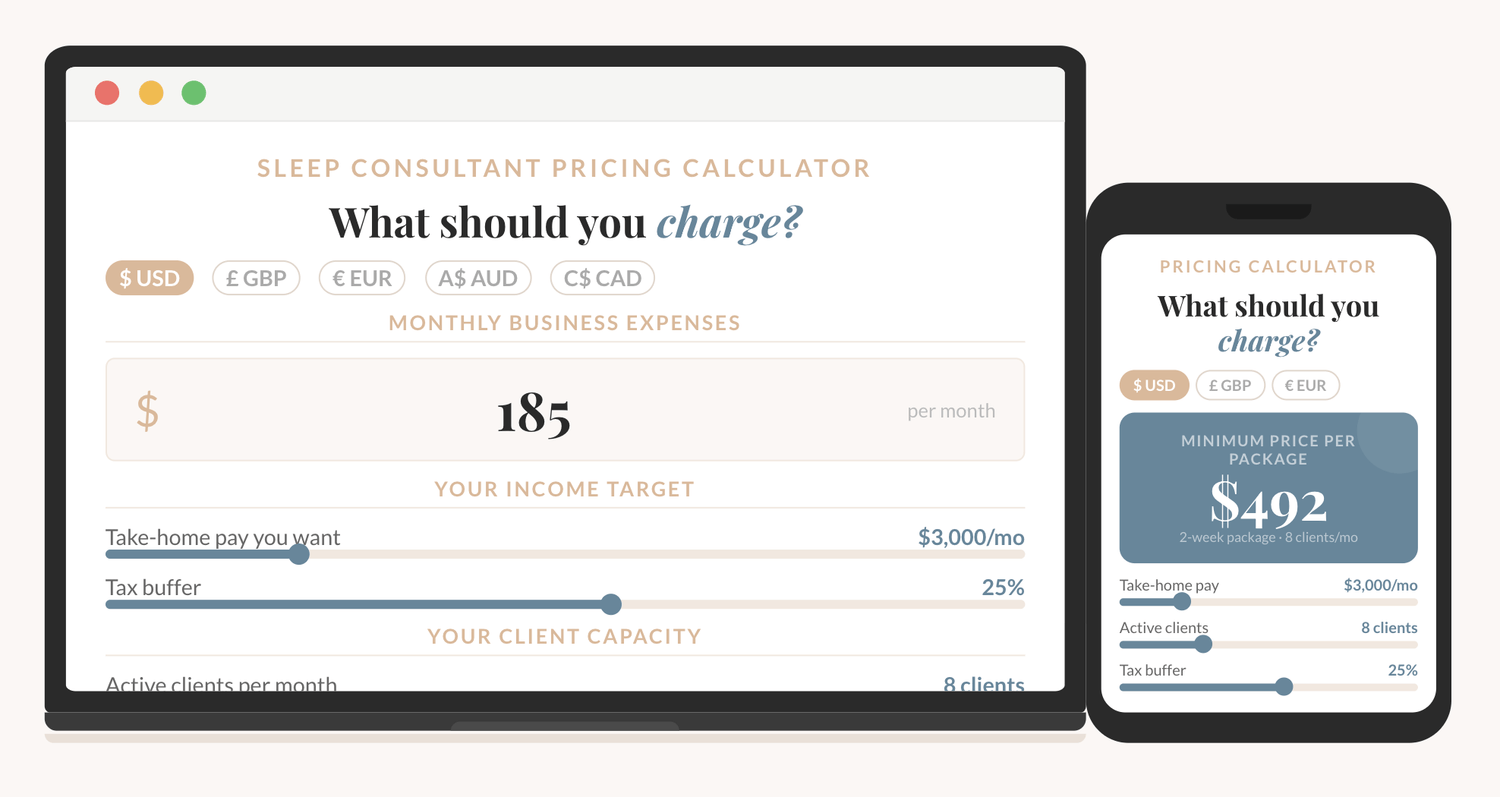
How to price your sleep consulting services?
The Sleep Consultant Pricing Calculator shows you exactly what to charge, based on your real expenses, your income goal, and how many clients you want to take on.
I'm thrilled to offer you an exclusive preview of what’s inside!
You can read the first 22 pages of The Sleep Consultant Playbook and get a taste of the value, insights, and actionable strategies that are waiting for you.
Other articles you might be interested in:
© 2021-2026 Sleep Consultant Business. All Rights Reserved.