
How to Set Client Communication Boundaries as a Sleep Consultant
Client communication boundaries are the rules you set about when you are available, how you can be contacted, and how quickly you will respond. Without them, clients will reach you at any hour, and you will feel obligated to respond because a family is distressed and a baby is not sleeping. Setting clear communication expectations at the start of every engagement is not about being less available. It is about being sustainably available, in a way that actually serves families well.
In this guide
- Why communication boundaries matter more in sleep consulting than most fields
- What happens when you don't have them
- What boundaries to set and how to word them
- Where to communicate your boundaries
- How to hold the line without damaging the relationship
- When to make exceptions and when not to
- Common mistakes sleep consultants make
- Frequently asked questions
Sleep consulting is one of the few service businesses where your clients reach you in moments of genuine distress. Not "I have a question about my invoice" distress. Real distress. A parent who hasn't slept properly in eight months, sitting alone in the dark at 2am, messaging you because their baby will not go back to sleep and they genuinely don't know what to do.
That emotional reality is exactly why you got into this work. It's also exactly why boundaries are not optional in this field. Without them, you're not just answering messages at midnight. You're absorbing panic, troubleshooting in real time without the full picture, and depleting the energy you need to actually serve families well.
Setting communication boundaries is one of the most professional things you can do as a sleep consultant. It's not a sign you don't care. It's what caring for the long term actually looks like.
Why Communication Boundaries Matter More in Sleep Consulting Than Most Fields
Your energy is your most valuable resource. You're holding space for families who are stressed, sleep-deprived, emotionally raw, and sometimes not thinking clearly. If you're not careful, it's easy to overwork yourself, blur the lines between professional and personal time, and burn out quietly before you even realise it's happening.
Every "yes" to a late-night message is also a "no" to something else. Your sleep. Your family. The capacity to show up at your best for the next day's clients. When you're running on empty, your judgment suffers, your empathy suffers, and ironically your clients suffer too.
There's also a practical problem with unlimited availability: it doesn't actually help. When a family messages you at midnight in a panic, you're responding without context, without calm, and without the full picture of what's happening. Often the problem looks completely different in daylight, after a few clarifying questions. The response you give at 2am, pulled out of a half-asleep brain by an anxious message, is rarely your best work.
What Happens When You Don't Have Them
I remember sitting up texting with a family at 2am, fully pulled into their panic. Nothing was working, everything felt urgent, and I was right there with them in that spiral, trying to troubleshoot in real time with almost no useful information. By the end of it I'd sent a long string of messages, felt completely wrung out, and honestly wasn't sure I'd helped at all.
The next morning I jumped on a quick call. Asked a few clarifying questions. What came out: the baby had been overtired going into bedtime (which they hadn't mentioned the night before), and they'd shifted the nap schedule on a day they had visitors. Ten minutes into the call it was obvious. We moved the nap back by 30 minutes, added a brief wind-down before the feed, and kept the rest of the plan exactly the same. Problem solved.
It was never as bad as it felt at 2am. It never is. That was the moment I decided that a clear response window policy wasn't just about protecting my time. It was about serving families better.
Exhausted parents are not good historians. In the moment, everything feels like an emergency. What they report via message at midnight is rarely the complete picture. When you respond in real time to partial information in a charged emotional state, you often make the situation worse, not better. A calm, full conversation the next morning with a few specific questions almost always reveals something they forgot to mention, or something that shifts the whole picture.
The boundary isn't abandoning the family. It's choosing the response format that actually helps them.
What Boundaries to Set and How to Word Them
You need to decide three things: when you're available, how you can be reached, and how quickly you'll respond. Write these down before your next client starts. Your non-negotiables are only as strong as your ability to state them clearly.
Contact hours
The hours during which you're available to receive and respond to messages. This is not the same as your working hours. It's the window when clients can expect to reach you. Something like Monday to Friday, 9am to 6pm works well for most sleep consultants. Whatever you choose, make it real. If you pick hours you'll bend every time, they're not boundaries, they're suggestions.
Contact channels
Where clients can reach you. One channel. Not your personal WhatsApp, your business WhatsApp, your email, and your Instagram DMs. Pick one dedicated channel for client communication and direct all contact there. This protects your personal number, keeps everything in one place, and makes it much easier to switch off at the end of the day.
Response time
How long clients can expect to wait for a reply. Within your contact hours, something like "I respond to messages within 4 hours during contact hours" is clear and realistic. It prevents the expectation of an instant reply and still communicates that you're attentive and reliable.
What to say in your client contract or welcome materials
"I'm available for messages Monday to Friday, 9am to 6pm [your time zone]. I do my best to respond within 4 hours during these hours. Messages received outside these times will be replied to the following business day.
Please send all support messages through [your platform/channel]. I'm not able to respond to messages sent through personal channels or social media.
If something urgent comes up outside contact hours, please write it all down: what happened, what you tried, and how the baby responded, so we can go through it properly when I'm back online. In most cases, the morning call is the most effective way to troubleshoot, because I can ask questions and get the full picture."
Where to Communicate Your Boundaries
Communication boundaries only work if clients know about them before the situation arises. Not after they've sent you a midnight message. Before. This means:
- In your client contract. State your contact hours, your response time, and the contact channel clearly. If it's in the contract they've signed, there's no ambiguity and no room for "I didn't know."
- In your welcome email. Repeat the key points when you welcome a new client. Something like: "Before we get started, a quick note on how to reach me during our time together." This normalises the boundary as part of your professional process rather than something you're reluctantly enforcing.
- On your consultation call. Mention it briefly during the consultation as part of explaining how the support phase works. "During our time together, I'm available via [channel] during [hours]. Here's what to do if something comes up at night..."
- In your sleep plan document. Include a brief communication section at the top of the plan itself, so families have it in front of them during the support phase when they're most likely to need it.
Setting the expectation in multiple places means it never comes as a surprise. It's simply how your professional service works.
How to Hold the Line Without Damaging the Relationship
When a parent messages outside your contact hours and you're tempted to respond anyway, remember: every exception you make becomes a new expectation. If you respond at 11pm once, they'll message at 11pm again. When you bend your non-negotiables early, you set a precedent that's very hard to walk back.
What I decided to do instead of responding in real time was to set up an automatic reply for after-hours messages. Something simple, warm, and clear:
"Hi! I've received your message and I'll respond first thing tomorrow morning during my contact hours (Mon-Fri, 9am-6pm). In the meantime, please write down exactly what happened: the timing, what you tried, and how your baby responded. Having this ready will help us troubleshoot much more effectively together. Hang in there, you're doing great."
The key is warmth. Boundaries that feel cold or transactional damage trust. Boundaries that feel caring and professional strengthen it. The parent reading that message feels acknowledged, given something useful to do (write down what happened), and reassured that help is coming. They don't feel abandoned.
If someone contacts you through a channel you've asked them not to use, a gentle redirect is enough: "Thanks for reaching out! Just a reminder that for support during your plan, [channel] is the best place to reach me so I can keep everything in one place. I'll look out for your message there."
When to Make Exceptions and When Not To
There is a difference between a family being emotionally overwhelmed and a family facing a genuine safety concern. A baby who won't fall back asleep and a parent who is panicking is the former. A baby with a fever, unusual breathing, or signs of illness is something else entirely.
Your communication policy should explicitly state that if there is any concern about a child's health or safety, parents should contact their doctor or emergency services, not you. A clear policy on this point protects children first, and you second. Sleep consulting is not medical support, and a clear policy on this point protects both the family and you.
For everything else, the general rule is: sleep struggles, implementation questions, "the baby won't settle" messages: these wait until the morning. Not because they don't matter. Because the morning response will almost always be more helpful than the midnight one.
Common Mistakes Sleep Consultants Make
Setting boundaries in the contract but not reinforcing them
A boundary buried in clause 7 of a contract that nobody reads carefully is not a boundary that's been communicated. Mention your contact hours in the welcome email, on the consultation call, and in the sleep plan. Repetition is not nagging. It's clarity.
Bending the rule early because you're nervous about the client relationship
Especially in the early days, when you want every client to be happy and you're not yet confident in your service, it's tempting to respond at all hours just to show how committed you are. It feels like good service. What it actually does is train your clients to expect unlimited access and train yourself to never truly switch off. Start as you mean to go on. Your first clients set the template for every client who follows.
Troubleshooting in text when the situation needs a call
Some situations cannot be resolved by message. If a family has been going back and forth with you for three days and things aren't shifting, a 15-minute call will do what no number of texts can. Knowing when to switch formats is a skill. If the messages are getting longer and more panicked, that's a signal to pick up the phone, not to write a longer reply.
Not having an after-hours response system
Going silent when a parent messages you at 11pm feels cold, even if they knew about your contact hours. An automatic reply that acknowledges the message, tells them when to expect a response, and gives them something to do in the meantime (write it all down) means nobody is left hanging. Set it up once and it handles itself.
Letting clients determine the communication channel
If you don't specify a channel, some clients will text your personal number, some will DM you on Instagram, some will email. You end up managing five different places and nothing is in one thread. Pick one channel, state it clearly, and redirect gently but consistently when anyone uses a different one.
Frequently Asked Questions
What if a client gets upset that I didn't respond overnight?
If you've set the expectation clearly and in multiple places before the engagement starts, a client who is upset about your contact hours is a rare situation. When it does happen, respond warmly but don't apologise for your policy. Acknowledge how hard the night was, address whatever the actual problem is, and resolve it. In most cases, a good solution in the morning is the thing that matters, not the fact that you weren't available at 2am.
Does having contact hours make me seem less committed than sleep consultants who are always available?
No. Clear professional boundaries signal confidence in your service, not reluctance to help. Clients who have worked with professionals in any field know that having structured availability is a sign of a serious, organised business. The sleep consultant who responds to everything at all hours does not communicate commitment. They communicate that they have no system. And clients do notice that eventually.
What's the best platform for client messaging?
The best platform is whichever one you can realistically use within a defined window and not feel pulled to check at all hours. A dedicated business messaging tool that you can close at 6pm is better than a personal WhatsApp that lives in the same app as your family chats. The automation tools inside your business platform can handle after-hours auto-replies so you don't have to manage that manually.
How do I handle a client who keeps messaging outside hours, even after reminders?
Stop responding to the out-of-hours messages. Reply to them during your contact hours, not at the time they were sent. If you reply to a midnight message at midnight, even once, you've reset the expectation. If you reply to that same message the next morning, you've reinforced the boundary. The response time matters. Not ignoring. Just timing.
Should I charge extra for fast-turnaround or weekend support?
Yes, if you offer it. Some sleep consultants offer premium packages that include weekend availability or faster response windows. If you're going to provide that level of access, it should be reflected in your pricing, not offered at your standard rate because a family pushed back. Unlimited access at standard pricing is not sustainable and devalues both your time and your expertise.
Key Takeaways
- Your energy is the product. Without boundaries that protect it, the quality of your service degrades before you even notice it's happening.
- The midnight message is almost never the full picture. A calm call the next morning with a few clarifying questions will almost always surface something that changes the entire diagnosis, and leads to a faster, more accurate fix.
- Set your boundaries in writing before the engagement starts, in your contract, your welcome email, and your sleep plan document. Repetition is clarity, not nagging.
- An after-hours auto-reply is not silence. A warm message that acknowledges the contact, states when you'll respond, and gives the family something to do is active support within a boundary.
- Every exception sets a new expectation. Start as you mean to go on, even with your very first client.
- If things are escalating over text, switch to a call. Some problems need a voice and a few good questions, not a longer message thread.
Write your communication policy this week. One paragraph. Contact hours, contact channel, response window. Put it in your contract. Put it in your welcome email. You'll only have to write it once, and from that point on, it works for you without you having to think about it again.
Disclaimer: The information shared in these articles is for educational and informational purposes only. It does not constitute legal, financial, or professional advice. Always consult with a qualified professional regarding your specific situation.

Rianna Hijlkema
Certified Pediatric Sleep Consultant, Certified Postpartum Doula, Former Teacher & School Director, Founder of Sleep Consultant Design & Sleep Consultant Business and the author of The Sleep Consultant Playbook (available on Amazon).
The Sleep Consultant Newsletter
Weekly tips, strategies and marketing ideas for sleep consultants written by a fellow sleep consultant. 1500+ active subscribers!
I’ll only send helpful emails, and you can unsubscribe anytime with one click.
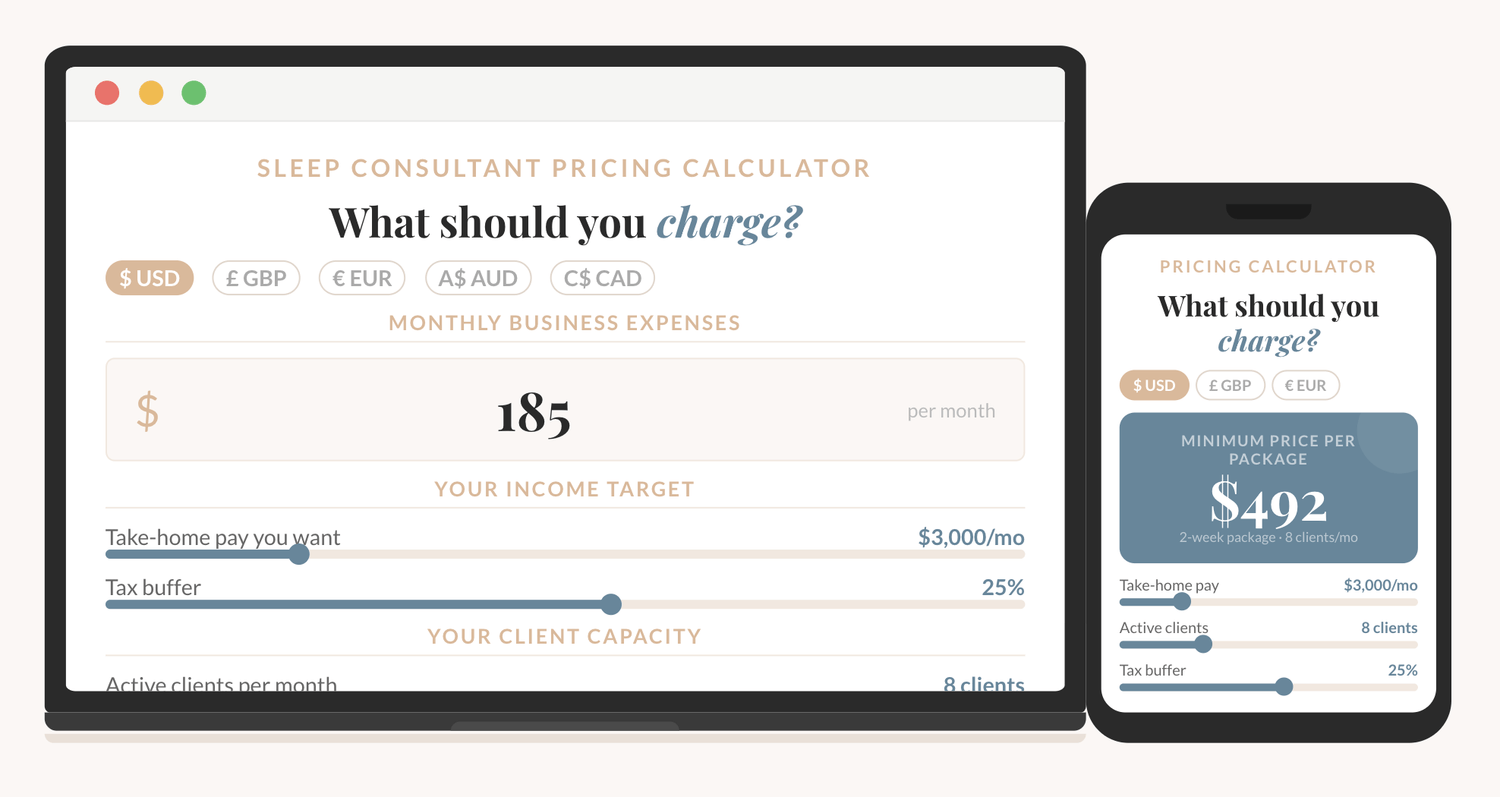
How to price your sleep consulting services?
The Sleep Consultant Pricing Calculator shows you exactly what to charge, based on your real expenses, your income goal, and how many clients you want to take on.
I'm thrilled to offer you an exclusive preview of what’s inside!
You can read the first 22 pages of The Sleep Consultant Playbook and get a taste of the value, insights, and actionable strategies that are waiting for you.
Other articles you might be interested in:
© 2021-2026 Sleep Consultant Business. All Rights Reserved.