
How to Create an Online Course as a Sleep Consultant
Start with a mini-course, not a massive one. Pick one specific problem your ideal client is facing right now, define a clear transformation, break it into 4 to 6 short modules, record simple video lessons of 5 to 15 minutes each, and price it low enough to be a no-brainer first step. A focused $29 course that solves one real problem will outsell a $297 course that tries to cover everything. Get beta students, collect testimonials, then launch properly. Don't wait until it's perfect. Done beats perfect every time.
In this guide
- When you're actually ready to create a course
- Why a mini-course beats a big course every time
- How to structure your course
- Setting up the tech
- How to launch it: the four phases
- Common course creation mistakes sleep consultants make
- Frequently asked questions
There's a ceiling to one-on-one sleep consulting. You can only work with so many families at a time, and your income is directly tied to your available hours. An online course changes that equation. You create the content once, and it keeps delivering value to families and revenue to your business whether you're working, travelling, or asleep.
Before we go any further though, let's clear something up. You've probably heard the term "passive income" thrown around as the dream, money rolling in while you sip a cocktail on the beach. That's not really how it works. An online course is more accurately described as a leveraged income stream. It still needs attention: updating content, engaging with students, running launches. But it lets you help far more people without trading more of your time for every dollar. That's the real value of it.
This article covers when you're ready to build one, why starting small is the right move, how to structure and set up your course, and how to launch it in a way that actually generates students.
When You're Actually Ready to Create a Course
If you're newly certified, right now is not the time to build an online course. Your focus should be on getting your first clients, delivering excellent one-on-one work, and learning what your ideal clients actually struggle with. An online course built before you have that real-world experience tends to be generic, and generic doesn't sell.
You're ready to start thinking about an online course when you have a steady stream of one-on-one clients, you're seeing the same questions and challenges come up repeatedly, you have testimonials and client results to reference, and you feel the ceiling of how many families you can serve individually. Those repeated questions and patterns are your course content. They're also the proof that there's demand.
Promise yourself you won't try to launch multiple things at once: a course, digital products, a membership, all at the same time. I know it's tempting when the ideas are flowing, but scattered energy produces unfinished projects. Pick one income stream, make it operational, make it valuable, make it profitable, and then consider the next thing. That's the path that actually works.
Why a Mini-Course Beats a Big Course Every Time
Most sleep consultants think a course needs to be a massive, comprehensive product covering everything they know, priced at $297 or more. That instinct is understandable, but it's wrong. Selling a high-ticket course to someone who doesn't know you yet requires advanced marketing skills most new course creators don't have. And the completion rates on big, expensive courses are famously low, which means worse results, worse testimonials, and less word of mouth.
Think about it this way. If you've just brought home a puppy, which would you choose: "Complete Puppy Training: Master All Essential Skills in 20 Hours for $297" or "Teach Your Puppy the 3 Most Crucial Commands in 1 Day for $29"? The second one wins. Why? Because it's specific, affordable, and promises a result you can achieve today.
The same principle applies to sleep consulting courses. A focused mini-course that solves one problem for $19 to $49 does several things at once. It's an easy yes for parents who are curious but not yet ready to invest in a full one-on-one package. It gets them a real result, which builds trust. And it creates a natural next step toward booking your higher-ticket service. Think of it like Tony Robbins selling a $13 book on Amazon and then charging $10,000 for an event. The cheap entry point is how most people discover and start trusting him.
Don't build it before you know people want it. The biggest mistake in course creation is spending months creating something you're not even sure will sell. Instead, test the idea first. Post about the topic on social media and see what response you get. Survey your email list. Or offer a live workshop version first to test the content with real people before recording anything. Get proof of demand before you invest the time to build.
How to Structure Your Course
Step 1: Define the specific transformation
Start with one clear outcome, not a broad topic. "Toddler Sleep Basics" is a topic. "Help Your Toddler Transition From a Crib to a Bed Without Three Weeks of Bedtime Battles" is a transformation. The more specific the promise, the easier it is for a parent to know whether this course is for them, and the easier it is for you to know exactly what to include and what to leave out.
Step 2: Outline the modules
Break the journey from the parent's starting point to the transformation into 4 to 6 modules. Each module covers one key milestone, not everything you know about that milestone. Here's an example for a crib-to-bed transition course:
| Module | What it covers |
|---|---|
| Module 1 | When and how to know it's time to transition |
| Module 2 | Preparing your toddler for the change (mindset and environment) |
| Module 3 | The first night: step-by-step game plan |
| Module 4 | Handling setbacks and night wakings |
| Module 5 | Creating long-term sleep success |
Each module should be short, actionable, and focused on moving the parent forward. Not everything you know, just what they need to reach the next milestone.
Step 3: Decide on the format
Video is the most effective format for sleep consulting courses because it builds the personal connection that makes parents trust you. It doesn't require a studio setup. A smartphone, a quiet space, good natural light, and a clear explanation is all you need. Keep videos between 5 and 15 minutes per lesson. Shorter is better. Add downloadable worksheets, checklists, or PDF guides to reinforce the key points from each lesson. These take less than an hour to create in Canva and significantly increase the perceived value of your course.
Also decide upfront whether your course will be fully self-paced (parents access everything immediately) or if you'll add live elements like a monthly Q&A call. Self-paced is simpler to start and easier to automate. Live elements increase the value and the price you can charge, but they also require your time.
Setting Up the Tech
You don't need anything fancy. Here's the actual minimum you need to get a course live:
- A course hosting platform. In my tools section you can find the simplest option where you can upload lessons, set up payment, and automate the welcome sequence all in one place. Alternatives like Teachable, Thinkific, and Kajabi are also purpose-built for online courses if you want a dedicated platform, but are more expensive.
- A payment processor. Connect your Stripe or PayPal account to your course platform. Most platforms have this built in. Set it up so students get immediate access as soon as payment is confirmed.
- An automated welcome sequence. As soon as someone enrols, they should receive a welcome email with their login details, what to expect, and how to get the most out of the course. Set this up once and it runs for every new student automatically.
- A sales page. This doesn't need to be long. It needs to cover the problem the course solves, the transformation students will achieve, a breakdown of what's included, the price, any testimonials from beta students, and a clear enrol button.
That's the whole tech stack. Resist the urge to add complexity. A simple, reliable setup is better than a sophisticated one that breaks or confuses students.
How to Launch It: the Four Phases
A great course that nobody knows about won't sell. A launch is a structured process that builds awareness, generates excitement, and guides people from curious to enrolled. Here are the four phases:
Phase 1: Build your audience (ongoing)
If you don't have an audience, you don't have anyone to sell to. Your email list is the most important asset for a course launch. Before you launch, spend time actively growing your list with a lead magnet related to your course topic. Here's the maths: if your course is $49 and you want to make $2,500, you need about 51 sales. At a 2% email conversion rate, you need a list of around 2,550 people. That number tells you exactly how big your list needs to be before a launch makes sense at your target revenue.
Phase 2: Pre-launch (4 to 8 weeks before launch day)
This phase is about warming up your audience before you open the doors. Share content related to your course topic: tips, polls, behind-the-scenes previews. Run a beta group at a discounted rate (more on this below). Set up your sales funnel so that on launch day, a parent can discover the course, pay, and get immediate access without any manual steps from you. Send a pre-launch email sequence that delivers value, tells your story around why you created this, and builds anticipation for what's coming.
One word of warning: avoid false scarcity ("only 3 spots left!" when it's an unlimited digital product) or inflated bonus values. Parents can sense when something feels off, and nothing destroys trust faster than marketing that isn't authentic.
Phase 3: Launch day
One of the most effective launch day strategies for sleep consultants is hosting a live webinar. Teach something genuinely valuable related to your course topic, address your audience's biggest pain points, and at the end, present your course as the natural next step. The webinar does the trust-building work that a sales page can't do on its own. Your enthusiasm is contagious on a live call. Use it.
Give people a reason to buy today rather than thinking about it. A launch discount with a real deadline, or a bonus module that disappears after launch, are both genuine urgency drivers. Be clear and transparent about exactly what the discount is and when it expires. No confusion, no gimmicks, just a clear incentive to act now.
Phase 4: Post-launch
Not everyone buys on launch day. That's fine. Have a follow-up email sequence ready for people who didn't enrol, continuing to provide value and addressing the most common objections. Send a thank-you email to everyone who did enrol straight away to confirm their decision was the right one. Then track your key metrics: enrollment rates, completion rates, where students drop off. Use that data to improve the course before your next launch.
Run a beta group first
Before you launch to a full audience, invite a small group of beta students at a meaningful discount in exchange for detailed feedback and testimonials. Beta groups do two things: they give you real-world data on what's working and what's confusing before you put it in front of everyone, and they give you testimonials you can use in your official launch. Five beta students who got a genuine result are worth more to your launch than a beautifully designed sales page.
Common Course Creation Mistakes Sleep Consultants Make
Making it too big and too expensive from the start
The bigger the course, the harder it is to sell to someone who doesn't know you yet. Start small, prove the concept, get testimonials, then expand. A $29 course that sells consistently is a better business decision than a $297 course that you spent three months building and that sits with two purchases.
Building a course before the one-on-one work is solid
A course built before you really understand your clients' specific struggles tends to be generic. Generic doesn't convert. Your one-on-one client work is where you learn the real objections, the real confusion points, the real language parents use when they're desperate for help. That insight is what makes course content land. Don't skip that stage.
Creating it without validating demand first
Spending months perfecting content you're not even sure people want is one of the most common (and demoralising) course creation mistakes. Test before you build. Post about the topic and measure engagement. Survey your list. Run a live workshop version first. Get real signal from real people before investing weeks of effort.
Launching without an audience
A course with no audience is a tree falling in an empty forest. If your email list has 50 people and a 2% conversion rate, you're looking at one sale. Building the audience comes before the launch, not at the same time. Grow your list consistently around the course topic before you open the doors.
Forgetting to make it evergreen
Once you've launched and refined your course, set it up as an evergreen offer that's always available for purchase. This is where the leveraged income part actually kicks in. Automate your marketing with email funnels, a lead magnet that feeds into the course, and retargeting so new students keep enrolling without you needing to run a big launch every time.
Frequently Asked Questions
How long does it take to create an online course?
A focused mini-course of 4 to 5 modules can realistically be outlined, recorded, and set up in two to four weeks if you're working on it consistently. A larger course takes longer. The trap is perfectionism: spending three months polishing something instead of getting it in front of beta students who can tell you what actually needs improving. Get it done enough to be useful, then refine.
What should I charge for a mini-course?
For an entry-level mini-course, $19 to $49 is the sweet spot. It's a no-brainer purchase for a parent who is struggling, and it's low enough to attract people who haven't worked with you before. A mid-level course with more modules and supporting materials can be priced between $49 and $127. Save the higher price points for courses with live elements, community access, or certification components.
Do I need a proper camera and studio setup?
No. A smartphone, good natural light, and a quiet space produces perfectly acceptable course videos. What matters far more than production quality is clarity and warmth. Parents watching a sleep course are looking for a real person they can trust, not a TV presenter. That said, good audio matters more than good video: clear sound is the minimum standard. An inexpensive lapel microphone makes a noticeable difference.
Which platform should I use to host the course?
Take a look in the 'tools' section of this website, where you can find the Business Operating System including all templates and the complete course setup you need as a sleep consultant.
What if my first launch doesn't go as well as I hoped?
Every launch is a learning exercise. Look at where people dropped off: did they visit the sales page but not buy (messaging or price issue)? Did they open your launch emails but not click (weak call to action)? Did they buy but not complete the course (engagement or content issue)? Each of those tells you something specific to fix before next time. A low-converting first launch is not a failed course. It's data.
Can I create a course while still taking one-on-one clients?
Yes, and it's actually the right order of operations. Your one-on-one clients fund the business while you're building the course, and they give you the real-world insights that make the course content valuable. The course eventually reduces your dependence on one-on-one time, but it shouldn't replace it before it's proven and profitable. Build the course alongside the client work, not instead of it.
Key Takeaways
- Online courses are leveraged income, not passive income. They still need attention, but they let you help far more families without trading more hours for every dollar.
- Start with a mini-course. One specific problem, one clear transformation, 4 to 5 modules, a price that's an easy yes. Prove the concept before you go big.
- Validate demand before you build. Test the topic with your audience first. A live workshop version is the fastest way to find out whether people actually want what you're planning to create.
- The tech setup is simple: a course platform, a payment processor, an automated welcome sequence, and a sales page. That's it.
- Run a beta group first. Discounted rate, detailed feedback, testimonials. Five beta students who got a real result are worth more than a perfect sales page.
- Launch properly: build your audience, warm them up in pre-launch, host a webinar on launch day, follow up with those who didn't buy. A good course with a weak launch will underperform. A great launch will do a lot of the heavy lifting for you.
Disclaimer: The information shared in these articles is for educational and informational purposes only. It does not constitute legal, financial, or professional advice. Always consult with a qualified professional regarding your specific situation.

Rianna Hijlkema
Certified Pediatric Sleep Consultant, Certified Postpartum Doula, Former Teacher & School Director, Founder of Sleep Consultant Design & Sleep Consultant Business and the author of The Sleep Consultant Playbook (available on Amazon).
The Sleep Consultant Newsletter
Weekly tips, strategies and marketing ideas for sleep consultants written by a fellow sleep consultant. 1500+ active subscribers!
I’ll only send helpful emails, and you can unsubscribe anytime with one click.
How to price your sleep consulting services?
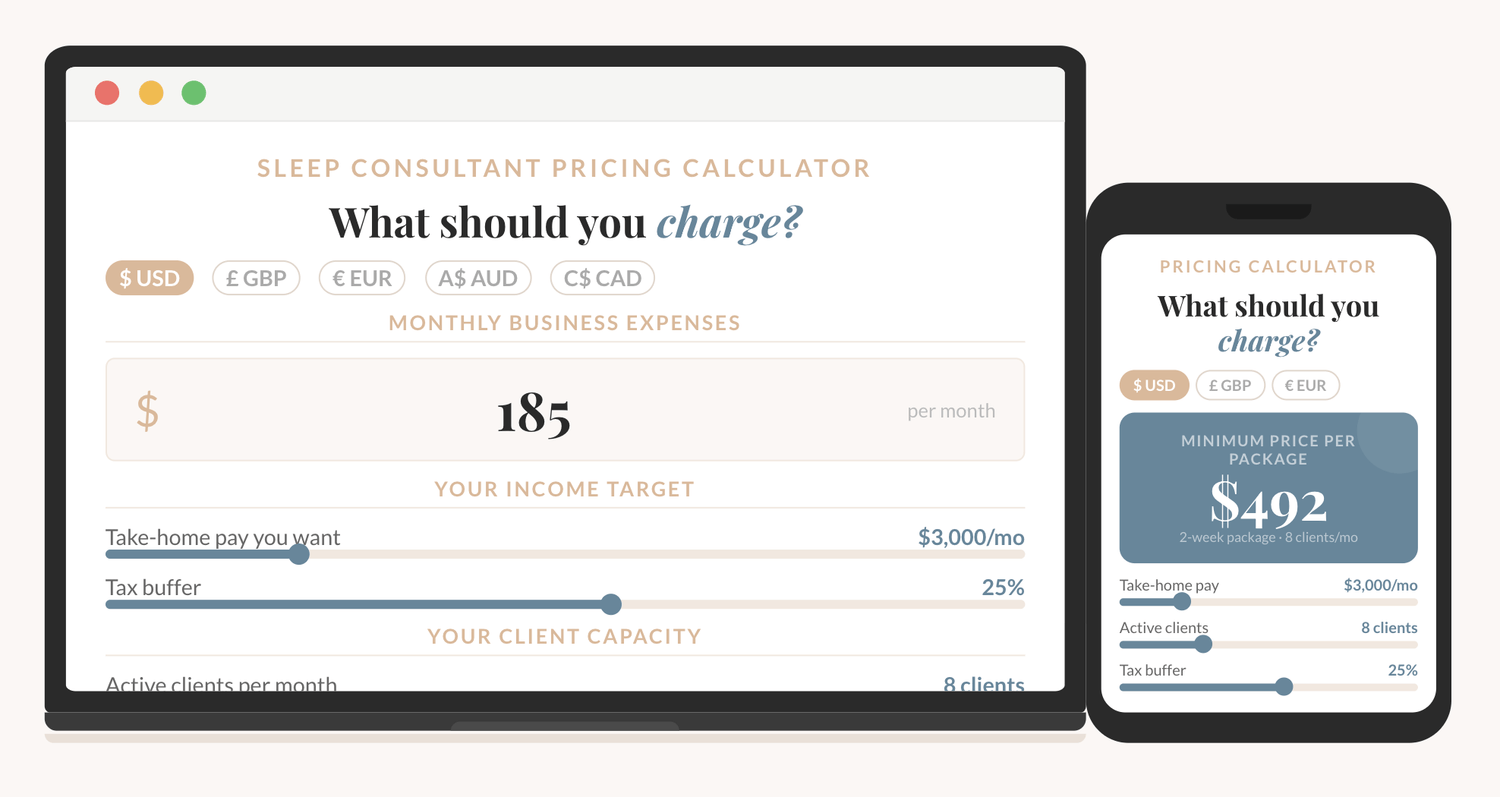
The Sleep Consultant Pricing Calculator shows you exactly what to charge, based on your real expenses, your income goal, and how many clients you want to take on.
I'm thrilled to offer you an exclusive preview of what’s inside!
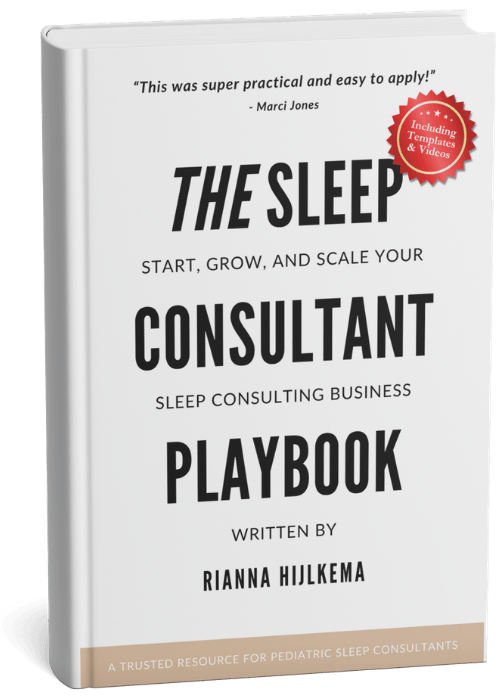
You can read the first 22 pages of The Sleep Consultant Playbook and get a taste of the value, insights, and actionable strategies that are waiting for you.
Other articles you might be interested in:
© 2021-2026 Sleep Consultant Business. All Rights Reserved.