
How to Price Your Services for Twins and Siblings as a Sleep Consultant
Working with twins or siblings in the same home is genuinely more work than working with a single child: more complex planning, two separate sleep plans or a carefully synchronised joint plan, more moving parts to track during the support phase, and more variables that can affect each other. Your pricing should reflect that. A common approach is to charge your full rate for the first child and a reduced rate (typically 50-70% of your standard fee) for the second, framing it as a family rate rather than a discount. This covers the additional time and complexity while remaining accessible to families who often need the support most.
In this guide
- Why twins and siblings are different to price
- Twins vs close-in-age siblings: what changes
- Pricing models you can use
- How to calculate your twins or siblings rate
- How to communicate the pricing
- Common pricing mistakes sleep consultants make
- Frequently asked questions
It's one of the most common questions sleep consultants get stuck on. A family with twins reaches out, or a family with two children at different sleep stages both needing support. You know your standard package rate. You know this is more work. But you're not sure exactly how much more, or how to explain the difference without it feeling awkward.
You're not alone. There's no universal standard in the industry for multi-child pricing, which is exactly why so many sleep consultants either charge the same as for a single child (undercharging significantly) or freeze entirely and don't quote at all.
This article gives you a clear framework for thinking through the pricing, a model you can apply immediately, and the language to communicate it with confidence.
Why Twins and Siblings Are Different to Price
Your pricing needs to cover your time, your expertise, and the complexity of what you're delivering. For a single child, you're assessing one child's sleep history, creating one sleep plan, tracking one set of variables during the support phase, and troubleshooting one child's responses.
For two children in the same household, that work multiplies, but not simply doubles. Here's what actually increases:
- Intake and assessment. Two questionnaires, two sleep histories, two sets of developmental context to review and hold together when building the plan.
- Sleep plan complexity. You're either creating one highly coordinated joint plan that accounts for how the children affect each other (room sharing, simultaneous wake-ups, noise sensitivity) or two separate plans that have to be realistic for one set of parents to implement simultaneously.
- Consultation time. More to cover, more questions, more scenarios to work through. A consultation that typically runs 60 minutes for one child often runs 75 to 90 for two.
- Support phase messages. More check-in reports to read, more variables to track, more troubleshooting when one child's progress affects the other's.
- Emotional load. Twin families and families with two young children are often running on less sleep and more stress than the average single-child family. The support they need is real and often more intensive.
This doesn't mean you charge double. It means you charge fairly for work that is genuinely more complex, more time-intensive, and more cognitively demanding than a single-child engagement.
Twins vs Close-in-Age Siblings: What Changes
Twins and close-in-age siblings are both multi-child situations, but they come with different challenges that affect how you structure and price the work.
Twins
Same age, often same room, and the central question is always synchronisation: do you sync their schedules completely, and if one wakes, how does that affect the other? Twins who are close in developmental stage can often be worked on with a shared plan structure, which saves some planning time compared to two children at very different ages. However, the practical implementation complexity is significant. Parents doing night sleep training with two babies simultaneously need very specific, very detailed guidance. The support phase is often more intensive.
Close-in-age siblings (under 3 years apart)
Two children at different developmental stages means two distinct sleep needs, often two different approaches, and two plans that may interact (room sharing, older child woken by younger, nap schedules that don't overlap cleanly). This is often more complex in terms of planning than twins, because you don't have the shortcut of a shared developmental stage. You're genuinely building two separate plans that need to coexist practically in one household.
Siblings with a larger age gap
When the children are further apart in age (3 years or more), they often have largely separate sleep situations. They may not share a room, their schedules may not interfere much, and the interaction between the two sleep plans is minimal. Depending on the family's situation, this might be handled as two largely separate engagements with modest coordination, and priced accordingly.
| Situation | Plan complexity | Support intensity | Pricing approach |
|---|---|---|---|
| Twins | High (sync decisions, shared room) | High | Full rate + 50-70% for second child |
| Siblings under 3 years apart | High (two distinct ages, one household) | Medium-high | Full rate + 50-70% for second child |
| Siblings 3+ years apart | Lower (often largely separate) | Lower | Full rate + smaller add-on, or two separate packages |
Pricing Models You Can Use
There are a few common approaches in the industry. None is universally right. The best one depends on how you've structured your packages and how you prefer to communicate pricing to families.
Model 1: Full rate plus a family add-on for the second child
Charge your standard package rate for the first child, and an add-on fee for the second child, typically 50 to 70% of your standard rate. So if your package is $400, a twins or siblings package is $400 + $200-$280, totalling $600-$680. This is the clearest and most commonly used structure. It acknowledges the extra work while making the family feel they're getting genuine value for addressing both children together rather than paying two full fees.
Model 2: A dedicated twins or siblings package at a set price
Create a named package specifically for multi-child families, priced at roughly 1.5 to 1.75 times your standard single-child rate. So if your single-child package is $400, the twins package is $600-$700. This works well if you work with multi-child families regularly, as it avoids the need to explain add-on pricing in the moment and presents as a complete offer.
Model 3: Two separate packages with a family discount
Charge two standard packages with a stated family discount (typically 20-30% off the second). For a $400 package, this is $400 + $280-$320, totalling $680-$720. This approach works well for siblings with a larger age gap where the work is genuinely closer to two separate engagements. It's slightly less graceful for twins, where the shared nature of the work makes the "two packages" framing less intuitive.
What I decided early on was to use model 1 as the default and only switch to model 3 when the age gap was large enough that the two children's situations were genuinely quite separate. The "full rate plus add-on" framing sits well with families because it gives them the sense of a complete service for both children, with the second child clearly not being an afterthought. It also makes the math easy to explain on a call without hesitation.
How to Calculate Your Twins or Siblings Rate
Start from your standard package and work through the actual additional time involved. Don't guess. Estimate it concretely so your add-on reflects real work rather than an arbitrary percentage.
- Add up the extra time for a multi-child engagement. For twins or close-in-age siblings, a rough estimate: 30-45 extra minutes reviewing a second questionnaire, 45-60 extra minutes writing a more complex or second sleep plan, 15-20 extra minutes per consultation, and 20-30% more time during the support phase. That adds up to 2 to 3 extra hours for a typical engagement.
- Calculate what those extra hours are worth at your effective hourly rate. If your standard $400 package involves roughly 5 hours of your time, your effective rate is $80/hour. Two extra hours at that rate is $160. Round to $175 or $200 for a clean number.
- Cross-check against the 50-70% benchmark. Is your calculated add-on within that range? If yes, you're in a sensible place. If it's significantly outside it in either direction, revisit your estimates.
- Set the number and don't move it. Once you've calculated your twins or siblings rate, that's the rate. Don't re-negotiate it on a call because a family seems surprised. The price reflects the work involved, not what the family wants to pay.
How to Communicate the Pricing
Most sleep consultants know their number. The discomfort comes in the moment of saying it. These scripts will help.
On the Sleep Assessment Call
When someone asks for a single-child rate for twins
What NOT to say
Don't apologise for the pricing, don't pre-emptively offer to reduce it, and don't phrase it as "unfortunately I do need to charge a bit more." These phrases signal that you don't fully believe the price is fair. If you don't believe it, the family won't either. State it simply, explain it briefly, and let it land.
For a broader framework on holding your pricing confidently, see How to Price Your Sleep Consulting Services.
Common Pricing Mistakes Sleep Consultants Make
Charging the same for two children as for one
Usually driven by not wanting to seem greedy or by sympathy for parents who are already stretched. But charging single-child rates for a twins engagement means you're doing significantly more work for the same money, which builds resentment over time and isn't sustainable. Fair pricing protects both you and the client relationship.
Charging full double without any family consideration
Two full standard packages for twins or siblings is technically justifiable from a workload perspective, but it often feels tone-deaf to families who are hoping for some acknowledgment that they're dealing with multiple children at once. A 50-70% rate for the second child is both fair and commercially sensible. You keep the engagement rather than pricing the family out.
Not having the rate decided before the call
When a family mentions twins or siblings and you haven't thought through your pricing in advance, you end up either making up a number on the spot (which usually comes out too low) or hedging with "let me think about it and come back to you", which kills momentum and creates uncertainty. Decide your twins rate before it comes up. Write it down. Know it the way you know your standard rate.
Treating all multi-child situations the same
Twins sleeping in the same room with a synchronisation challenge is different from siblings who are 4 years apart with largely separate sleep situations. Applying the same add-on rate regardless of complexity means occasionally undercharging (for the very complex cases) and occasionally overcharging (for the simple ones). A quick assessment of whether the two children's situations are intertwined or largely separate helps you price more accurately.
Writing a twins plan without adjusting the intake process
A single-child questionnaire is not enough to build a solid twins or siblings plan. If you're using the same intake form, you're missing information about how the children affect each other, room-sharing dynamics, and whether the parents are trying to synchronise or not. Either adapt your questionnaire to include a multi-child section or send it twice with specific additions for the second child's details.
Frequently Asked Questions
Should I create a dedicated twins package on my website?
If you work with twins families regularly, yes. A named package that speaks directly to the twin experience ("Twin Sleep Package") feels more considered than "standard package with an add-on." It also signals that you understand twin-specific sleep challenges, which builds trust before the family even contacts you. If twins are occasional rather than a focus area, showing the add-on pricing in your packages page is enough.
What if a family can only afford support for one child right now?
That's completely valid. Help with one child now and flag that you can come back to the second when they're ready. In many cases, improving one child's sleep naturally improves the household dynamic enough that the second child settles better too. Just be clear in the scope of what you're delivering so there's no expectation that you're including the second child in the support.
Do I create one sleep plan or two for twins?
Usually one coordinated plan that addresses both children, with sections specific to each. This is more useful for parents than two separate documents they have to cross-reference, and it lets you directly address the interactions between the two children's sleep. For siblings at very different developmental stages, two plans that reference each other's schedules is often cleaner.
What about triplets?
Apply the same principle: full rate for child one, and a family rate for each additional child. The complexity with triplets is genuinely significant: triple the intake, a highly coordinated plan, and a support phase that requires more check-ins and faster response to changes. A rate of full price plus 50% for child two and 50% for child three is reasonable (so 200% of your standard rate total). You might also consider adding an additional consultation call to the package, given the complexity.
Should the twins or siblings rate be listed on my website?
Yes, if you're comfortable with transparent pricing. A note under your standard packages that reads something like "Working with twins or siblings? A family rate applies, contact me for details" or a listed twins package with the price shown makes multi-child families feel immediately seen and informed. Hiding the pricing doesn't protect you. It just creates a conversation where the family has to ask, which sometimes creates hesitation before they ever reach you.
Key Takeaways
- Multi-child work is genuinely more complex and time-intensive. Your pricing should reflect that, without apology.
- The most common approach: full rate for the first child, 50-70% for the second. Frame it as a family rate, not a discount or an added cost.
- Twins and close-in-age siblings are typically more complex than siblings with a larger gap. Use the situation to guide the add-on, not a blanket rule.
- Decide your twins rate before it comes up. Knowing the number in advance means you can state it confidently on a call without hesitating or improvising.
- Adjust your intake process for multi-child families. A single-child questionnaire won't capture what you need to build a plan that accounts for how the children affect each other.
- State the pricing simply and let it land. Apologising for it or pre-empting objections signals you don't believe the price is fair. If you've calculated it properly, it is.
If you don't have a twins or siblings rate written down yet, set one today. Work backwards from your standard package, add up the extra hours, cross-check against the 50-70% guideline, and write the number down. The next time a family of twins asks, you'll have an answer ready.
Next Article: How to Price Your Sleep Consulting Services
Disclaimer: The information shared in these articles is for educational and informational purposes only. It does not constitute legal, financial, or professional advice. Always consult with a qualified professional regarding your specific situation.

Rianna Hijlkema
Certified Pediatric Sleep Consultant, Certified Postpartum Doula, Former Teacher & School Director, Founder of Sleep Consultant Design & Sleep Consultant Business and the author of The Sleep Consultant Playbook (available on Amazon).
The Sleep Consultant Newsletter
Weekly tips, strategies and marketing ideas for sleep consultants written by a fellow sleep consultant. 1500+ active subscribers!
I’ll only send helpful emails, and you can unsubscribe anytime with one click.
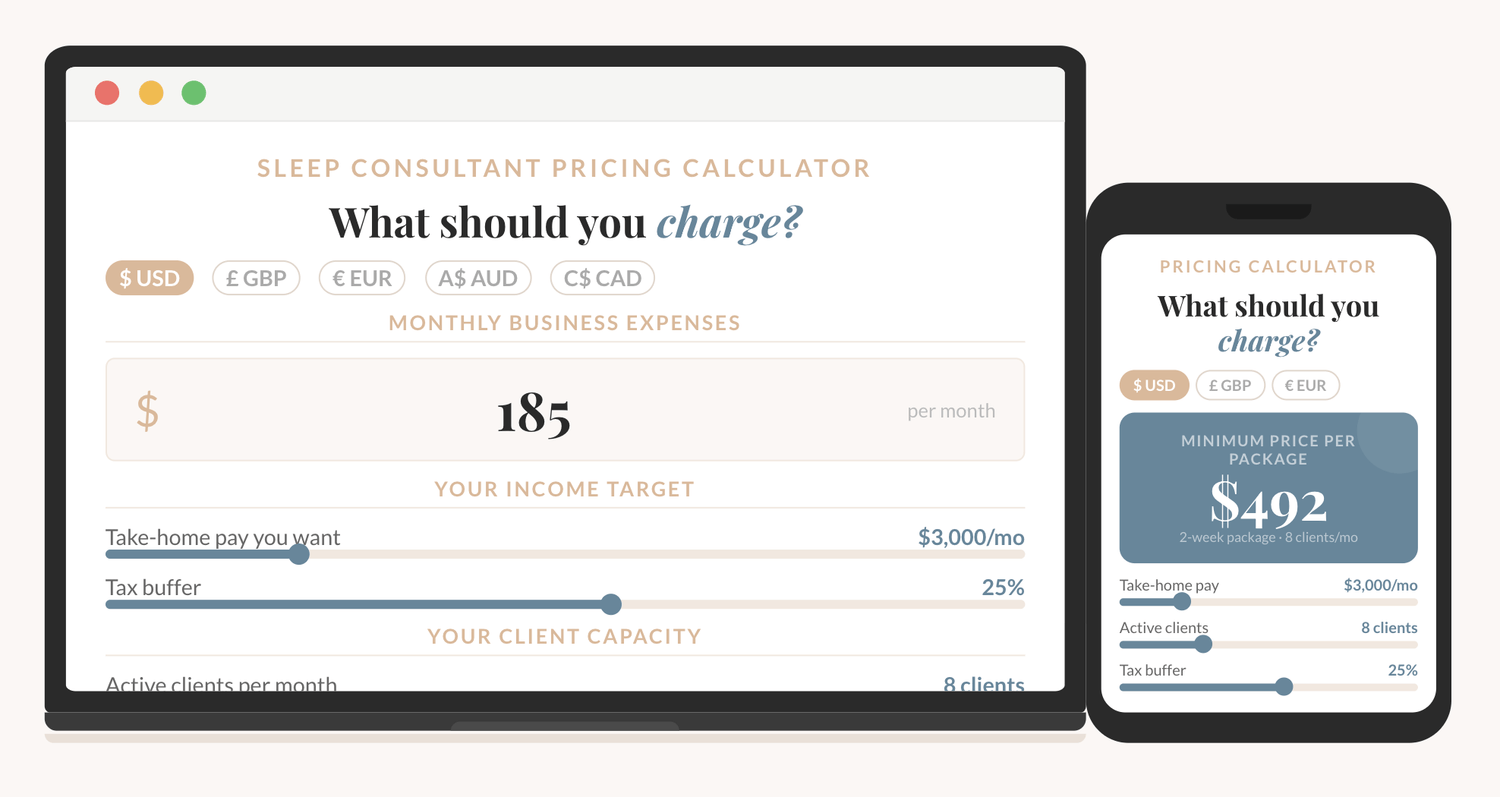
How to price your sleep consulting services?
The Sleep Consultant Pricing Calculator shows you exactly what to charge, based on your real expenses, your income goal, and how many clients you want to take on.
I'm thrilled to offer you an exclusive preview of what’s inside!
You can read the first 22 pages of The Sleep Consultant Playbook and get a taste of the value, insights, and actionable strategies that are waiting for you.
Other articles you might be interested in:
© 2021-2026 Sleep Consultant Business. All Rights Reserved.