
How to Price Your Sleep Consulting Services
Most new sleep consultants charge between $150 and $400 USD for a standard sleep package, depending on their location, experience, and what is included. The biggest mistake is pricing too low out of fear. Your price signals your value. Start by calculating what you need to earn, research what established consultants charge in your market, and build a package that reflects the real transformation you deliver.
In this guide
- Why pricing feels so hard for new consultants
- What sleep consultants actually charge
- How to set your rate: a step-by-step guide
- Pricing benchmarks by country
- Common pricing mistakes sleep consultants make
- Frequently asked questions
Pricing is one of the first things new sleep consultants get stuck on, and it makes sense. You have just finished your certification, you are excited to start helping families, and then you have to answer the question: what do I charge? It is uncomfortable when you are new. You do not have a track record yet. You are not sure if your services are worth what you want to charge. And you worry that if you price too high, no one will hire you.
Here is what most consultants discover within the first few months: pricing too low does not make it easier to get clients. It makes it harder. Low prices attract clients who question your value, take longer to commit, and are more likely to ghost. A clear, confident price attracts clients who are ready to invest and who take the process seriously.
This guide will walk you through exactly how to price your services as a sleep consultant, from setting your base rate to structuring your packages. No guesswork, no vague advice about knowing your worth. Just a practical framework you can apply today.
Why Pricing Feels So Hard for New Consultants
Pricing discomfort is almost universal among newly certified consultants. It is worth naming the reasons, because understanding them helps you move past them.
You are comparing yourself to your most experienced peers
When you look at what established sleep consultants charge, you assume you cannot charge anywhere near that because you are new. But those consultants were also new once, and they started somewhere. Your certification represents real training and real knowledge. Families are not hiring you for your years of experience. They are hiring you because they are exhausted and need help now.
You are thinking about what you would pay, not what your client would pay
New consultants almost always price based on what they personally would spend on something like this. But your client is not you. A parent who has been awake every two hours for six months and whose relationship and work performance are suffering will happily pay $300 to solve that problem. The value of your service is not the number of hours you spend on it. It is the outcome you deliver.
You have not calculated what you actually need to earn
Most sleep consultants pick a price that feels comfortable rather than one that makes financial sense. If you need to earn $2,000 a month from your sleep consulting business and you charge $150 per package, you need to sign 14 clients a month. That is not sustainable for most people. Price is not just about the market. It is also about math.
The sleep consultants who consistently undercharge are also the ones who burn out fastest. When you are paid well for your work, you show up differently. You have energy for your clients. You invest in your own development. You build a business that lasts.
I remember sitting at my desk after my certification, staring at a blank invoice template and genuinely not knowing what number to type in. I went back and forth for days. Too high felt arrogant. Too low felt desperate. What I eventually figured out, and what I wish someone had told me earlier, is that the number you pick is less important than the thinking behind it. Once I had done the math and looked at what other certified sleep consultants were charging, the decision got a lot simpler.
What Sleep Consultants Actually Charge
Pricing varies significantly by country, experience level, and what is included in the package. The table below gives you a realistic starting point.
| Experience Level | Typical Package Price (USD) |
|---|---|
| New sleep consultant (0–12 months) | $150–$275 |
| Established sleep consultant (1–3 years) | $275–$450 |
| Experienced sleep consultant (3+ years) | $450–$800+ |
| Specialist (multiples, special needs) | $500–$1,000+ |
These are USD figures and will vary considerably by country. See the country benchmarks section below for local context.
Do not build your pricing entirely around what competitors charge. Many consultants undercharge, and pricing yourself against them just perpetuates the problem. Use market rates as context, not as your ceiling.
How to Set Your Rate: A Step-by-Step Guide
Rather than guessing, work through these five steps in order. Each one builds on the last.
Step 1: Calculate your minimum viable income
Write down what you need to earn each month to cover your expenses and pay yourself a liveable amount. Include business costs: software, insurance, website, continuing education. This is your floor. Every pricing decision starts here.
Step 2: Estimate how many clients you can realistically serve
Be honest. If you are building this part-time alongside other commitments, you might realistically work with four to six clients a month. If full-time, eight to twelve might be possible. Divide your minimum income by that number. That is your minimum price per package.
Step 3: Research your local market
Look at what certified sleep consultants in your city or country are charging. Not the cheapest ones, and not the most expensive. Look at consultants who are one to two years ahead of where you are. That is your near-term benchmark.
Step 4: Build your package around the outcome, not the hours
Define what a client gets from start to finish: the initial consultation, the sleep plan, the follow-up support, the check-in calls. Price the transformation, not your time. Most new consultants underestimate how much support they actually provide.
Step 5: Set a price you can say out loud with confidence
This matters more than it sounds. If you hesitate when you say your price, clients feel it. Practice saying your rate out loud before your first discovery call. If you cannot say it without wincing, either your price is not right or your confidence needs work. Usually it is the second one.
One package is enough to start
Before you worry about package structure, get your rate right. When you are new, one clear package at one clear price is all you need. Trying to build a full service menu before you have even had your first client creates confusion for you and for them. Get five to ten sleep consulting clients through a single package, learn what they actually need, and build from there. The full guide to structuring your packages is coming in the next article: How to Package Your Sleep Consulting Services.
Pricing Benchmarks by Country
Sleep consulting is a global service, and what families can and will pay varies significantly by market. Use these as rough benchmarks only.
| Country | Entry-Level Package | Mid-Range Package | Notes |
|---|---|---|---|
| United States | $150–$250 | $300–$500 | Strong market, high willingness to pay for certified consultants |
| United Kingdom | £120–£200 | £250–£450 | Growing market, urban areas support higher rates |
| Australia | AUD $200–$350 | AUD $400–$700 | Competitive market, high consumer awareness |
| Canada | CAD $175–$300 | CAD $350–$550 | Similar to US, bilingual market in Quebec |
| Netherlands | EUR 150–250 | EUR 300–500 | Strong expat market, English-language services viable |
| New Zealand | NZD $200–$350 | NZD $400–$600 | Smaller market, less competition |
| South Africa | ZAR 1,500–3,000 | ZAR 4,000–7,000 | Price-sensitive market, urban clients willing to pay more |
| Germany | EUR 150–280 | EUR 300–550 | Growing awareness, German-language services preferred |
These are estimates based on typical market rates and may not reflect your specific city or niche. Local parent Facebook groups and sleep-related communities are often the best place to research what consultants in your area actually charge. Always verify locally before setting your rates.
Common Pricing Mistakes Sleep Consultants Make
Starting too low and never raising rates
Many new consultants pick a low price to get their first few clients, then feel stuck there permanently. Existing clients expect the same price. New enquiries arrive expecting the same. The result is a business that grows in volume but not in income. Build in a planned price increase from the start. Tell early clients clearly that their rate is an introductory one.
Charging by the hour instead of by the package
Hourly pricing penalises you for getting better at your job. As you become more experienced, you will solve problems faster. If you charge by the hour, your income goes down as your skills go up. Package pricing removes this problem entirely. It also gives clients clarity: they know exactly what they are paying and what they get.
Discounting to win clients
Offering discounts when a potential client pushes back on price almost never results in a better client relationship. It teaches them that your price is negotiable. If someone cannot afford your rate, offering a payment plan is reasonable. Discounting your actual price is a different thing, and worth avoiding.
Not including follow-up support in the price
New consultants often underestimate how much time they spend on follow-up messages, questions, and check-ins after delivering the sleep plan. If that support is not built into your price, you end up giving it away for free. Define your support window clearly (for example, two weeks of email support) and price accordingly.
Waiting until you feel ready to charge full rates
There is no version of this where you will suddenly feel completely confident charging what you are worth. The confidence comes after you charge the price and see that clients happily pay it. Start at a reasonable rate, not your dream rate. But do not start so low that you resent the work.
Frequently Asked Questions
How much should a new sleep consultant charge for their first client?
Most new consultants charge between $150 and $250 USD for their first few packages. This gives you room to learn your process without significantly undervaluing your work. Avoid going below $100 for a full package, even at the very start. Clients who pay very little often expect the most.
Should I offer a free or discounted package to build my portfolio?
One or two case studies at a reduced rate (not free) can be worth it in your first month if you genuinely have no testimonials yet. Set a clear limit: two clients at an introductory rate, then full price. Make sure you get written permission to use their story and a testimonial in exchange.
How do I handle it when a potential client says my price is too high?
Stay calm and do not immediately drop your price. Acknowledge their concern, then restate the value: what they get, what outcome they can expect, and what it costs them to keep doing nothing. Offer a payment plan if that helps. Holding your price is almost always the right move.
When should I raise my prices?
Raise your prices when you are consistently fully booked, when you have five or more strong testimonials, or when you have been at the same rate for six months or more. A 15 to 25 percent increase is reasonable at each stage. You do not need to justify it to anyone. Update your pricing and move forward.
Do I need to charge differently for different age groups?
Some consultants charge more for older children or specific specialisations (multiples, special needs, toddlers) because those cases require more time and expertise. When starting out, a single package price for your core age range is simpler. Introduce tiered or specialised pricing once your main process is running smoothly.
Can I operate as a sleep consultant internationally and charge in different currencies?
Yes. Many sleep consultants work with clients globally, particularly online. Most charge in their home currency and let the client handle conversion. Payment platforms like Stripe, PayPal, and Wave handle multi-currency transactions well. If a large portion of your clients come from another country, consider whether pricing in that currency makes sense for your market.
Key Takeaways
- Most new sleep consultants charge $150 to $275 USD per package. That range is a starting point, not a ceiling.
- Price based on what you need to earn and the outcome you deliver, not what you personally would pay.
- Package pricing beats hourly pricing every time. It protects your income as you get more efficient.
- The most common mistake is starting too low and never raising rates. Build in a plan to increase from day one.
- Confidence in your price comes after you say it out loud, not before.
- Ready to build your full pricing structure? The Sleep Consultant Business Operating System™ includes a pricing calculator, package templates, and a discovery call script.
Disclaimer: The information shared in these articles is for educational and informational purposes only. It does not constitute legal, financial, or professional advice. Always consult with a qualified professional regarding your specific situation.

Rianna Hijlkema
Certified Pediatric Sleep Consultant, Certified Postpartum Doula, Former Teacher & School Director, Founder of Sleep Consultant Design & Sleep Consultant Business and the author of The Sleep Consultant Playbook (available on Amazon).
The Sleep Consultant Newsletter
Weekly tips, strategies and marketing ideas for sleep consultants written by a fellow sleep consultant. 1500+ active subscribers!
I’ll only send helpful emails, and you can unsubscribe anytime with one click.
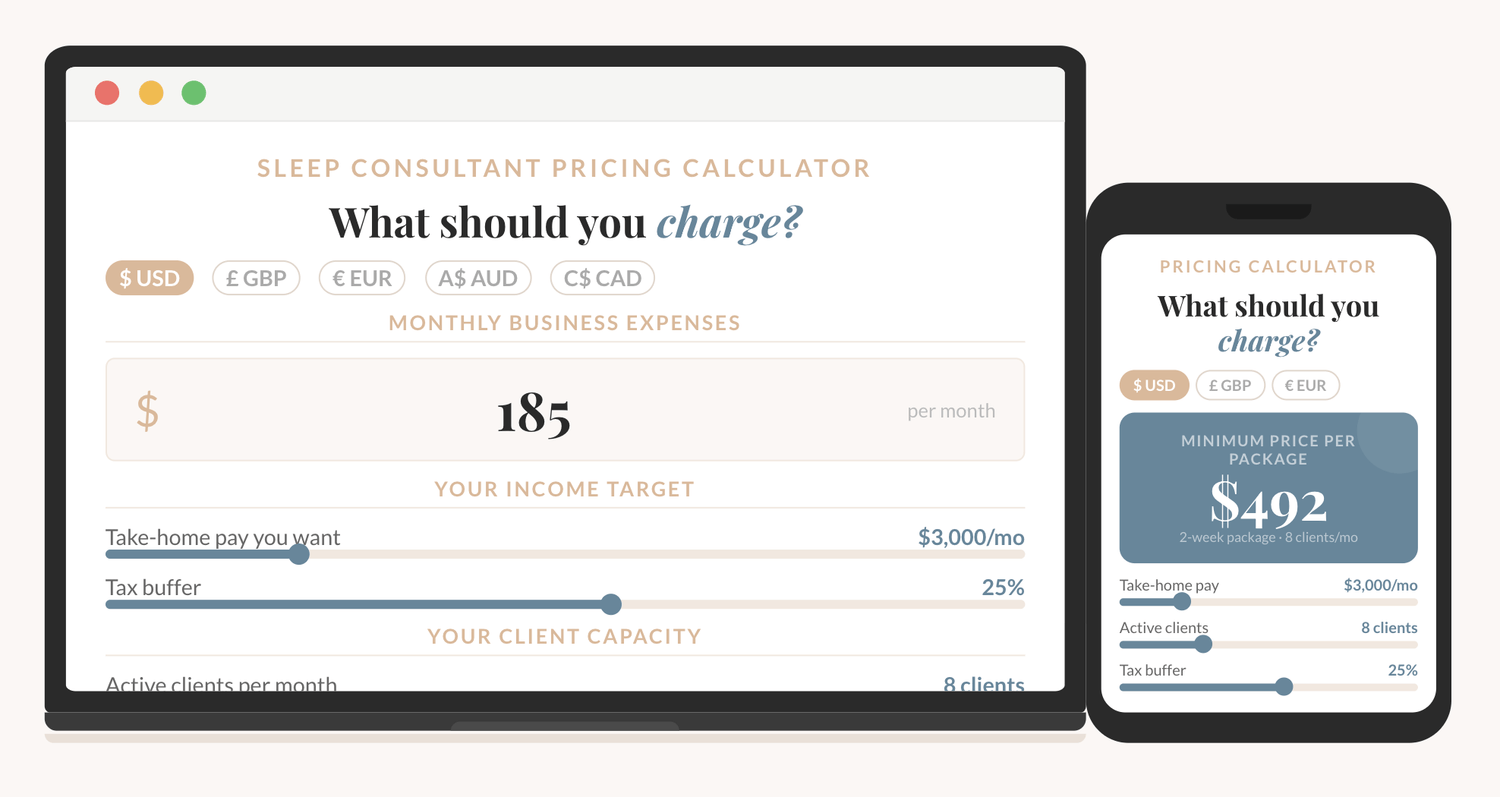
How to price your sleep consulting services?
The Sleep Consultant Pricing Calculator shows you exactly what to charge, based on your real expenses, your income goal, and how many clients you want to take on.
I'm thrilled to offer you an exclusive preview of what’s inside!
You can read the first 22 pages of The Sleep Consultant Playbook and get a taste of the value, insights, and actionable strategies that are waiting for you.
Other articles you might be interested in:
© 2021-2026 Sleep Consultant Business. All Rights Reserved.