
How to Raise Your Rates as a Sleep Consultant
Raise your rates when you are consistently booking clients, receiving strong testimonials, or when your current prices no longer reflect the time and value you are providing. Review your pricing every six months, announce increases with at least 30 days' notice, and apply them to new clients first. The discomfort of raising your rates is nearly always a mindset issue, not a market one. Your value is determined by the transformation you provide, not by how long you have been in business.
In this guide
- Why most new sleep consultants undercharge
- When you are ready to raise your rates
- How much to raise your rates
- How to raise your rates: step by step
- How to tell existing clients about a rate increase
- The mindset shift that makes raising rates easier
- Common rate-raising mistakes sleep consultants make
- Frequently asked questions
You set your rates when you were newly certified, probably with a mix of market research, a rough calculation, and the hope that the number felt reasonable enough that someone would actually say yes. That was the right approach for where you were at the time. But if you have been working with clients for a while, getting results, collecting testimonials, and still charging what you charged on day one, something needs to change.
Raising your rates is not a reward you earn after some arbitrary amount of time. It is a business decision you make based on evidence: your results, your demand, your experience, and the actual value of the transformation you are delivering. Most sleep consultants wait far too long, and they leave a significant amount of money on the table in the process.
This article will help you recognise when the time is right, decide how much to increase by, communicate it clearly to your clients, and get past the mental block that is almost certainly the biggest thing standing between you and charging what your work is worth.
Why Most New Sleep Consultants Undercharge
Undercharging is rarely about the market. In most cases, it is a symptom of something else: uncertainty about whether the results will be good enough, worry that no one will pay more, or a belief that you need to earn the right to charge properly first. These are understandable feelings, especially in the early months. They are also, in most cases, wrong.
Your value as a sleep consultant is not determined by how long you have been in business or how many clients you have worked with. It is determined by the transformation you provide. A family that goes from a child waking four times a night to sleeping 11 hours straight has received something worth far more than a bargain price. Pricing below your value does not make clients more grateful. It often makes them take the process less seriously, because the price signals how much the outcome is worth.
There is also a practical problem with undercharging that many sleep consultants do not see until they are deep into it: if your rates are too low, you have to work with more clients to earn the income you need, which leaves you with less time for each one, which erodes the quality of your results, which makes you feel like you are not good enough to charge more. It is a cycle that starts with a number that was too low from the beginning.
I remember the first time I said my full rate out loud. My voice went up at the end like it was a question. That is the moment most sleep consultants give themselves away: the hesitation, the apologetic tone, the speed at which they start justifying the price before the parent has even responded. Charging what you are worth starts with believing it yourself. The number is the easy part.
When You Are Ready to Raise Your Rates
There is no single moment that tells you it is time to raise your rates. There are signals. When several of these are present at once, you are almost certainly overdue for a review.
You are consistently booking clients
If your enquiry rate is steady and you are filling your availability without much difficulty, your pricing is probably at or below market. Consistent demand is the clearest signal that the market is accepting your current rate easily, which means there is room to move it up. When bookings slow down after a rate increase, you will know you have found your ceiling. Until then, you are leaving income behind.
You are fully booked or turning people away
This is the most obvious signal and the one most sleep consultants ignore. If you have a waitlist, or if you are regularly telling enquiries that you cannot take them on right now, your price is too low. Supply and demand applies here exactly as it does anywhere else. Higher demand than supply means the price can go up. Staying at your current rate while turning work away is actively costing you money.
You have strong testimonials and proven results
Once you have three to five specific testimonials that describe real outcomes, you have social proof that your work delivers results. You are no longer an unknown quantity. A prospective client reading that another family went from multiple night wakings to full nights of sleep in under two weeks is far more willing to pay a higher rate than one who has nothing to go on but your certification. Results justify rates. Get the results, collect the evidence, then raise the number.
It has been six months or more since you last reviewed your pricing
Review and adjust your pricing every six months. Not every time a parent says no to your rate, and not every time you read a post in a sleep consultant group about what someone else charges. Every six months, as a deliberate business practice. Inflation, your growing experience, changes in the market, and changes in your offer all affect what your correct rate should be. If you have not reviewed in six months, do it now. The answer is almost always that it is time to go up.
You have developed a niche or specialisation
If you have found yourself consistently working with a particular type of family and becoming known for it, whether that is newborns, toddlers, twins, children with neurodivergent profiles, or any other specific group, your expertise in that area commands a premium rate. Generalising attracts general clients at general prices. Specialising attracts clients who are specifically looking for you and are willing to pay accordingly. If your most popular service or age group is consistently in demand, that is a clear signal to price it as the specialist offering it now is.
How Much to Raise Your Rates
Before you settle on a number, make sure your current pricing is grounded in an actual calculation rather than a feeling. The formula is straightforward: add up your monthly expenses and your desired monthly income, then divide by the maximum number of clients you can take on in a month. That is your base rate per client. Compare it to the market, and adjust from there.
In terms of where to position yourself against the market:
| Position | What it means | When it fits |
|---|---|---|
| Low end | 10–15% below market average | First 1–5 clients only. Should not persist beyond the testimonial-building phase. |
| Mid range | Aligned with market average | Standard rate once established. Appropriate for most sleep consultants in years one and two. |
| High end | 20% or more above market average | Strong testimonials, established niche, specialist expertise, or a premium offer with additional elements. |
When raising rates, a 10–20% increase at each review is a reasonable and sustainable approach for most sleep consultants. Large jumps, such as doubling your rate overnight, create more friction than necessary both psychologically for you and practically for the market. Steady, regular increases are easier to implement, easier to communicate, and they compound meaningfully over time.
Do not adjust your rates every time a parent says no on a Sleep Assessment Call. Objections are a normal part of the process and are almost never about the number itself. They are usually about value, trust, or timing. A single no is not data. A consistent pattern of nos after a rate increase, especially from clients who previously converted easily, is data. Know the difference before touching your prices.
How to Raise Your Rates: Step by Step
A rate increase is a business decision, not an announcement that requires extensive justification. Here is how to do it cleanly and confidently.
Step 1: Run the pricing formula
Before deciding on a new rate, recalculate your base price. Add your monthly expenses and your desired monthly income, then divide by your maximum monthly client capacity. This gives you the floor your rate must be above to be profitable. If your current rate is below or barely above this floor, the case for raising is already made. If you want to run the numbers quickly, use the free Sleep Consultant Pricing Calculator to check where your rate should sit.
Step 2: Research the current market
Look at what sleep consultants with comparable experience and package structures are charging in your market. Note whether you are at the low end, mid range, or high end. If you are below mid range and have been working for more than a few months with solid results, you have a clear justification for an increase that brings you to at least market average.
Step 3: Set your new rate
Choose a number that feels slightly uncomfortable but not out of reach. If it feels completely easy to say, it is probably not high enough. If it makes you want to apologise immediately, it may be too large a jump. Aim for the version of the number where you feel a small pull of "can I really charge that?" and then sit with it until the answer becomes yes.
Step 4: Apply the new rate to new clients first
Update your booking systems, website (if applicable), and any materials that reference pricing. New enquiries from this point forward receive the new rate. This is the lowest friction implementation: no conversations required, no existing clients affected, no announcement needed beyond what is already on your materials.
Step 5: Communicate the change to existing or returning clients
If you have existing clients who may book a follow-up package, or if you have clients currently in your pipeline, give them at least 30 days' notice that rates are changing. Keep it brief, warm, and factual. You do not need to justify the increase at length. See the section below for how to word this.
Step 6: Practice saying the new rate out loud
This is not optional. Before your next Sleep Assessment Call, say your new rate out loud several times, on its own and in context, until it sounds like a statement and not a question. "My packages start at [rate]." Say it until the apology disappears from your voice. The way you say a number communicates as much as the number itself.
How to Tell Existing Clients About a Rate Increase
Most sleep consultants dread this conversation far more than they need to. Clients who have had a good experience with you are not going to feel betrayed by a price increase. They understand that businesses evolve and that expertise has value. What matters is how you communicate it: directly, warmly, and without over-explaining.
Here is a template you can adapt:
Subject: A note on pricing from [Your Name]
Hi [Name],
I wanted to give you a heads-up that from [date], my package rates will be changing. If you have been thinking about booking a follow-up package or referring a friend, the current rates will be available until [date].
It has been a genuine pleasure working with families like yours, and I am really proud of what [child's name] has achieved. I look forward to supporting you if you need anything down the line.
Warmly,
[Your Name]
A few things to note about this approach. It does not apologise. It does not provide a lengthy explanation of why rates are going up. It gives a clear deadline that creates a natural, non-pushy reason to act. And it leaves the relationship warm. You do not need to write three paragraphs about your continued commitment to quality or explain your cost of living. Just tell them, give them the date, and move on.
The Mindset Shift That Makes Raising Rates Easier
If raising your rates feels uncomfortable, the issue is almost never the number. It is a belief about what you are worth and what you are allowed to charge. This is worth examining directly, because it will not resolve itself.
You are not just selling a sleep plan. You are offering a family the chance to sleep again: peaceful nights, restored relationships, a parent who can function properly, a child who is genuinely rested. The ripple effect of one sleep transformation extends into every part of that family's life. That is not a small thing. Price it accordingly.
Families are not hiring you because you are the cheapest option available. They are hiring you because they believe you can solve a problem that is affecting every part of their lives. A lower price does not attract better clients. It often attracts clients who are less invested in the process, less likely to implement consistently, and less likely to get results. Pricing below your value is not a generous act. It is a self-limiting one.
One reframe that helps many sleep consultants: stop apologising for your prices and start thinking of them as a filter. Your rate is not a barrier to the right clients. It is a signal that attracts the ones who are serious and weeds out the ones who are not. The right client at the right price will show up more committed, implement more consistently, and get better results, which means more testimonials, more referrals, and more evidence that your rate is justified.
Stop apologising for your prices, doubting your skills, or waiting for someone else to validate your worth. Your value is not determined by the number of years you have been in business or the number of clients you have worked with. It is determined by the transformation you provide. Trust that you are enough.
Common Rate-Raising Mistakes Sleep Consultants Make
Waiting until they feel ready
Readiness is a feeling, not a milestone. There is no number of clients that will make raising your rates feel completely comfortable before you do it. The confidence comes after the action, not before. If you have the signals, consistent bookings, strong results, and it has been six months since your last review, you are ready. Do not wait for the feeling to arrive first.
Over-explaining or apologising in the announcement
A long explanation of why you are raising your rates signals that you are not fully confident in the decision. It invites clients to engage with your reasoning, which opens a negotiation you did not intend to start. State the change, give the effective date, and keep it brief. You are informing them, not asking for their approval.
Lowering rates again after a single objection
One prospective client who says the rate is too high is not the market speaking. It is one person's response in one conversation. Objections are almost always a request for more information or reassurance, not a verdict on your pricing. Before assuming your rate is the problem, ask "If cost were not a factor, would this feel like the right fit?" The answer will tell you whether you have a pricing problem or a value communication problem. They are very different issues.
Keeping old clients on old rates indefinitely
Grandfathering clients on old rates feels kind but creates a problem over time: you end up with a two-tier client base where long-term clients are paying significantly less than new ones for the same service. This is not sustainable, and it quietly builds resentment in you over time. It is fine to give returning clients a short window at old rates as a loyalty gesture. It is not fine to let that window become indefinite.
Not reviewing rates on a schedule
Pricing is not a set-and-forget decision. Put a recurring reminder in your calendar every six months to review your rate against the formula, against the market, and against your current demand level. Sleep consultants who skip this review consistently end up charging what they charged two years ago, wondering why their business feels harder than it should.
Frequently Asked Questions
Will I lose clients if I raise my rates?
You may lose some enquiries who were primarily price-driven, and that is not necessarily a loss. Clients who choose you because you are the cheapest option are often the most difficult to work with and the least likely to implement your guidance consistently. A modest rate increase of 10 to 20% will rarely affect clients who value your work. If demand drops significantly after an increase, you have useful data and can adjust. But most sleep consultants who raise their rates report little to no drop in bookings.
Can I raise my rates if I am newly certified and have only a few clients?
If you started with a deliberately low introductory rate while building testimonials, yes. Moving from that introductory rate to your standard rate once you have your first three to five clients and their results is not a rate increase in the traditional sense. It is completing the process you set up deliberately. Be transparent about this: let your early clients know that you offered a discounted rate while building your practice, and that your standard rate from a certain date forward reflects your full offer.
How do I handle a client who pushes back on the new rate?
Start by understanding what the pushback is actually about. Ask whether the rate is the issue or whether they have concerns about the value or the fit. If it is genuinely a financial barrier for a client you want to work with, a payment plan is a reasonable option. What is not reasonable is quietly reverting to the old rate to avoid the discomfort. That tells the client that your rates are negotiable, which creates a dynamic that is hard to undo.
What if my market is very price-sensitive?
Every market has a ceiling, but most sleep consultants hit their market ceiling far less often than they imagine. Price sensitivity is real, but it is often overstated as a reason to stay low. The solution is usually not to charge less but to communicate value more clearly: specific testimonials, concrete outcome language, and a strong intake process that builds confidence before the price is ever discussed. If after all of that your market genuinely cannot support a rate increase, that is a signal to consider niching into a higher-value segment rather than staying at a rate that does not cover your time.
Do I need to explain my rate on the Sleep Assessment Call?
No. On the Sleep Assessment Call, the rate is stated once, clearly, and then you go silent. You do not justify it, describe everything included unprompted, or soften it with "but I know it is a lot." State the number as a fact. Silence is your ally. The parent who is right for you will ask follow-up questions. The one who is not was not going to book regardless of what you said after the number.
Key Takeaways
- Review your pricing every six months, not every time someone says no. Consistent demand, strong testimonials, and a growing niche are your signals to raise, not how long you have been in business.
- Your value is the transformation, not the hours. A family that goes from broken nights to full sleep has received something worth far more than a bargain rate. Price it accordingly.
- Apply new rates to new clients first. Give existing or returning clients 30 days' notice before the new rate kicks in. Keep the communication brief, warm, and free of apology.
- Discomfort is not a sign to stop. If your new rate feels slightly uncomfortable to say, you are probably in the right territory. Practice it out loud until it sounds like a statement, not a question.
- One objection is not the market speaking. Objections on a Sleep Assessment Call are almost always a request for more information. Ask "If cost were not a factor, would this feel like the right fit?" before assuming your rate is the problem.
- Charging less does not get you better clients. It gets you clients who chose you because you were the cheapest. Your rate is a filter. Use it to attract the families who are serious about the process.
Pricing is never just a number. It is a signal, a filter, and a statement about the value of what you do. Getting it right is one of the most important things you can do for the long-term health of your sleep consulting business.
Next Article: How to Package Your Sleep Consulting Services
Disclaimer: The information shared in these articles is for educational and informational purposes only. It does not constitute legal, financial, or professional advice. Always consult with a qualified professional regarding your specific situation.

Rianna Hijlkema
Certified Pediatric Sleep Consultant, Certified Postpartum Doula, Former Teacher & School Director, Founder of Sleep Consultant Design & Sleep Consultant Business and the author of The Sleep Consultant Playbook (available on Amazon).
The Sleep Consultant Newsletter
Weekly tips, strategies and marketing ideas for sleep consultants written by a fellow sleep consultant. 1500+ active subscribers!
I’ll only send helpful emails, and you can unsubscribe anytime with one click.
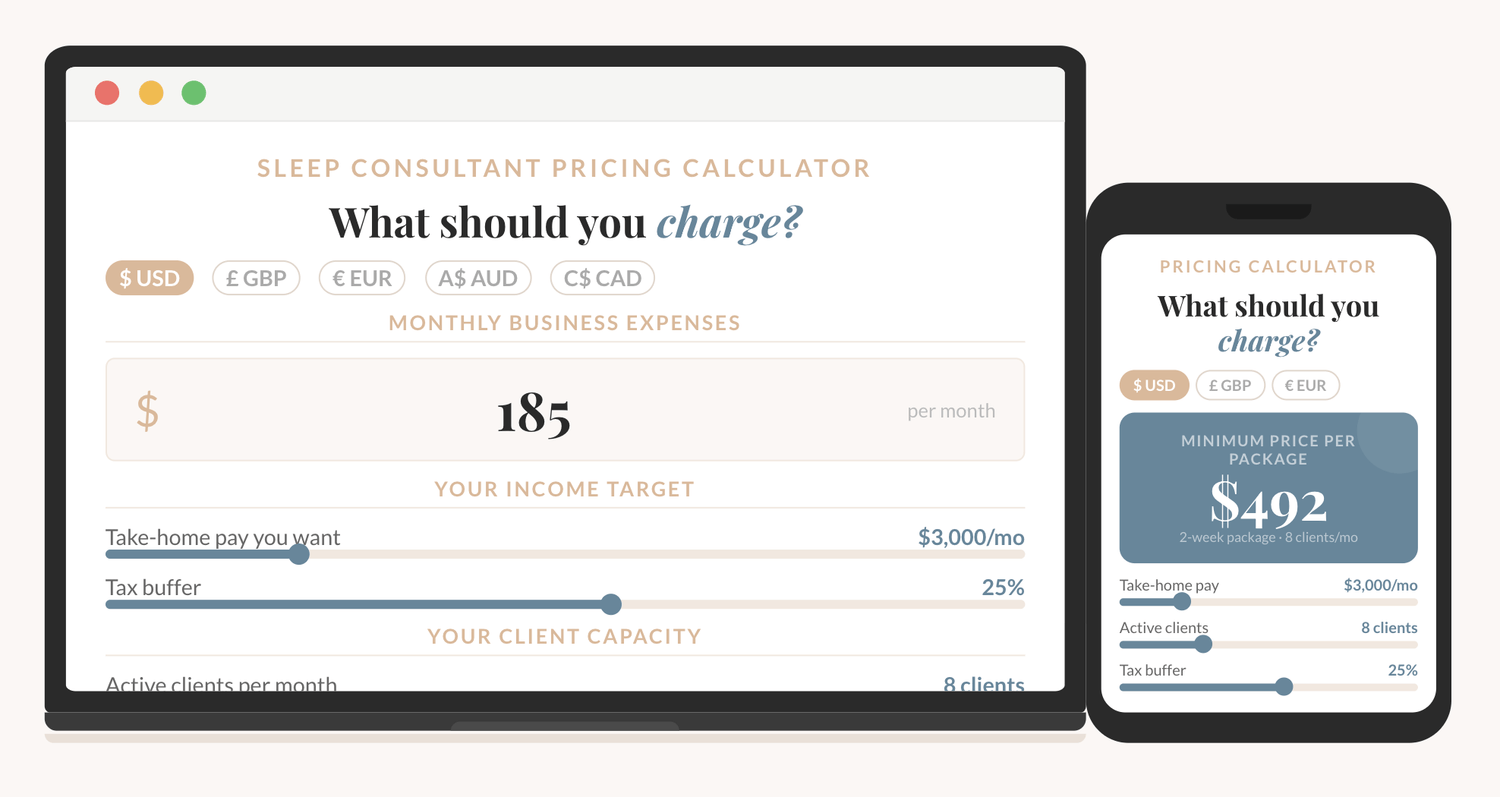
How to price your sleep consulting services?
The Sleep Consultant Pricing Calculator shows you exactly what to charge, based on your real expenses, your income goal, and how many clients you want to take on.
I'm thrilled to offer you an exclusive preview of what’s inside!
You can read the first 22 pages of The Sleep Consultant Playbook and get a taste of the value, insights, and actionable strategies that are waiting for you.
Other articles you might be interested in:
© 2021-2026 Sleep Consultant Business. All Rights Reserved.