
Order Bumps, Upsells and Downsells for Digital Products: How Sleep Consultants Earn More From Every Sale
When you sell a digital product, four small moves can increase what each buyer spends. An order bump is a cheap, relevant add-on offered as a checkbox on the checkout page. An upsell offers a bigger product straight after purchase, like a course to someone who has bought a guide. A downsell catches a parent who declined the upsell with something smaller. A cross-sell recommends a complementary product afterwards. All four raise your average order value with buyers who already trust you, and because digital products cost nothing to deliver twice, almost all of it is profit. The rule that keeps it honest: only offer what truly helps the parent who's buying.
In this guide
- The four moves, defined
- Why digital products make this so profitable
- Order bumps: the checkbox at checkout
- Upsells: the offer straight after the yes
- Downsells: catching the parent who said no
- Cross-sells: the follow-up recommendation
- Where each move belongs in a digital funnel
- The line you don't cross
- Common mistakes
- Frequently asked questions
You've built a digital product. A nap guide, a wake window tool, a short course on the four month regression. You've written the sales page, driven some traffic, and the sales are coming in. Then most Sleep Consultants do the same thing: send the buyer to a plain thank you page and start hunting for the next visitor.
That's the moment the money is left on the table. The parent who bought your guide moments ago has never trusted you more than she does right now, card already out, decision already made. What she's offered in the next thirty seconds decides whether that sale is worth twenty pounds or fifty. The difference isn't more traffic. It's what you built for her to say yes to on the way through.
This guide covers the four offer moves that raise the value of every digital sale, written for guides, tools and courses rather than one to one packages. What each one is, exactly what it looks like for a sleep product, where it sits in your checkout flow, and the line between serving a tired parent well and taking advantage of one.
The Four Moves, Defined
All four change what a buyer walks away with, and they differ by timing and direction.
| Move | What it is | Digital product example |
|---|---|---|
| Order bump | A cheap, relevant checkbox add-on on the checkout page | Buying the nap guide, add a printable routine and tracker pack for a few pounds |
| Upsell | A bigger product offered right after the purchase | She bought the guide, now offer the full course that walks her through it |
| Downsell | A smaller option offered after she declines the upsell | No to the full course, so offer one module, or a payment plan for it |
| Cross-sell | A complementary product recommended afterwards, often by email | A week after the newborn guide, suggest the wake window tool |
The key distinction is direction. Order bumps and upsells happen while the buyer is moving toward yes. A downsell happens after a no, and it exists to catch a parent who wants more from you and balked at the price. A cross-sell comes later, once she's used what she bought.
Why Digital Products Make This So Profitable
These moves work in any business. Digital products make them unusually good, for three reasons.
Delivery is free after the first sale. A one to one package costs you hours every time. A guide, a tool or a course costs the same whether ten people buy it or ten thousand. Every extra product a buyer adds is close to pure profit, so lifting average order value moves your income directly.
Digital products let you earn while you're asleep or with a client, which is the floor under the quiet stretches in the feast and famine cycle. The offer moves stack on top of that, so a quiet month still produces something.
The whole thing runs without you. The checkbox, the after-purchase offer, the follow-up email all fire automatically once you set them up. You build the sequence once and it works on every buyer forever, at 3am when a desperate parent finally buys your guide and would happily grab the tool that goes with it.
My first digital product had a sales page, a buy button, and a thank you page that said thank you. Nothing else. I later added a single checkbox at checkout offering a printable pack for a few pounds, changed not one other thing, and a big share of buyers ticked it. That was money I'd been throwing away on every order for months without noticing.
Order Bumps: The Checkbox at Checkout
An order bump is a small, low priced offer sitting on the checkout page as a checkbox, added with one tick and no new payment details. It's the easiest of the four to add and often the highest converting, because the buyer has already decided to spend and a small extra needs almost no thought.
The rule for a good bump is that it makes the main product easier to use. It solves the next small problem the buyer will hit.
Buying a guide? Bump a printable pack that turns the guide into something she can stick on the fridge. Routine cards, a sleep log, a wake window chart.
Buying an interactive tool? Bump a short walkthrough or a companion guide that explains the why behind the numbers the tool gives her.
Buying a course? Bump the printable workbook that goes with it, or a set of tracking sheets for each stage. Keep the bump cheap relative to the main product and keep it to one. A checkout with three checkboxes creates hesitation, and hesitation at the buy button costs you the whole order.
Upsells: The Offer Straight After the Yes
An upsell appears right after the purchase completes, before the thank you page. She has bought, her trust in you has peaked, and the natural next question is what more you can do for her.
The strongest digital upsell is the next size up on the same journey.
Guide to course. She bought the guide, which tells her what to do. The course shows her how, with video, examples and a structure that carries her through the hard nights the guide can only describe. Offer to credit what she paid toward it and the upgrade feels obvious.
Single tool to toolkit. She bought the wake window calculator. Offer the full set: the calculator plus the nap transition planner plus the schedule builder, as one bundle at a saving on buying them separately.
Course to membership or group. She bought the course. Offer ongoing access, a community, or a monthly live call, for parents who want support as questions come up rather than a one time answer. Whatever the upsell, it has to be the honest next step for someone who wanted the first thing, not a random more expensive product wheeled out because it costs more.
Downsells: Catching the Parent Who Said No
When a buyer declines your upsell, a no isn't the end. Often it means not that, not right now. A downsell offers a smaller version of the same help, and it recovers sales you'd otherwise lose entirely.
A downsell has to be a smaller thing, not the same thing discounted. Slashing the price of the course you offered a moment ago teaches buyers to click no and wait for the drop, and it stings the parent who paid full price an hour earlier.
Offer one part instead of the whole. She said no to the full course, so offer the single module that covers her exact issue, at a fraction of the price. She solves today's problem and can upgrade later.
Offer a payment plan. Sometimes the total is the barrier, not the value. Splitting a course fee across two or three payments rescues buyers who wanted it but couldn't take the whole cost at once.
Fall back to the guide. If your upsell was the course and she started with a tool, the guide can be the middle option she didn't see the first time. A smaller, cheaper, useful product keeps her moving forward with you instead of clicking away to a free forum.
Cross-Sells: The Follow-Up Recommendation
A cross-sell recommends a different product that sits next to what she bought, usually in the days after, once she's had a chance to use the first one. The test is whether the second product solves a real, separate problem she'll hit soon.
By stage. A parent who bought the newborn guide will face the four month regression next. An email timed to roughly that point, offering the regression course, lands as help rather than a pitch because the timing matches her real life.
By gap. Someone who bought a nap tool might need a night wakings guide. Different problem, same family, natural pairing.
This is where an email sequence earns its keep. A short automated follow-up that checks in, offers a quick win, and mentions the next product at the right moment turns one purchase into a relationship. It also brings the same buyer back through the toddler years, when the questions keep changing and your catalogue keeps answering them.
Where Each Move Belongs in a Digital Funnel
Timing carries most of the result. The same offer lands well in one place and badly a step earlier.
| Point in the flow | Which move | Why it fits there |
|---|---|---|
| On the checkout page | Order bump | She's committed and paying, so a one-tick extra needs no real decision |
| Immediately after payment | Upsell | Trust and enthusiasm peak in the seconds after the yes |
| Right after she declines the upsell | Downsell | The interest is still live and she's still on the page |
| On the thank you page | Cross-sell or invite | A warm buyer will happily join your list or grab a related freebie |
| Days later, by email | Cross-sell | She's used the product and the next problem is coming into view |
| Weeks or months later | Return offer | Nap drops, regressions and new stages send the same buyer back |
The thank you page is the most wasted spot in most funnels. It loads on every single order and usually does nothing but confirm the receipt. Give it a job: invite the buyer onto your list, hand her a quick-start video, or point her at the one product that pairs with what she bought.
The Line You Don't Cross
Your buyers are sleep deprived, worried, and sometimes buying at 3am in a low moment. That makes them easy to sell to, which is exactly why this needs a stated line rather than a good intention.
The test is simple: would you recommend this product to her if it earned you nothing. If the course is the honest next step for a parent who bought the guide, offering it is a service. If you're pushing it because it pays more, you've stopped helping and started extracting, and parents feel that even when they can't name it. It comes back as refund requests and buyers who never open a second email.
Three practical rules hold the line. Never use fear about a child's development or safety to push a bigger product. Never dress a downsell up as inferior help for people who couldn't afford the real thing, because a single module or a short guide is genuine value and deserves to be described that way. And make everything easy to decline, with a clear no thanks on every offer, so a buyer never feels trapped in your funnel. Respecting the no is what makes the yes worth having.
Common Mistakes
Stacking too many offers
Three order bumps, two upsells and a downsell in a row exhausts the buyer and drops your conversion on all of them. One bump, one upsell, one downsell behind it. That's the whole sequence, and it's plenty.
Bumping something unrelated
An order bump for a toddler product on a newborn guide checkout confuses more than it converts. The bump has to make the thing she's buying work better, not point somewhere else entirely.
Making the downsell a discount
Knocking money off the same course trains buyers to say no and wait, and undercuts everyone who paid full price. A smaller product at a lower price is a different thing and keeps your pricing clean.
Pricing the upsell too high
A guide buyer at fifteen pounds will hesitate at a two hundred pound upsell. Keep the jump within reach, roughly a small multiple of what she spent, so the upgrade feels like a step rather than a leap.
Leaving the thank you page empty
A page that only says thank you is a wasted asset that shows up on every order. At minimum, use it to get the buyer onto your email list so the cross-sells have somewhere to land.
Frequently Asked Questions
What's the difference between an order bump and an upsell?
An order bump is a small checkbox add-on on the checkout page, ticked before payment. An upsell is a bigger offer shown straight after payment completes. The bump adds a little to the current order, the upsell adds a whole extra product while trust is at its highest.
Which move should I set up first?
The order bump. It's the quickest to build, it sits on a page buyers already reach, and a relevant checkbox at checkout tends to convert well because the decision is small. Add the after-purchase upsell once the bump is running.
How much should a digital upsell cost?
Keep it within reach of what she paid. A small multiple of the first purchase reads as an upgrade, while a jump of ten times the price reads as a different decision and usually stalls. Whatever the number, the buyer has to see the extra value clearly.
Do I need lots of products before this works?
No. Two products are enough to begin: a small one and a bigger one. The small one gets bought, the bigger one becomes the upsell, and a printable pack becomes the order bump. You can add cross-sells as your catalogue grows.
Isn't this pushy with parents who are struggling?
It's pushy when the offer serves you more than the buyer. A relevant, clearly optional product that solves her next problem is help. Manufactured urgency, fear about her child, or hard-to-decline pages are not. Keep every offer easy to skip and only recommend what you'd stand behind for free.
Can I run all of this automatically?
Yes, and that's the point. Checkout order bumps, post-purchase upsell and downsell pages, and follow-up cross-sell emails are standard features on the platforms Sleep Consultants use to sell digital products. You set the sequence once and it runs on every buyer without you.
Key Takeaways
- The sale doesn't end at the buy button. An order bump, an upsell, a downsell and a cross-sell each lift what a buyer spends without new traffic.
- Digital products make it near pure profit, since delivering the same guide, tool or course twice costs nothing.
- Start with the order bump, a cheap relevant checkbox on the checkout page, then add the after-purchase upsell.
- A downsell is a smaller product, never a discount, because discounting trains buyers to wait and undercuts full-price customers.
- Apply one test: would you recommend this if it earned you nothing. If not, don't offer it.
All of this assumes buyers are finding your products in the first place, so pair it with Why Only 3% of Your Audience Is Ready to Book to keep enough parents arriving at your sales page.
Disclaimer: The information shared in these articles is for educational and informational purposes only. It does not constitute legal, financial, or professional advice. Always consult with a qualified professional regarding your specific situation.

Rianna Hijlkema
Certified Pediatric Sleep Consultant, Certified Postpartum Doula, Former Teacher & School Director, Founder of Sleep Consultant Design & Sleep Consultant Business and the author of The Sleep Consultant Playbook (available on Amazon).
The Sleep Consultant Newsletter
Weekly tips, strategies and marketing ideas for sleep consultants written by a fellow sleep consultant. 1500+ active subscribers!
I’ll only send helpful emails, and you can unsubscribe anytime with one click.
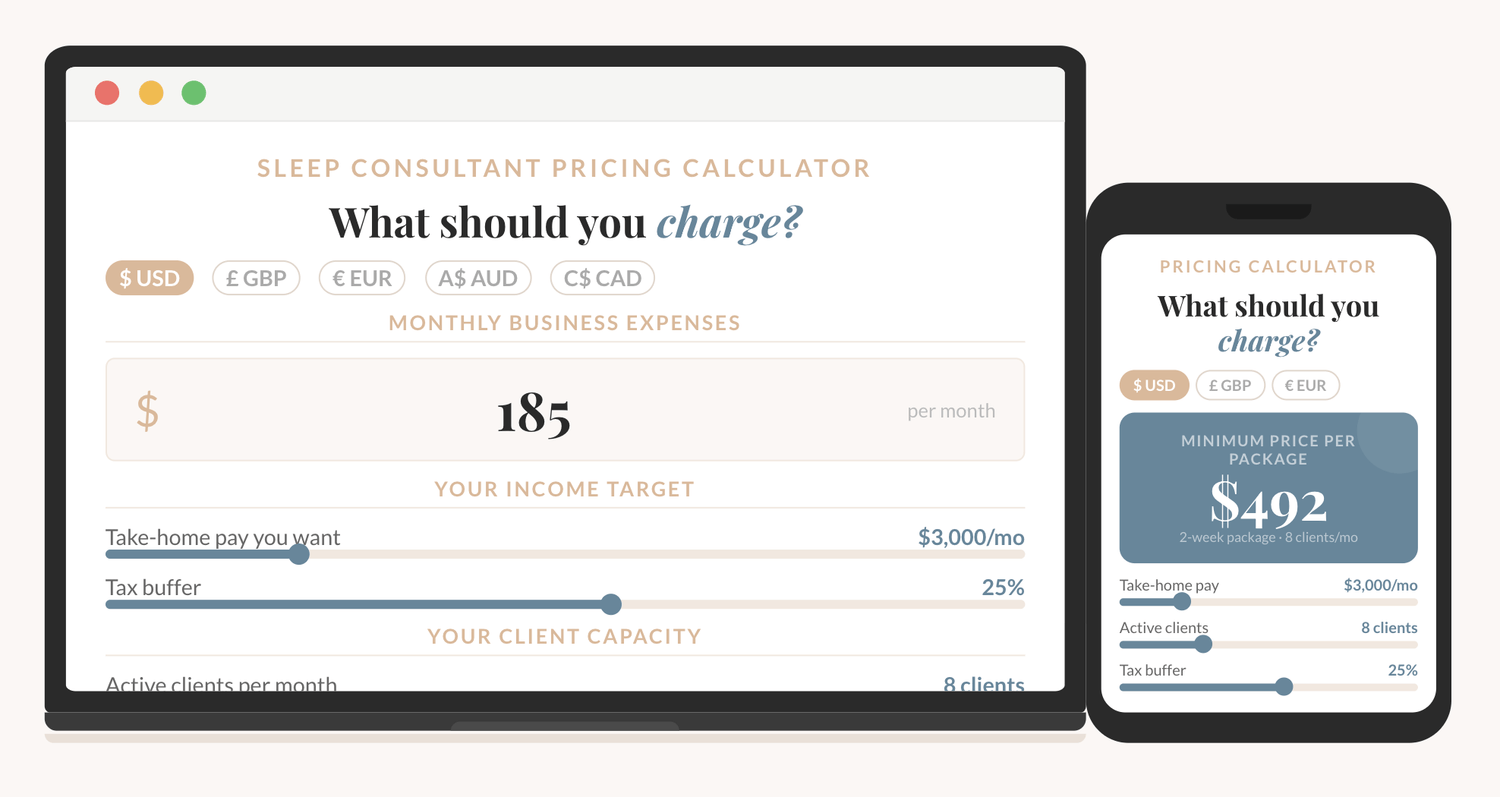
How to price your sleep consulting services?
The Sleep Consultant Pricing Calculator shows you exactly what to charge, based on your real expenses, your income goal, and how many clients you want to take on.
I'm thrilled to offer you an exclusive preview of what’s inside!
You can read the first 22 pages of The Sleep Consultant Playbook and get a taste of the value, insights, and actionable strategies that are waiting for you.
Other articles you might be interested in:
© 2021-2026 Sleep Consultant Business. All Rights Reserved.