
How to Handle Negative Comments on Social Media as a Sleep Consultant
Negative comments feel disproportionately heavy because of something called the negativity bias: your brain is literally wired to treat criticism as a threat and prioritise it above positive feedback. Understanding why it hits so hard is the first step to not letting it derail you. The practical response is this: pause, breathe, extract any genuine feedback if it exists, and leave the rest alone. A negative comment on your content says far more about the person writing it than about you or your work.
In this guide
- It will happen, and that means you're visible
- Why one negative comment hits harder than ten positive ones
- The different types of negative comments
- How to respond, and when not to
- When to delete, hide, or block
- What not to do
- Protecting yourself long term
- Frequently asked questions
You post something you're proud of. Maybe a sleep tip that helped a client this week, or a reel about the 4-month regression, or an honest behind-the-scenes moment about what this work actually looks like. Twenty people reply warmly. Then one person leaves a comment that's dismissive, rude, or just plain unkind.
The twenty warm responses blur into the background. The one comment stays. You re-read it. You wonder if they have a point. You screenshot it and send it to a friend asking if it's as bad as you think. You lie awake at 2am turning it over.
This is not a sign that you're too sensitive, too online, or not cut out for this. It's a sign that your brain is working exactly as it was designed to. Understanding that doesn't make the comment hurt less in the moment. It does help you respond to it from a grounded place rather than a reactive one.
It Will Happen, and That Means You're Visible
Truth be told, the sleep consultants who never get a negative comment are usually the ones who aren't saying anything that ruffles some feathers. Safe, vague, non-committal content rarely gets challenged. Specific, confident, opinionated content (the kind that actually builds trust and attracts clients) occasionally attracts pushback from people it wasn't made for.
If you're sharing a genuine perspective on sleep, recommending an approach, or taking a clear position on something that matters to parents, occasionally someone will disagree. That's evidence that you have a point of view strong enough to be noticed.
Negative comments are part of putting yourself out there. The alternative, staying quiet and posting nothing that could possibly be challenged, will protect you from criticism and guarantee obscurity at the same time. Every sleep consultant who has built real visibility online has a story about the comment that almost made them quit. They didn't quit. Neither should you.
Why One Negative Comment Hits Harder Than Ten Positive Ones
Your brain is wired to focus on negative experiences more than positive ones. This is called the negativity bias, and it's not a weakness. It's an evolutionary survival mechanism that kept our ancestors alive. When survival depended on spotting danger (a predator, a rival, a threat to the group), the brain learned to prioritise threats above everything else. One near-miss mattered more than ten safe days.
Your brain doesn't know you're reading a comment on Instagram. It registers the negativity as a threat and responds accordingly: elevated attention, emotional amplification, repetitive replay. Here's why the experience of a negative comment is so hard to shake:
- Your brain treats negative information as more urgent than positive information. A single critical comment feels heavier than ten encouraging ones because your brain processes them at different intensities. This is not a rational assessment. It's neurological prioritisation.
- Putting yourself online activates your social brain. When we share content publicly, we're making ourselves visible to others, and our brain associates social acceptance with safety. A negative comment triggers the same primal response as social rejection, even though the stakes are obviously different.
- Negative comments can amplify existing self-doubt. If you're already questioning whether you know enough, whether you're interesting enough, whether you should be posting at all. A critical comment can feel like confirmation. It isn't. It's one stranger's reaction on one post on one day. It feels like evidence because your brain is primed to interpret it that way.
- Your brain replays it trying to "solve" it. The rumination (re-reading the comment, playing out imaginary responses, analysing every word) is your brain's attempt to process and resolve a perceived threat. Unfortunately, the repetition often makes the comment feel bigger and more significant than it ever was.
Knowing this doesn't stop the feeling. But it does give you a framework for observing the reaction without being completely controlled by it. When you feel the pull to spiral, you can name it: "That's my negativity bias. My brain is treating this as a threat. It isn't one."
The Different Types of Negative Comments
Not all critical comments are the same, and they shouldn't all be handled the same way. Being able to identify which kind you're dealing with changes how you respond.
Genuine disagreement or concern
A parent who questions an approach you've shared, cites a different source, or pushes back on your recommendation in a respectful way. This is not a hater. This is someone engaging with your content in good faith. It deserves a thoughtful response. It might even improve your content if you take it seriously.
Frustration or fear expressed badly
A parent who is exhausted and overwhelmed and takes it out on your post. They don't really disagree with you. They're just at the end of their rope and your content happened to be in front of them. These comments often have nothing to do with you personally. A little compassion in the response can turn them into a client.
Misinformation or an opposing philosophy
Someone who follows a fundamentally different parenting philosophy and objects to yours on principle. These conversations rarely go anywhere productive in a comment thread. A brief, non-defensive acknowledgment that different approaches work for different families is usually enough, and far better than an argument that plays out publicly under your post.
Trolling or bad-faith criticism
A comment that isn't engaging with your content at all. It's designed to provoke, upset, or dismiss you. No amount of thoughtful response will change a troll's behaviour, and engaging with them publicly just gives the interaction more visibility. These get deleted, hidden, or ignored.
Competitor sniping
Rare but it happens: another sleep consultant undermining your content, sometimes subtly. The right response here is zero engagement. If you're receiving this kind of comment, you've reached a level of visibility that someone feels threatened by. That's worth knowing.
How to Respond, and When Not To
Step 1: Don't respond immediately. The immediate urge to respond (to defend yourself, to explain, to correct) is the negativity bias in action. That urge will produce a worse response than the one you'll write after you've had ten minutes to breathe. Step away first. Every time.
Step 2: Identify which type of comment it is. Is this a genuine question or concern dressed up as a criticism? Is this frustration that has nothing to do with you? Is this trolling? Identifying the type determines everything that follows.
Step 3: Ask yourself if there's anything useful in it. Is there a genuine piece of feedback here that you could learn from, even if the delivery was unkind? If yes, extract it and let the rest go. If no, you already have your answer about how much mental real estate this deserves.
Step 4: Respond from your values, not your emotions. If a response is warranted (genuine disagreement, a concerned parent, a factual misunderstanding), respond calmly and professionally. Acknowledge their perspective. Share yours clearly. Don't over-explain or apologise for your position. One reply. Not a thread.
For genuine disagreement: "Thanks for sharing your perspective. I can see why you'd think that. There are definitely different approaches to this. What works in my experience with families is [your position]. Every child is different, so I always recommend parents do what feels right for them."
For a frustrated parent: "I hear you. Sleep deprivation is genuinely exhausting and I know it can feel overwhelming when nothing seems to be working. I'm happy to chat if you'd like to share a bit more about what's going on for your family."
For trolling: No response. Delete or hide. Move on.
When to Delete, Hide, or Block
Your social media accounts are your professional space. You are allowed to moderate them. Setting boundaries on what kinds of comments are permitted in your space is not fragile or avoidant. It's responsible community management.
Delete or hide when: The comment is abusive, threatening, or uses language that would make other parents in your community feel unsafe. The comment contains misinformation that could genuinely harm families who read it. The comment is spam or promotional. The commenter is clearly a troll with no intention of engaging genuinely.
Don't delete when: Someone respectfully disagrees with you. Deleting good-faith criticism looks defensive and loses you credibility with the people watching the exchange. Respond thoughtfully instead.
Block when: Someone is repeatedly hostile across multiple posts or has made it clear they're not engaging in good faith. You don't have to give everyone equal access to your platform. Blocking a persistent troll is not dramatic. It's practical.
Most platforms also allow you to filter comments automatically. You can set up keyword filters that hide comments containing specific words before they even appear publicly. This is worth setting up proactively if you're posting content in a space that tends to attract heated debates (sleep training, in particular, can attract strong opinions from people who've never worked with a family professionally in their lives).
What Not to Do
Don't respond while you're upset
A defensive or emotional response under your own post is visible to every parent who follows you. The people watching your response will form an opinion about your professionalism based on how you handle criticism in public. A calm, measured reply elevates you. A reactive one does the opposite.
Don't argue in the comments
Nobody has ever won an argument in an Instagram comment thread. Your ideal clients are watching how you handle this. One response that acknowledges the commenter and restates your position clearly is enough. Anything beyond that is an argument, and arguments on your own content make you look unsteady, not right.
Don't let one comment change your content strategy
If a comment rattles you and you respond by making your content safer, more generic, and less specific. You've let a stranger on the internet determine the direction of your business. They win. You lose the clients who would have connected with your specific, confident point of view. Don't change what you're doing based on one hostile comment. Respond to patterns across many clients and conversations. One comment is noise.
Don't screenshot it and send it to everyone
It's tempting to seek validation by sharing the comment with friends, colleagues, or your online community. Occasionally this helps. More often it just keeps you circling the comment for longer and invites other people's emotional responses into the situation, which can make it feel bigger than it was. Talk to one trusted person if you need to process it. Then let it go.
Protecting Yourself Long Term
The emotional weight of negative comments doesn't go away entirely, but it does get lighter with experience. The first one is the hardest. By the tenth, you'll have a system. By the fiftieth, most of them will genuinely bounce off.
A few things that help in the long run:
- Keep a folder of positive messages. Something that personally helped me was to create a folder with screenshots of thank-you messages, client wins, warm DMs, genuine compliments. When a negative comment lands, you can open the folde, and remind yourself what the actual ratio is.
- Set limits on when you check comments. Checking social media first thing in the morning or last thing at night makes your emotional state hostage to whatever someone happened to type overnight. Check comments at a set time, in a set window, when you're already in a stable headspace.
- Come back to your purpose. Negative comments are less about you and more about the commenter. What matters is staying connected to why you do this work: the families you're helping, the results you've seen, the difference this makes. A stranger's bad day on the internet doesn't change any of that.
- Bookmark this article. Whenever a negative comment arrives, take a breath, revisit this section, and remind yourself how to handle it from a grounded place rather than a reactive one.
Frequently Asked Questions
What if the negative comment is from another sleep consultant?
This happens. Sleep training is a field with genuinely different philosophical approaches, and not everyone is gracious about the differences. If it's a professional disagreement expressed respectfully, engage briefly and professionally. If it's sniping or dismissiveness, ignore it completely. Responding publicly to a fellow professional's bad behaviour elevates the conflict. Not responding lets it die. Your clients are watching your response, not theirs.
What if the comment is something I'm worried other parents will believe?
If the comment contains genuine misinformation that could mislead the parents following you, it's worth a calm, factual correction, not to convince the commenter, but for the benefit of everyone else reading the thread. Keep it brief, cite your source if relevant, and don't get drawn into a back-and-forth. One clear, confident response is enough. Then move on.
Is it unprofessional to delete comments?
Deleting abusive, threatening, or deliberately misleading comments is not unprofessional. It's responsible moderation. You wouldn't allow someone to stand up in the middle of a talk you were giving and shout abuse at the audience. Your social media feed is your professional space and you have every right to manage it. The distinction is between deleting genuine criticism (which you shouldn't do) and deleting hostility or misinformation (which you absolutely can).
A comment really got to me and I don't want to post for a while. What should I do?
Take the break if you genuinely need it. A few days away from posting is fine. What you want to avoid is letting one comment become the reason you gradually post less and less until you've gone quiet altogether. That's the comment winning. Give yourself the space to process it, then come back. Your buffer of pre-scheduled content (see How to Stay Consistent With Your Content Without Living by a Strict Schedule) means your audience doesn't even notice the gap while you recover.
How do I stop checking the comment after I've replied?
Close the app and do something physical. Make a coffee, go for a ten-minute walk, do something that fully occupies your attention. The urge to re-read the thread is the brain's replay mechanism trying to "solve" the situation. There's nothing left to solve once you've replied. The physical break interrupts the loop better than trying to think your way out of it.
Key Takeaways
- The negativity bias is real and neurological. One negative comment hitting harder than ten positive ones is not weakness. It's your brain doing exactly what it was designed to do.
- Getting negative comments means you're visible enough to matter. Safe content doesn't get challenged. Specific, confident content occasionally does.
- Identify the type before you respond. Genuine concern deserves engagement. Trolling deserves nothing. Knowing the difference saves you from both under-responding and over-responding.
- Always wait before responding. The first-draft response written while you're upset is never the right one. Breathe first, respond second.
- You can moderate your own space. Delete abuse, hide misinformation, block persistent hostility. Your social media feed is your professional platform and you get to decide what happens in it.
- One comment is noise. Don't let it change your content strategy, shrink your voice, or define how you see your own expertise.
- Keep a folder of the good ones. The real ratio is almost always much better than it feels in the moment of reading the difficult one.
Negative comments are part of putting yourself out there. They're not easy, but they're also not the end of the world. What matters most is staying connected to your purpose and responding in a way that reflects who you are, not who the comment was trying to make you feel like.
Disclaimer: The information shared in these articles is for educational and informational purposes only. It does not constitute legal, financial, or professional advice. Always consult with a qualified professional regarding your specific situation.

Rianna Hijlkema
Certified Pediatric Sleep Consultant, Certified Postpartum Doula, Former Teacher & School Director, Founder of Sleep Consultant Design & Sleep Consultant Business and the author of The Sleep Consultant Playbook (available on Amazon).
The Sleep Consultant Newsletter
Weekly tips, strategies and marketing ideas for sleep consultants written by a fellow sleep consultant. 1500+ active subscribers!
I’ll only send helpful emails, and you can unsubscribe anytime with one click.
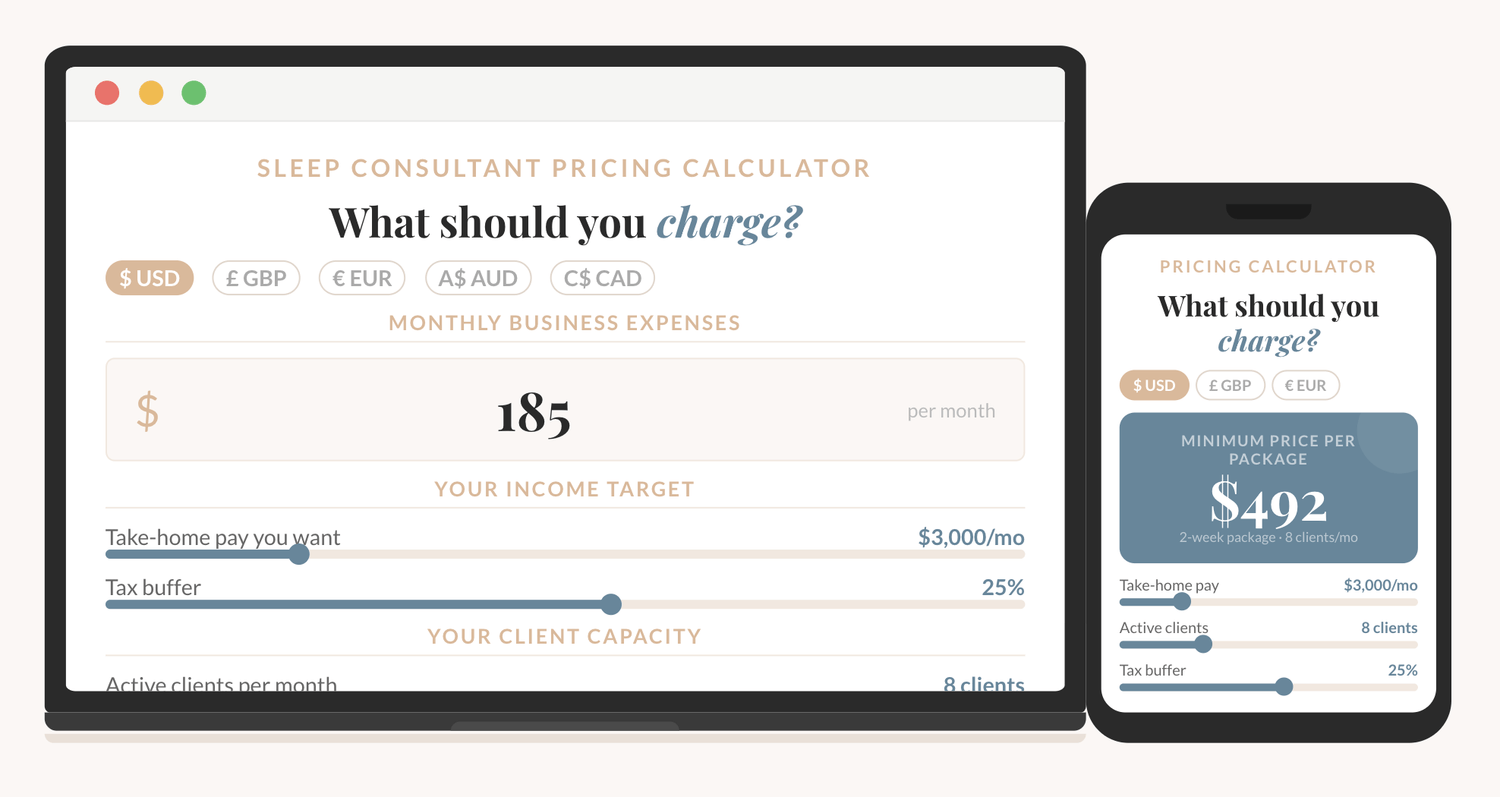
How to price your sleep consulting services?
The Sleep Consultant Pricing Calculator shows you exactly what to charge, based on your real expenses, your income goal, and how many clients you want to take on.
I'm thrilled to offer you an exclusive preview of what’s inside!
You can read the first 22 pages of The Sleep Consultant Playbook and get a taste of the value, insights, and actionable strategies that are waiting for you.
Other articles you might be interested in:
© 2021-2026 Sleep Consultant Business. All Rights Reserved.