
How to Get Great Testimonials as a Sleep Consultant (and Make Them Work for Your Business)
Great testimonials are specific, emotionally honest, and written from the other side of the transformation. A vague "she was so helpful!" does very little for a prospective client. "My daughter went from waking four times a night to sleeping 11 hours straight, and I finally feel like myself again" does a great deal. To collect testimonials that actually convert, you need to ask at the right moment, ask in a way that draws out the detail, and then place them where the people who need to see them will actually find them. This article covers all of it.
In this guide
- Why testimonials matter more than almost anything else you can do early on
- What makes a testimonial actually convert
- When to ask for a testimonial
- How to ask in a way that gets the detail you need
- Where to collect testimonials
- How to use testimonials across your marketing
- What to do when you do not have enough testimonials yet
- Common testimonial mistakes sleep consultants make
- Frequently asked questions
Before a parent books a sleep assessment call with you, they are doing the same thing every one of us does before trusting someone with something that matters: they are looking for evidence that you have done this before and that it worked.
Your credentials matter. Your website matters. Your social media presence matters. But none of those things carry the weight of a real parent saying, in their own words, what it was like to work with you and what changed. That is what a testimonial does, and it is why building a strong testimonial library is one of the highest-leverage things you can do in the first year of your business.
This article is not just about collecting reviews. It is about collecting the right kind of review, placing it in the right places, and using it in a way that actually moves a prospective client from curious to ready to book.
Why Testimonials Matter More Than Almost Anything Else You Can Do Early On
When you are new, you are asking parents to trust you with something deeply personal: their child's sleep, their own sleep, and the daily functioning of their family. That is a significant ask, especially from someone they have never met. Social proof is the shortcut that bridges that gap. It says: other people took this step, here is what happened, and it was worth it.
A parent who is sleep-deprived and researching sleep consultants at 11pm is not reading your about page carefully. They are scanning for signals. A few strong testimonials on your website, a handful of Google reviews, a screenshot shared on Instagram, these are the signals that make a hesitant parent pick up the phone. Content builds visibility. Testimonials build trust. Both matter, but in the early months, trust is the bottleneck.
There is also a compounding effect worth understanding. Your first three testimonials are harder to get than your next ten, because without them, the momentum has not started. Once you have a strong base, the trust signals you have built make it easier to attract new clients, who then become new testimonials. Getting that initial base right is worth investing real effort in.
What Makes a Testimonial Actually Convert
Most testimonials that sleep consultants collect are too generic to do much work. They are warm and appreciative, but they do not give a prospective client anything concrete to hold onto. Understanding the difference between a weak testimonial and a strong one is the first step to collecting more of the latter.
Weak vs strong: what the difference looks like
| Weak testimonial | Strong testimonial |
|---|---|
| "She was so helpful and really knew her stuff." | "Before working with Rianna, my son had not slept more than two hours at a stretch in six months. Three weeks in, he is sleeping 10 hours straight and I am finally functioning like a human again." |
| "I would definitely recommend her to anyone." | "I was worried that sleep training would mean a lot of crying and that it would damage our bond. It was nothing like that. The approach she recommended felt right for us, and my daughter actually seems happier now that she is getting proper sleep." |
| "Amazing experience, very professional." | "I had tried three other things before this. Nothing worked. The sleep plan was the most detailed and personalised thing I had ever received, and having someone to message during those first few nights made all the difference." |
The strong testimonials do several things the weak ones do not. They name the specific problem the parent had before working with you. They describe a measurable or emotionally meaningful outcome. They address a common objection, such as fears about crying or about sleep training damaging the parent-child bond. And they put another real parent's voice to the experience in a way that a prospective client can recognise themselves in.
The four elements of a high-converting testimonial are: the before (what the situation was like before working with you), the specific result (what changed, ideally with a number or a concrete detail), the experience (what it was like to work with you), and the objection handled (something that addresses a fear or doubt the prospective client is likely to have). Not every testimonial will have all four, but the closer you get, the more work it does.
When to Ask for a Testimonial
Timing is everything. The same ask, sent at the wrong moment, will get a polite response at best and a weak one-liner at worst. The right moment is when the client is emotionally at the peak of their experience with you, when the result is fresh and real and they are still feeling it.
At the close of the support phase
The most natural and reliable moment is at the end of the engagement, when the support phase wraps up and the family has seen the results. This is when you send the offboarding email with the testimonial request. The transformation is complete, the family is still connected to the experience emotionally, and they have a reason to feel grateful. This is your primary testimonial moment.
Mid-process, after a significant win
When a client messages you mid-process to share a genuine breakthrough, that moment of excitement is one of the most powerful you will ever get. If a parent tells you on night five that their child slept through for the first time, or that naps that had been 30 minutes are suddenly an hour and a half, that feeling is vivid and real in a way that it will not be three weeks later. A simple "I'm so glad to hear that! Would you be open to sharing that on my Google profile while it's fresh?" can work beautifully in that moment. You are not asking them to evaluate the full experience. You are just asking them to capture how they feel right now.
A few weeks after the engagement ends
If a client did not leave a review at the close of the engagement and you follow up a few weeks later, the tone of the testimonial shifts. Instead of capturing the relief and excitement of the result, you are capturing the durability of it. A parent who can say "it has now been six weeks and she is still sleeping through the night" is giving you something different but equally valuable: proof that the results last. A well-timed check-in a few weeks out is worth attempting once if the first ask did not convert.
The testimonials I have found most useful in my marketing are almost never the ones I received without asking. They are the ones I asked for at exactly the right moment, when the parent was still feeling the difference every morning. Timing is not a small detail. It is most of the difference between a testimonial that moves someone to book and one that just sits in a folder on your desktop.
How to Ask in a Way That Gets the Detail You Need
The standard testimonial ask, "feel free to leave a review when you get a chance," produces standard testimonials. Vague asks produce vague responses. If you want a specific, emotionally rich testimonial, you need to ask a specific, emotionally rich question.
The most effective approach is to give the client a short prompt that guides them toward the detail you need, without telling them what to say. A few prompts that consistently produce strong responses:
- "What was sleep like in your house before we started working together?"
- "What has changed most for your family since completing the plan?"
- "Was there anything you were worried about or hesitant about before starting?"
- "What would you say to another parent who was thinking about working with a sleep consultant but was not sure?"
- "Is there one moment or change that stands out most for you?"
You do not need to use all of these. One or two questions, included in your offboarding email or in a short follow-up message, is enough. The goal is to give the client a starting point so they are not staring at a blank Google review box wondering what to write.
For Google reviews specifically, it helps to acknowledge in your ask that they can answer one of those questions in their review. Something like: "If it helps to have a starting point, you could share what sleep was like before we started, or what has changed most for your family. But whatever feels natural is perfect." This removes the blank-page anxiety without scripting their response.
Never write or suggest specific sentences for a client to copy into their review. Prompting with questions is fine and ethical. Scripting their words is not, and on platforms like Google it violates their review policies. The testimonial needs to be in the client's own voice. That is also what makes it credible.
Where to Collect Testimonials
Not all testimonials live in the same place, and the platform matters for how they are used and who sees them. Here is where to focus your effort and why.
Google Business Profile: your highest priority
Google reviews are publicly visible, indexed by search engines, and often the first thing a prospective client sees when they search your name or your business. A sleep consultant with five strong Google reviews ranks and converts better than one with none, even if the latter has a more polished website. In the first year of your business, getting three to five genuine Google reviews should be one of your top marketing priorities. Always include a direct link in your ask. The fewer clicks between the ask and the action, the higher your conversion rate.
Written testimonials for your website
Website testimonials give you more control over format, placement, and length. You can collect these via a simple Google Form after the engagement closes. Ask three to four open questions, as covered in the previous section, and use the responses as website testimonials with the client's permission. Always get explicit written consent before publishing a testimonial anywhere on your site, and always ask whether they are comfortable being named. Some clients prefer to be listed as "Sarah, mum of a 9-month-old" rather than their full name. Respect that completely.
Screenshots from messages and emails
Some of the most powerful testimonials you will ever collect are the spontaneous ones: the voice note a parent sends you on morning six, the text message that says "she slept 11 hours last night and I actually cried when I woke up and realised what time it was." These moments happen naturally during the support phase and they are gold. Save them. Ask the client if you can share them (always ask, always get a yes before posting). Authentic, unscripted messages shared as screenshots on Instagram carry a different kind of weight than polished website copy, because they feel real in a way that even the best-written testimonial does not quite replicate.
Professional directories
If you are listed in sleep consultant or parenting directories that allow client reviews, encourage reviews there too. Multiple review locations build your credibility across platforms and increase the chances that a parent researching their options will find social proof about you wherever they look. Prioritise Google first, but do not ignore other directories once your Google base is solid.
How to Use Testimonials Across Your Marketing
Collecting testimonials is only half the work. The other half is placing them where they will actually be seen by parents who are in the process of deciding whether to work with you. Here is where testimonials do the most work.
Your website
Your homepage should have at least one strong testimonial above the fold, or very close to it. This is the first thing many visitors see, and trust needs to be established quickly. Your services page should also carry testimonials, ideally matched by age group or challenge type if possible. A testimonial from a toddler mum on a toddler sleep package page does more work than a generic one, because the prospective client sees their own situation reflected.
If you only have one or two testimonials, do not repeat the same one on every page. Instead, break a longer testimonial into two or three distinct quotes and feature each one separately in different locations. Attribute each one clearly. This creates the impression of a broader testimonial library while still being fully honest about what you have.
Instagram and social media
Testimonials and client wins are some of the highest-performing content you can share on social media, because they are concrete and emotionally resonant in a way that tips and advice posts rarely are. Share screenshots of spontaneous messages with the client's permission. Create simple graphics with a powerful quote. Write a caption that adds context without editorialising the result. Repost regularly, not just once. A testimonial you shared six months ago is not one that your current followers have seen.
Instagram Stories and Highlights are particularly useful for testimonials because they allow you to build a dedicated collection that a prospective client can browse. A Highlight titled "Client wins" or "Sleep transformations" gives someone who lands on your profile a fast, low-effort way to see evidence of your results.
The sleep assessment call
When a prospective client raises an objection or hesitation during the sleep assessment call, a specific client story is often the most effective response. Not quoting the review word for word, but sharing the essence of it. "I actually worked with a family recently in a very similar situation, their son was also waking four or five times a night, and what we found was..." This is not manipulation. It is honest and relevant context that helps the parent understand what is possible. Building a mental library of client outcomes that map to common objections is one of the things that makes experienced sleep consultants so effective on assessment calls.
Email marketing and nurture sequences
If you have an email list, including a client story or testimonial in a nurture email is one of the most effective ways to move a subscriber toward booking. This does not need to be a dedicated testimonial email. A single paragraph within a longer email that shares a client outcome and then connects it to the offer performs well. The rule is the same as everywhere else: specific, emotional, and honest.
I keep a folder of every testimonial and client win message I receive, and I scroll through it regularly. Not just for marketing purposes, but because on the days when building a business feels hard, it is a reminder of why this work matters. Save everything. A message that does not feel usable for marketing right now might be exactly what you need for a social post six months from now.
What to Do When You Do Not Have Enough Testimonials Yet
Every sleep consultant starts from zero testimonials. The goal in your first few months is not to have a full testimonial library. It is to get your first three to five strong ones, which means your first priority is getting those first clients, delivering excellent results, and collecting feedback immediately.
A few things that help in the early stage:
- Offer your first few clients a discounted rate in exchange for detailed feedback. This is a legitimate and common approach for newly certified consultants. Be transparent about it. Frame it honestly: you are building your practice, you want to deliver excellent results, and in return you are asking them to share their experience in detail at the end. Most people are happy with this arrangement. The testimonials you get from these early clients are often the most detailed you will ever receive, because the clients have been explicitly told their feedback matters to you.
- Work with people in your warm network first. Friends, family members, colleagues, people who know you and trust you already. They are more likely to follow through on the testimonial ask, and their experience of working with you will be more relaxed, which often produces better results and stronger feedback.
- Be honest about where you are. You do not need to hide the fact that you are newly certified. Many parents actively prefer working with someone newer because of the attention and care they receive. What you can say truthfully is that you have completed your certification, you are committed to delivering excellent results, and you have capacity to give this family your full focus.
- Use one testimonial in multiple locations while you build. If you only have one strong testimonial, a longer one can be split into two or three separate quotes used in different places on your website, each attributed clearly. Do not invent or exaggerate. Just be strategic about how far one strong response can reach.
Common Testimonial Mistakes Sleep Consultants Make
Accepting generic testimonials without following up
When a client sends you a warm but vague message, it is tempting to just save it and move on. But in many cases, a single follow-up question, "would you be willing to share a bit about what things were like before we started?" can transform that one-liner into a detailed, useful testimonial. You have permission to gently draw out the detail. Most clients are happy to provide it when asked.
Collecting testimonials and never using them
A testimonial that sits in a Google Form response sheet and never appears on your website, your social media, or your marketing is wasted. Build a simple system: when a testimonial comes in, add it to your website that week, schedule a social media post using it, and file the original in a folder you can access easily. The testimonial is only doing work if it is visible.
Using fully anonymous testimonials everywhere
Some clients will prefer not to be fully named, and that is completely fine. But a testimonial attributed to "a happy client" carries far less weight than one from "Sarah, mum of 9-month-old twins." The more detail you can include, name, child's age, location, the more credible and relatable the testimonial becomes. Always ask whether the client is comfortable being named and with how much detail. Most will say yes to at least a first name and child's age.
Only collecting one type of testimonial
Over time, aim to build a library that covers different ages, different sleep challenges, different objections addressed, and different aspects of working with you. A prospective client with a toddler who is worried about cry-it-out needs to see different testimonials than a parent of a four-month-old who just wants to know if the plan works. The broader your testimonial library, the more prospective clients will find something that reflects their specific situation.
Not asking because it feels uncomfortable
This is the most common mistake and also the most understandable one. Asking for a testimonial feels vulnerable, especially when the relationship has been warm and personal and you do not want to make it transactional. But consider it from the other direction: a parent who has just watched their family be transformed by the work you did together is usually grateful for the opportunity to say so. You are not asking them to do you a favour. You are giving them a channel to share something they are genuinely proud of. Most happy clients want to leave a review. They just do not do it without being asked.
Frequently Asked Questions
Can I edit a testimonial before publishing it on my website?
Light editing for spelling, grammar, or clarity is acceptable, provided it does not change the meaning or tone of what the client wrote. If you make any changes beyond fixing a typo, show the edited version to the client and get their approval before publishing. Never shorten a testimonial in a way that removes important context or makes it sound more positive than the full version reads. When in doubt, publish the original.
How many testimonials do I need before my website looks credible?
Three strong, specific testimonials will do more for your credibility than ten vague ones. Quality matters far more than quantity in the early months. Focus on getting three testimonials that include a before, a result, and an experience of working with you, and your website will look and feel significantly more trustworthy than one with a long list of one-liners.
What if a client leaves a negative Google review?
Respond calmly, professionally, and briefly. Acknowledge their experience without being defensive, and where appropriate offer to continue the conversation privately. Do not argue with a review or provide identifying information about the client in your response. A measured, professional response to a negative review often does as much for your credibility as the review itself does damage, because prospective clients are watching how you handle difficulty as much as they are reading what the reviewer said.
Should I ask for video testimonials?
Video testimonials are powerful when you can get them, because they add a layer of authenticity that written text cannot fully replicate. However, asking a sleep-deprived parent to record a video of themselves is a significant ask, and the conversion rate will be lower than for a written review. If a client is particularly enthusiastic and mentions they would love to share their experience, that is a good moment to ask. As a standard part of your offboarding process, stick to written reviews. The barrier is lower and the conversion rate is higher.
Can I use testimonials in paid advertising?
Yes, with the client's explicit written consent for that specific use. A client who consented to their testimonial appearing on your website has not necessarily consented to it being used in a paid ad. Get clear permission for each use case. This protects you legally and maintains the trust of the clients who shared their experience with you.
How do I ask a client to be more specific in their testimonial?
When a client submits a short or vague testimonial, a warm follow-up works well: "Thank you so much for taking the time to leave this, it really means a lot. Would you be open to adding one more detail? Even something like how many times your little one was waking before we started, or how things feel now, would make a big difference for other families reading it." Most clients are happy to add a line when asked this directly. Keep the follow-up brief and frame it around the impact it will have on other families, not on your business.
Key Takeaways
- Specific testimonials convert. Vague ones do not. The before, the result, the experience of working with you, and the objection handled: the closer a testimonial gets to those four elements, the harder it works.
- Timing is most of the difference. Ask at the close of the support phase, or at the moment of a significant mid-process win. The emotional peak is when you get the best responses.
- Give clients a starting point. One or two specific questions in your ask will produce far more detail than an open-ended "feel free to leave a review."
- Google Business Profile first. In the early months, three to five strong Google reviews will do more for your business than almost anything else in your marketing.
- Collect everything, including spontaneous messages. The unscripted text at 7am saying "she slept 11 hours" is often more powerful than any review you will ever formally collect. Save it, get permission, and use it.
- A testimonial only does work if it is visible. On your website, on social media, in your emails, on your assessment call. Collecting them is only half the job.
For the full guide to asking for testimonials as part of a structured offboarding process, including email templates and the 30-minute follow-up call, see How to Offboard a Sleep Consulting Client.
Next Article: How to Build a Referral System as a Sleep Consultant
Disclaimer: The information shared in these articles is for educational and informational purposes only. It does not constitute legal, financial, or professional advice. Always consult with a qualified professional regarding your specific situation.

Rianna Hijlkema
Certified Pediatric Sleep Consultant, Certified Postpartum Doula, Former Teacher & School Director, Founder of Sleep Consultant Design & Sleep Consultant Business and the author of The Sleep Consultant Playbook (available on Amazon).
The Sleep Consultant Newsletter
Weekly tips, strategies and marketing ideas for sleep consultants written by a fellow sleep consultant. 1500+ active subscribers!
I’ll only send helpful emails, and you can unsubscribe anytime with one click.
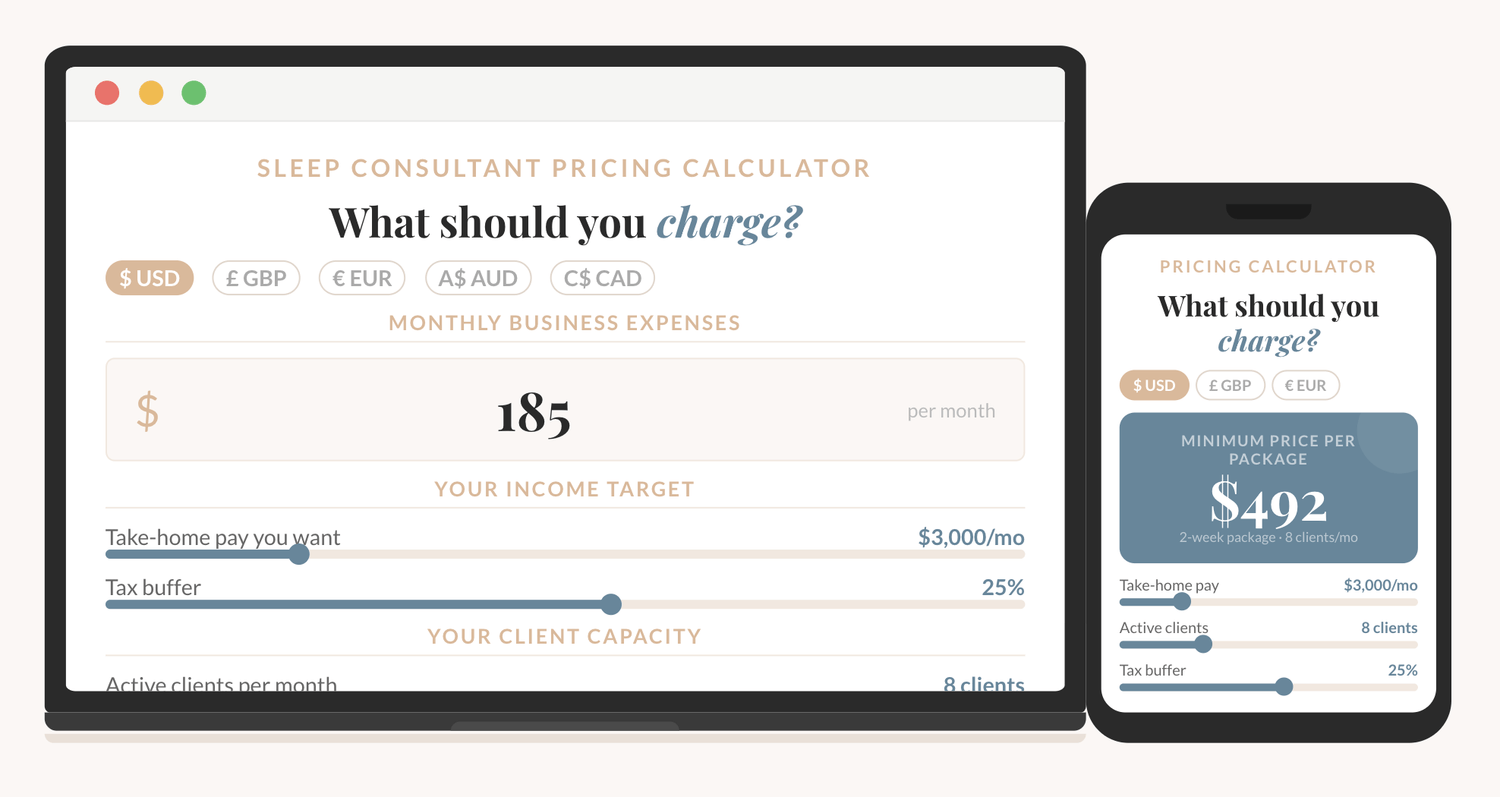
How to price your sleep consulting services?
The Sleep Consultant Pricing Calculator shows you exactly what to charge, based on your real expenses, your income goal, and how many clients you want to take on.
I'm thrilled to offer you an exclusive preview of what’s inside!
You can read the first 22 pages of The Sleep Consultant Playbook and get a taste of the value, insights, and actionable strategies that are waiting for you.
Other articles you might be interested in:
© 2021-2026 Sleep Consultant Business. All Rights Reserved.