
What Qualifications Do You Need to Become a Sleep Consultant?
To become a sleep consultant, you need to complete a recognised certification programme. There is no government-mandated licence or university degree required in most countries. A good certification covers infant and child sleep science, developmental stages, behavioural sleep strategies, and how to create personalised sleep plans. Beyond certification, you will need professional liability insurance, a registered business, and a basic set of client-facing documents before you start working with families. No prior medical or healthcare background is required, though any relevant life or professional experience you bring to the role adds genuine value.
In this guide
- Do you need a degree or medical background?
- What a sleep consultant certification covers
- How to choose the right certification programme
- What else you need beyond certification
- How your background and experience play a role
- Frequently asked questions
One of the first questions people ask when they consider sleep consulting as a career is whether they are qualified enough to do it. Many assume there is a formal academic pathway, a healthcare licence requirement, or a minimum professional background that must be met first. In most cases, none of those assumptions are correct.
Sleep consulting is an unregulated profession in most countries, which means there is no single governing body that sets mandatory entry requirements. What the industry has instead is a growing number of reputable certification programmes that train people specifically in infant and child sleep science, practical sleep strategies, and the skills needed to work professionally with families. Completing one of these programmes is both the standard entry point and the professional baseline for the role.
This article covers exactly what you need, what a good certification includes, how to choose a programme, and what else to put in place before you take your first client.
Do You Need a Degree or Medical Background?
No. Sleep consulting does not require a university degree, a healthcare licence, or any prior professional background in medicine, nursing, or child development. People come to this career from an enormous range of backgrounds: former teachers, stay-at-home parents, early childhood educators, doulas, lactation consultants, psychologists, physiotherapists, and people with no childcare professional background at all.
What matters far more than where you came from is the quality of the training you complete and the commitment you bring to applying it well. A certified sleep consultant who has completed rigorous training and works diligently within their scope of practice is fully qualified to support families with their child's sleep, regardless of their professional history before certification.
It is also worth being clear about what sleep consulting is not: it is not a medical role. Sleep consultants do not diagnose conditions, prescribe treatments, or provide clinical care. They work within a defined, non-medical scope of practice. A background in medicine or nursing is not required because the role does not overlap with medical practice. When a child's sleep challenges have a potential medical cause, a sleep consultant refers the family to a medical professional. The two roles are complementary, not competing.
You do not need a fancy degree to make this work. The families you help are not hiring you for a framed certificate on your wall. They are hiring you because you listen, you understand what they are going through, and you can give them a clear, personalised plan that actually fits their child and their life. That is what your training gives you. The rest you already bring.
What a Sleep Consultant Certification Covers
A reputable sleep consultant certification programme teaches you two distinct things: the knowledge base and the practical skills. Both matter equally. Strong knowledge without practical application produces consultants who can talk about sleep science but struggle to translate it into a real plan for a real family. Practical skills without a strong knowledge base produce consultants who follow scripts but cannot adapt when a family's situation does not fit the template.
A good certification programme typically covers:
| Area | What you learn |
|---|---|
| Sleep science | Sleep cycles, circadian rhythms, sleep architecture, how sleep develops across different ages, the role of wake windows and sleep pressure |
| Child development | Developmental milestones by age, how physical and cognitive development affects sleep, regressions and transitions, temperament |
| Sleep methods | A range of approaches from gentle, attachment-based methods to more structured behavioural approaches, when and how to apply each |
| Sleep plan creation | How to assess a family's situation, how to build a personalised plan, how to adapt recommendations to different parenting styles and family structures |
| Safe sleep guidelines | Current safe sleep recommendations by country and age, SIDS risk reduction, sleep environment setup |
| Client communication | How to conduct a consultation, how to support families during implementation, how to handle setbacks and adjust plans |
One important thing to be aware of: most certification programmes teach you how to be a sleep consultant in the clinical sense, how to assess sleep, create plans, and support families. What most programmes do not cover in depth is how to build and run a sleep consulting business: how to find clients, how to price your services, how to set up your systems, how to market yourself, and how to grow. That gap is why many certified sleep consultants struggle in their first year despite being genuinely skilled at the work itself.
How to Choose the Right Certification Programme
Because sleep consulting is an unregulated profession, the quality of certification programmes varies significantly. There is no single accrediting body that covers the whole industry internationally, and a certificate from one programme is not equivalent to a certificate from another. This makes the research stage genuinely important.
When evaluating a programme, look for the following:
- Transparent curriculum. You should be able to see clearly what the programme covers, how long it takes, and what format the learning takes before you enrol. Programmes that are vague about their curriculum content are a red flag.
- Practical case study or assessment component. A programme that tests only theoretical knowledge without requiring you to apply it to real or realistic client scenarios produces less prepared consultants. Look for programmes that include assessed practical work.
- Graduates who are actively practising. Talk to people who have completed the programme. Ask whether they feel prepared to work with families, what support they received after graduation, and whether they would recommend it. A programme with unhappy or underprepared graduates tells you more than any sales page.
- Professional credibility. Does the programme have a track record? Is the founder or lead educator a practising or experienced sleep consultant? Is the programme recognised by any professional associations in your country? Credibility matters when you are putting your name behind a certification.
- Scope clarity. The best programmes are explicit about what sleep consultants can and cannot do, and help you understand how to work appropriately within your scope. This is both ethically important and legally protective for you as a practitioner.
Be cautious about programmes that make very large earning claims on their marketing materials. Statements like "earn $5,000 to $10,000 per month" are common in this space and are not representative of what most newly certified sleep consultants earn in their first year. A reputable programme focuses on preparing you to do excellent work. The earnings that follow are a result of the business you build, not a guarantee that comes with the certificate.
What Else You Need Beyond Certification
Certification is the first step, not the whole step. Before you start working with paying clients, there are several additional elements that need to be in place. These are not bureaucratic obstacles. They are the foundations that protect both you and the families you work with.
Professional liability insurance
Also called professional indemnity insurance or errors and omissions insurance, this covers you if a client claims your advice or services caused harm. Sleep consulting is a low-risk profession, but any advice-based service carries some liability exposure, and professional liability insurance is the standard way to manage it. In some countries and regions, it may be legally required. Even where it is not, it is strongly recommended before you take a single paying client.
A registered business
The legal requirements for setting up as a sleep consultant vary by country. Most newly certified sleep consultants register as a sole trader or equivalent in their jurisdiction. You will also typically need a business bank account, a basic understanding of your tax obligations, and depending on your location, potentially a local business licence. The specifics are country-dependent, which is why it is worth researching your own jurisdiction's requirements rather than relying on general advice.
Core client-facing documents
Before working with families, you need a client contract that clearly outlines your scope of services, payment terms, cancellation policy, confidentiality clause, and liability disclaimer. You also need an intake questionnaire to gather the information you need to build a personalised sleep plan, and a basic system for delivering your work. These do not need to be complex, but they do need to exist before your first client pays you.
Clarity on your scope of practice
This is less tangible than a document or a registration, but it is equally important. You need to be clear on what you can and cannot do as a sleep consultant, and you need to be genuinely comfortable referring families to medical professionals when a situation falls outside your scope. Working confidently within boundaries is not a limitation. It is what makes the work safe, professional, and sustainable.
How Your Background and Experience Play a Role
While no specific background is required, the experiences you bring to sleep consulting are far from irrelevant. They shape how you connect with clients, which families you are best placed to serve, and how you position yourself in the market.
A background in psychology means you can engage with the emotional and behavioural dimensions of sleep in a particularly nuanced way. Experience as a parent of a child with special needs gives you a depth of understanding for families navigating similar challenges that no course can fully replicate. Time working as a doula or lactation consultant means you already understand how postpartum families think and communicate, and how to build trust quickly in a vulnerable moment. Teaching experience brings classroom management and communication skills that translate directly into explaining plans clearly and supporting parents under pressure.
None of these backgrounds are prerequisites. But all of them are assets. The goal is not to acquire more credentials before you start. The goal is to understand what you already bring, combine it with the training you complete, and use that combination to serve a specific group of families particularly well.
The families you will work with are not hiring the most credentialled person in the room. They are hiring the person they trust to understand their specific situation and guide them through it. Your life experience, your empathy, and your ability to make a stressed and exhausted parent feel heard are qualifications too, even if they do not appear on a certificate.
Frequently Asked Questions
Is sleep consulting regulated by the government?
In most countries, no. Sleep consulting is not a government-regulated profession and there is no mandatory licensing body in most jurisdictions. This means the industry is largely self-regulated through the certification programmes and professional associations that exist within it. It also means that the quality and rigour of training varies significantly between programmes, which makes researching your options carefully more important, not less.
How long does it take to become a certified sleep consultant?
It depends on the programme. Most reputable certification courses are self-paced and can be completed in anywhere from six weeks to six months, depending on how much time you dedicate to studying. Some programmes are more intensive and structured with fixed timelines. The length of a programme is not by itself a marker of quality, but programmes that can be completed in a few days should be viewed with caution, as genuine depth in sleep science and practical application takes more time than that to develop.
Do I need to keep my certification up to date?
Many certification programmes offer ongoing membership, continuing education credits, or periodic recertification. Staying current with sleep science research and evolving safe sleep guidelines is genuinely important, not just for credibility but because the field does develop over time. Setting up a Google Alert for sleep science and sleep training news and reading relevant research publications is a simple habit that keeps you informed between formal training updates.
Can I do a sleep consultant certification online?
Yes. The large majority of sleep consultant certification programmes are delivered fully online, which is part of what makes the career accessible to people in a wide range of locations and life circumstances. Online programmes vary in how they deliver content: some are video-based and self-paced, others include live group calls or one-to-one mentoring. If you learn better with some live interaction and feedback, look for a programme that includes those elements.
Do I need first aid certification?
It depends on how you work and where you are based. If you work exclusively online and virtually, first aid certification is not typically required. If you offer any in-person home visits, having current infant and child first aid certification is strongly advisable, both as a practical safeguard and as a professional standard that reassures families. Check the requirements in your specific country and region.
I already have my certification. What should I focus on next?
The single most common mistake newly certified sleep consultants make is staying in learning mode and delaying the business side. More courses, more reading, more preparation are not what stands between you and your first client. What stands between you and your first client is not having a strategy for getting one. The certification gives you the knowledge. The business side, your systems, your pricing, your client process, your visibility, is what puts that knowledge to work.
Key Takeaways
- You do not need a degree, a healthcare background, or a medical licence to become a sleep consultant. A recognised certification programme is the standard entry point for the profession.
- A good certification covers sleep science, child development, sleep methods, plan creation, safe sleep, and client communication. What most programmes do not cover is how to build and run the business itself.
- Choose your certification programme carefully. Quality varies significantly. Look for transparent curriculum, practical assessment, graduates who are actively practising, and honesty about what the role involves.
- Beyond certification, you need professional liability insurance, a registered business, and core client documents before you take your first paying client.
- Your background and life experience are genuine assets, even if they do not appear on a certificate. Combine what you already bring with the training you complete, and use that to serve a specific group of families particularly well.
- Once you have your certification, the next priority is the business side, not more training. The knowledge is there. Now the work is building the systems and strategy to put it in front of the families who need it.
Next Article: How to Price Your Sleep Consulting Services
Disclaimer: The information shared in these articles is for educational and informational purposes only. It does not constitute legal, financial, or professional advice. Always consult with a qualified professional regarding your specific situation.
Rianna Hijlkema
Certified Pediatric Sleep Consultant, Certified Postpartum Doula, Former Teacher & School Director, Founder of Sleep Consultant Design & Sleep Consultant Business and the author of The Sleep Consultant Playbook (available on Amazon).
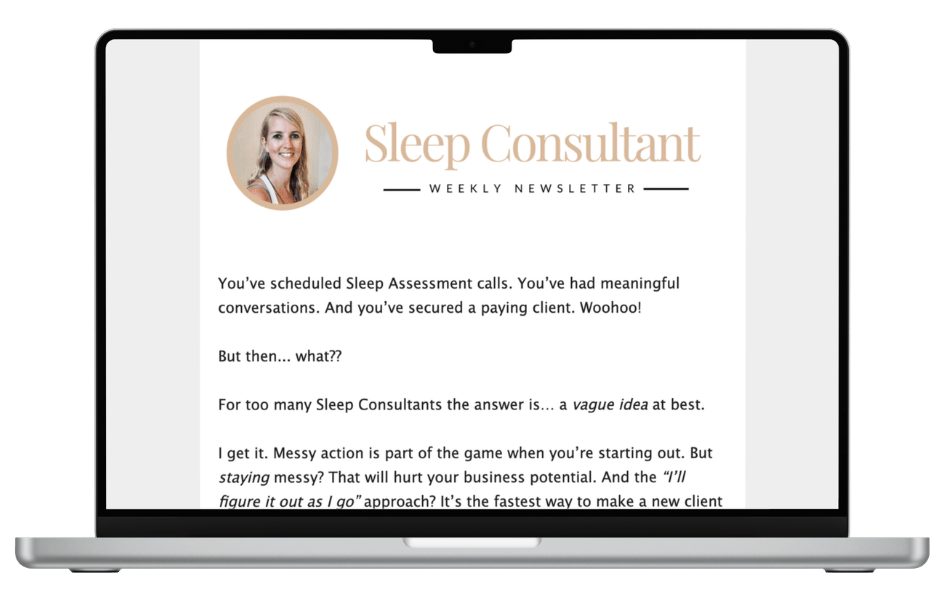
The Sleep Consultant Newsletter
Weekly tips, strategies and marketing ideas for sleep consultants written by a fellow sleep consultant. 1500+ active subscribers!
I’ll only send helpful emails, and you can unsubscribe anytime with one click.
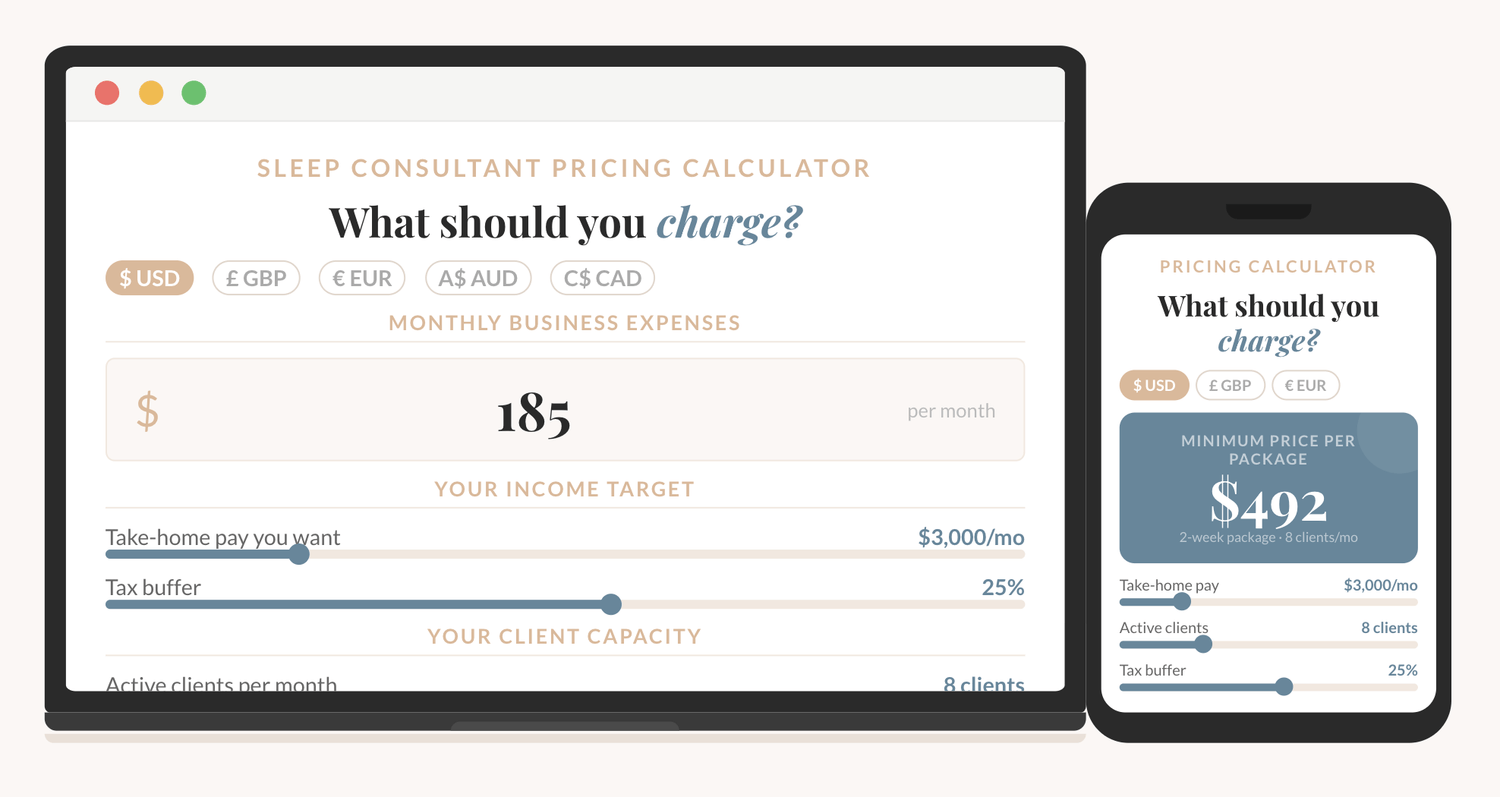
How to price your sleep consulting services?
The Sleep Consultant Pricing Calculator shows you exactly what to charge, based on your real expenses, your income goal, and how many clients you want to take on.
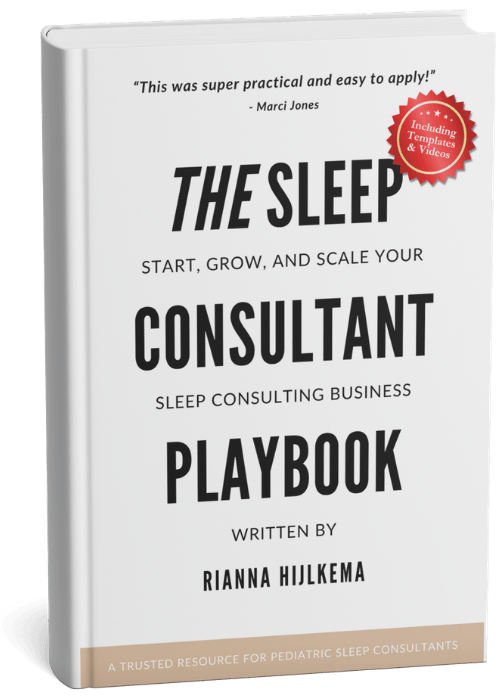
I'm thrilled to offer you an exclusive preview of what’s inside!
You can read the first 22 pages of The Sleep Consultant Playbook and get a taste of the value, insights, and actionable strategies that are waiting for you.
Other articles you might be interested in:
© 2021-2026 Sleep Consultant Business. All Rights Reserved.