
How to Use Local Directories to Get Found as a Sleep Consultant
Local directories help sleep consultants get found by parents who are actively searching for help, which is a fundamentally different and higher-intent audience than social media followers. The core types to focus on are local business directories, parenting and family-specific platforms, health and wellness directories, professional association member directories, and your local chamber of commerce. The single most important rule across all of them is NAP consistency: your business name, address, and phone number must be identical on every platform. Inconsistency confuses search engines and reduces how often your business appears in local search results.
In this guide
- Why directories work differently from social media
- The five types of directories to focus on
- How to find the right directories for your location
- How to create a listing that actually converts
- NAP consistency: the rule that affects your search rankings
- Getting reviews on your directory listings
- Step-by-step: getting listed in seven steps
- Frequently asked questions
Your ideal clients are not waiting to stumble across your Instagram. They are up at 2am, utterly exhausted, opening their phone and typing "sleep consultant near me" or "help my baby sleep through the night" into Google. That is a parent in active pain, looking for a specific solution, right now. The question is whether your business appears when they search.
Local directories and online listings are one of the most reliable and underused ways to make sure the answer is yes. They are not glamorous. They do not produce viral content. But they put your business in front of parents who are actively searching for exactly what you offer, and they work quietly in the background for years after you set them up.
This article covers the types of directories that matter, how to find them, how to write a listing that generates enquiries, and the consistency rule that has a direct effect on how often Google shows your business in local search results.
Why Directories Work Differently From Social Media
Social media reaches a passive audience, parents who happen to be scrolling when your content appears. Directories reach an active audience, parents who are specifically searching for a sleep consultant right now. That distinction is everything.
A parent who finds you through a directory search has already made the decision that they want professional help. They are not at the awareness stage, wondering whether sleep consulting is something they would consider. They are at the decision stage, evaluating which consultant to contact. That is a much shorter journey from discovery to booking, and it produces a fundamentally warmer lead than an Instagram follower who liked a post about wake windows.
There is also an SEO benefit. Each directory listing where your business name, website, and contact details appear is a signal to search engines that your business is legitimate and established. Multiple consistent listings across reputable platforms improve your authority in Google's eyes and make it more likely that your website and Google Business Profile appear higher in local search results. Some directories also allow other websites to link back to yours, which are called backlinks and are one of the most significant factors in organic search rankings.
These listings may not be as flashy as social media, but they are goldmines for increasing visibility and establishing trust in your local and online community. You are building before you even start expanding into social media. This is how you get found at the exact moment a parent needs help, before you have a hundred followers or a single viral post.
The Five Types of Directories to Focus On
Not all directories are equally worth your time. Focus on the five categories below, starting with the ones that are most specific to your audience and location.
1. Local business directories
General local business directories index businesses by location and category. When a parent searches "sleep consultant [your city]", these directories often appear in the results alongside your Google Business Profile. They are worth being on simply because they expand the surface area of your local search presence. Your local chamber of commerce directory is the most credible version of this and should always be a priority.
2. Parenting and family platforms
These are the highest-value directories for a sleep consultant because they put you directly in front of your ideal audience. Parenting blogs, family resource websites, local parenting group directories, and platforms specifically designed to connect parents with child and family service providers are all worth seeking out. The more niche the platform, the more qualified the parent who finds you there.
3. Health and wellness directories
Platforms that list health, wellness, and childcare practitioners often include sleep consultants alongside doulas, lactation consultants, and similar professionals. Parents who are already using one of those services may discover your listing while researching other aspects of their child's early development. These directories also reinforce the professional legitimacy of your practice.
4. Professional association directories
Professional associations related to pediatric sleep consulting often maintain member directories searchable by location. Being listed in an association directory adds a layer of credibility that general directories cannot, because it signals to a parent that you meet some standard of professional recognition. It also often generates backlinks to your website, which helps your search rankings.
5. Childcare and family service platforms
Platforms where parents search for childcare providers, babysitters, and family support services sometimes also list sleep consultants. The key is identifying which ones are actively used by parents in your target area, rather than listing yourself on every platform regardless of whether it actually drives relevant traffic.
How to Find the Right Directories for Your Location
Because sleep consultants operate in different countries, cities, and regions, no single directory list applies universally. The approach is to search for what exists in your specific context.
Start with these Google searches, replacing the location with your own:
- "local business directories [your city or region]"
- "pediatric sleep consultant directory [your country]"
- "parenting resources [your city]"
- "family services directory [your city or region]"
- "sleep consultant [your city]", then look at where your competitors are already listed
That last search is particularly useful. When you search for sleep consultants in your area and look at the results, you can see exactly which directories are showing up and where other practitioners have listed themselves. Those are your highest-priority targets.
Also ask directly. Reach out to your local chamber of commerce and ask which directories they recommend for service-based businesses in your area. Ask other practitioners in your network, such as doulas or lactation consultants, which platforms have sent them enquiries. Word of mouth uncovers directories you would never find through a Google search alone.
If you work virtually and serve clients across multiple countries, focus on national and international platforms rather than local ones. The principle is the same: find the platforms where your specific audience is already searching, and make sure your business appears there.
How to Create a Listing That Actually Converts
A directory listing that simply states your name and contact details is a missed opportunity. The description field in most directory listings is where you have a chance to speak directly to the parent who is already searching, and it deserves the same care as your website copy.
Write in outcome language, not feature language
Most sleep consultants write directory descriptions that list what they offer: "Personalised sleep plans, consultation calls, and two weeks of follow-up support." That describes the product. What converts a searching parent into an enquiry is the transformation: what their life will look like after working with you. Lead with the outcome. "Helping exhausted families get everyone sleeping through the night with gentle, personalised sleep plans, without hours of crying and without giving up your parenting values." Then describe the service.
Include a clear call to action
Every listing description should end with a specific next step. "Contact me today to book a free Sleep Assessment Call" is a small addition that makes a measurable difference in whether a parent who reads your listing takes action or moves on. Without it, you are relying on the parent to decide for themselves what to do next. With it, you are giving them a clear, low-commitment action to take right now.
Use the words your clients actually use
Write the description using the language an exhausted parent would type into a search bar, not the technical language of the profession. "Baby sleep problems," "won't sleep through the night," "sleep regression," "toddler bedtime battles," and "newborn sleep routine" are the phrases parents search for. Weaving these naturally into your listing description helps both the directory's internal search and Google's indexing of the page.
Add a professional photo
If the directory allows a photo, use one. A professional headshot on your listing makes you significantly more likely to be contacted than a listing without a photo. Parents are making a decision about inviting someone into their family's most vulnerable moments. Seeing your face starts the trust-building process before they have even clicked through to your website.
NAP Consistency: the Rule That Affects Your Search Rankings
NAP stands for Name, Address, and Phone number. The rule is simple: every directory listing must use exactly the same business name, address, and phone number that you have on your Google Business Profile and your website. Every single time. No abbreviations, no slight variations, no old phone numbers from before you updated your profile.
This matters because search engines use the information in directory listings to verify and confirm the legitimacy of a business. When they find consistent information across multiple platforms, it signals that the business is real, established, and trustworthy, which improves how the business ranks in local search results. When the information is inconsistent, your business name is spelled differently on different platforms, or your old address appears on some listings, it creates confusion for search engines and actively works against your local SEO.
Before you create any new listing, write down your exact business name, address or service area, phone number, website URL, and email address exactly as they appear on your Google Business Profile. Use this as your reference document for every listing you create. Any time you update your contact details anywhere, update every listing at the same time. Inconsistency across platforms is one of the most common and most avoidable SEO mistakes new sleep consultants make.
If you work virtually and do not have a fixed service area address, most directories allow you to list a service area instead of a street address. Use a consistent description of your service area, for example, "Serving clients online across Australia", and apply it uniformly across all listings.
Getting Reviews on Your Directory Listings
Some directories allow clients to leave reviews directly on your listing, similar to Google reviews. When you do your offboarding with satisfied clients, it is worth checking which of your active directory listings allow reviews and asking specifically for those, in addition to your Google Business Profile.
Having reviews across multiple platforms compounds your credibility. A parent who finds you on a parenting directory and sees five positive reviews there will arrive at your website in a very different headspace than a parent who sees only an empty listing. The reviews are doing part of the trust-building work before the parent has even reached out.
One important note: do not ask for a review while also offering a referral incentive, and do not ask for a review immediately after you ask for a testimonial. Space these requests out so each feels like a genuine and separate expression of gratitude, rather than a checklist item you are working through. The goal is authentic reviews from genuinely satisfied clients, and the framing of your ask affects whether that is what you receive.
Step-by-Step: Getting Listed in Seven Steps
Step 1: Compile your NAP reference document
Write down your exact business name, phone number, website URL, email address, and service area or address exactly as they appear on your Google Business Profile. This is your master reference. Every listing uses this, word for word.
Step 2: Research directories relevant to your location and audience
Use the Google search approaches described above. Search for what other sleep consultants in your area appear on. Ask your chamber of commerce. Ask other practitioners in your network. Build a shortlist of five to ten platforms worth submitting to.
Step 3: Write your listing description
Write one core description you can adapt for different directories. Lead with the transformation, describe your service, mention your age specialisations, and end with a clear call to action directing parents to book a free Sleep Assessment Call. Keep it between 100 and 200 words. Borrow naturally from your website and Google Business Profile description.
Step 4: Start with two or three listings and do them properly
Do not rush to list yourself everywhere at once. Pick two or three of the most relevant platforms and create complete, well-written listings with a professional photo and all details filled in accurately. A small number of strong listings will outperform a large number of sparse or inconsistent ones every time.
Step 5: Double-check every detail against your NAP reference document
Before submitting each listing, check every field against your reference document. Business name spelling, phone number format, website URL, every detail must be identical to your Google Business Profile. Submit only when everything is confirmed accurate.
Step 6: Add listings gradually over time
Once your first listings are live and accurate, continue adding to your shortlist over the following weeks and months. There is no urgency to be everywhere immediately. A steady expansion of consistent listings over time is more valuable than a rushed mass submission.
Step 7: Ask clients for directory reviews at offboarding
Once you have active listings on directories that allow reviews, include a mention in your offboarding process. Alongside your Google review request, let happy clients know which other platforms they can leave a review on if they are willing. Keep it warm and optional, never pressured.
Frequently Asked Questions
How many directories should I list on?
Start with a minimum of three and aim to build toward ten to fifteen over time. Quality and consistency matter more than volume. Three accurate, complete listings on relevant platforms will do more for your visibility than fifteen incomplete or inconsistent ones. A reasonable goal for a newly certified sleep consultant is to have at least three active directory listings in place before moving focus to other marketing channels.
Do directory listings cost money?
Most general local business directories and chamber of commerce listings are free. Some professional association directories require membership, which has an annual fee but typically includes other benefits beyond the listing. A few parenting or specialist platforms may offer both free basic listings and paid enhanced listings with additional visibility. Start with free options and only consider paid listings if there is clear evidence that the platform generates actual enquiries for practitioners in your field.
I work online with clients internationally. Do local directories still apply?
Yes, with adjustments. If you work fully virtually, replace local directories with national ones, online parenting platforms, and international professional association directories. You can still list on local directories in your home country or city without a physical address by specifying a service area. The goal is to appear wherever your specific audience is searching, and that includes online parenting communities and platforms that are not geographically restricted.
How long before directory listings start generating enquiries?
Directory listings are a slow-burn strategy rather than an immediate lead source. The SEO benefit, improved rankings in local search, typically becomes noticeable after two to four months of having consistent listings in place. Enquiries directly from directory platforms may come sooner if the platform has active parenting traffic, or they may take longer depending on your location and competition. The value compounds over time, which is why getting listings in place early is worthwhile even if the immediate return is not obvious.
What if a directory listing shows outdated information about me?
Update it as soon as you notice it. Many directories allow you to claim and manage your listing even if it was auto-generated from another source. Search for your business name on any major directory platform and check whether a listing exists before creating a new one, if one does exist with incorrect information, claim it and update it rather than leaving the inaccurate version active alongside a new one.
Should directory listings come before or after my Google Business Profile?
After. Your Google Business Profile is the foundation and the most important single listing for a sleep consultant. Get that set up, verified, and optimised first. Then expand into directories using your Google Business Profile as the reference point for your NAP details. The directories amplify what your Google Business Profile has already established, they do not replace it.
Key Takeaways
- Directories reach parents who are actively searching for help, not passively scrolling. That is a higher-intent and more conversion-ready audience than any social media platform.
- The five categories to focus on: local business directories, parenting and family platforms, health and wellness directories, professional association directories, and childcare and family service platforms.
- Find your specific directories by searching Google for your city, looking at where your competitors are listed, and asking your chamber of commerce and professional network.
- Write listing descriptions in outcome language, end with a clear call to action, and use the words parents actually search for.
- NAP consistency is non-negotiable. Your business name, address, and phone number must be identical across every platform. Inconsistency actively damages your local search rankings.
- Start with three listings done properly rather than fifteen done badly. Expand gradually, always checking accuracy against your Google Business Profile.
- Directory listings are a slow-build strategy. The SEO benefit compounds over months. Get listings in place early and let them work in the background while you focus on other client acquisition channels.
Disclaimer: The information shared in these articles is for educational and informational purposes only. It does not constitute legal, financial, or professional advice. Always consult with a qualified professional regarding your specific situation.

Rianna Hijlkema
Certified Pediatric Sleep Consultant, Certified Postpartum Doula, Former Teacher & School Director, Founder of Sleep Consultant Design & Sleep Consultant Business and the author of The Sleep Consultant Playbook (available on Amazon).
The Sleep Consultant Newsletter
Weekly tips, strategies and marketing ideas for sleep consultants written by a fellow sleep consultant. 1500+ active subscribers!
I’ll only send helpful emails, and you can unsubscribe anytime with one click.
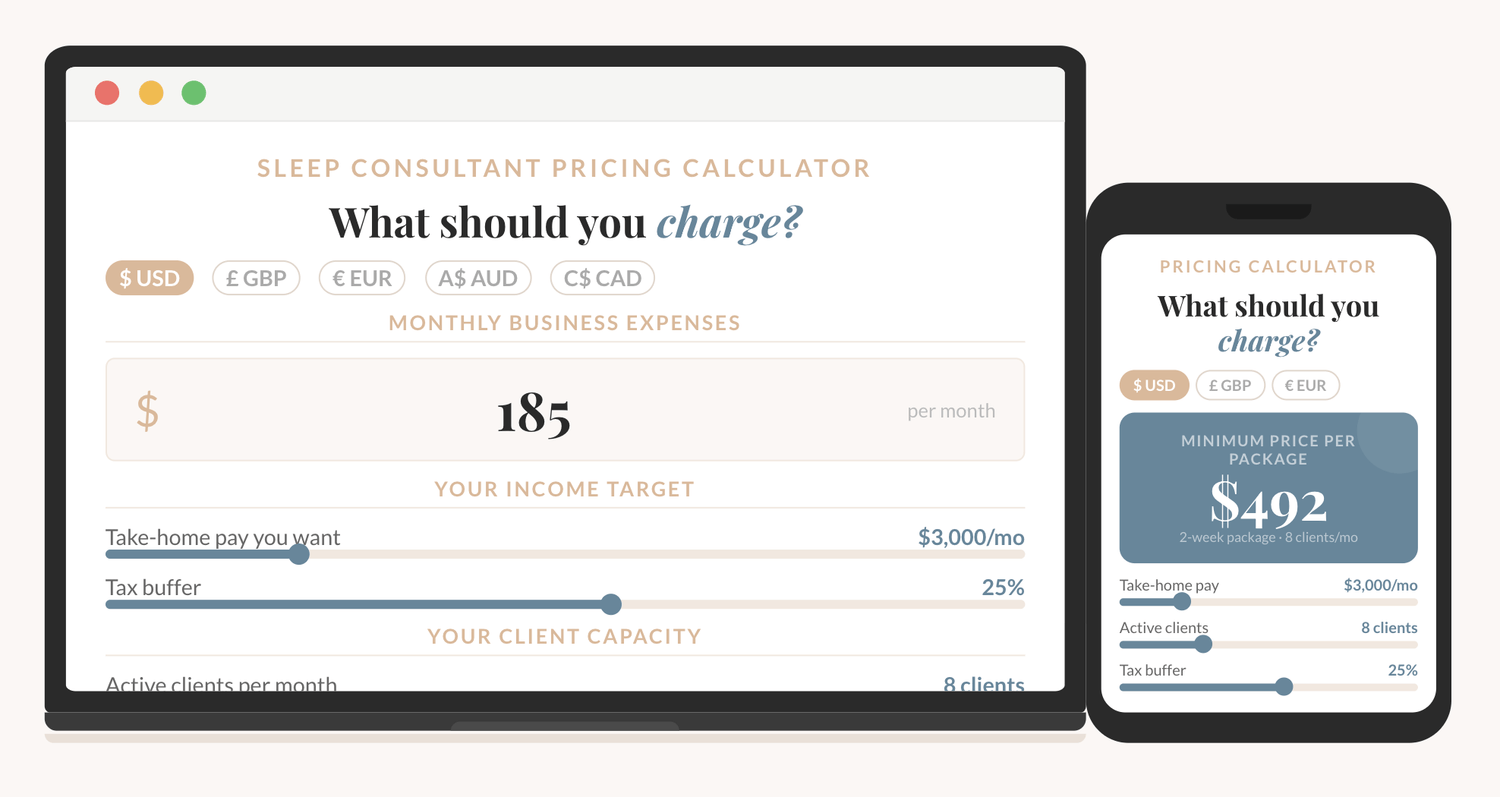
How to price your sleep consulting services?
The Sleep Consultant Pricing Calculator shows you exactly what to charge, based on your real expenses, your income goal, and how many clients you want to take on.
I'm thrilled to offer you an exclusive preview of what’s inside!
You can read the first 22 pages of The Sleep Consultant Playbook and get a taste of the value, insights, and actionable strategies that are waiting for you.
Other articles you might be interested in:
© 2021-2026 Sleep Consultant Business. All Rights Reserved.