
How to Choose a Business Name for Your Sleep Consulting Business
A great business name is simple, easy to spell, easy to say out loud, and aligned with the feeling you want families to associate with your work. Start with your audience: what tone resonates with the parents you want to serve? Brainstorm freely using a word bank, narrow to three to five favourites, then run each one through four availability checks: domain name, social media handles, business registry, and a Google search. Don't wait for the perfect name before moving forward. A good name you can actually get is worth far more than a perfect name that's already taken.
In this guide
- What makes a good sleep consultant business name
- Your own name vs a brand name: which is right for you?
- How to brainstorm: the word bank method
- Four checks to run before you commit
- Securing your domain name and professional email
- Registering your business name officially
- Common naming mistakes sleep consultants make
- Frequently asked questions
Choosing a business name is a little like naming a baby. It's exciting and nerve-wracking all at once, and yes, everyone will have an opinion. The difference is that your business name actually needs to pass a few practical tests your baby's name doesn't: domain availability, social media handles, legal registration, and the ability to say it out loud without having to spell it afterwards.
Here's the thing that trips up most new sleep consultants: they spend so long trying to find the perfect name that they don't move forward. The name becomes a reason to delay everything else: the website, the social media presence, the first clients. Don't let it. A good name you can actually use is worth far more than a perfect name you're still agonising over three months later.
This guide walks you through a practical, step-by-step process: what to think about, how to brainstorm, what to check, and how to make the decision and move on.
What Makes a Good Sleep Consultant Business Name
The best names are simple, memorable, and aligned with your vision. If someone has to pause and ask "wait, how do you spell that?" or "what does that mean?", you're making things harder than they need to be. Think effortlessly clear. Think easy to remember. Think: would an exhausted parent at 2am be able to find me based on this name?
A good sleep consultant business name does three things. It hints at the transformation you provide (peaceful nights, empowered parenting, trusted guidance). It reflects the tone your ideal client will connect with (warm and nurturing, calm and professional, or something playful and reassuring). And it stands out just enough to be memorable without being so creative that it's confusing.
Ask yourself these three questions before settling on a name:
- What transformation do I want to bring to families? Your name should hint at how you help. Do you want to emphasise peaceful nights, empowered parents, gentle approaches, or trusted expertise?
- What tone will resonate with my ideal client? The parents of a newborn who is terrified of crying it out need something that feels warm and gentle. A working parent who wants results fast might respond better to something clear and confident. The name sets the tone before they read a word of your copy.
- Does it stand out without being confusing? Generic names blend into the crowd. Something with a little personality is more memorable. But clever-for-the-sake-of-it usually backfires. If you have to explain the name, it's not working.
Your Own Name vs a Brand Name: Which Is Right for You?
This is one of the most common questions new sleep consultants have, and there's no single right answer. Both work. Here's how to think about it.
Using your own name
Operating as "Sarah Mitchell Sleep Consulting" or "Sarah Mitchell, Certified Sleep Consultant" puts you front and centre. This works especially well if you're building a personal brand, if your name is easy to spell and pronounce, and if you plan to stay as a solo practitioner without hiring other consultants under the business. It's also simpler from a legal standpoint. In many countries, operating under your own name doesn't require a separate business name registration.
The downside is that a personal name can be harder to sell or expand later if you want to grow into a multi-consultant business or create a product brand that stands independently from you.
Using a brand name
A brand name like "Restful Beginnings" or "Little Dreamers Sleep Studio" creates something that exists independently of you. It's easier to expand, potentially sell, or evolve over time. It also lets you build a brand identity that feels distinct and considered: a specific aesthetic, a specific tone, a specific feeling.
The trade-off is that if you're using a unique business name rather than your own name, you'll likely need to register it (as a DBA or Trading Name) before you can legally operate under it and open a business bank account. Rules vary by country, so check your local business registry for what's required in your area.
There's no wrong choice here. The more important thing is that you commit, register it, and move forward. Many sleep consultants start with a brand name and then find it doesn't fully fit them six months in. That's okay. You can always evolve it. What you can't do is build a business while you're still deciding what to call it. Pick something good, make it official, and go.
How to Brainstorm: the Word Bank Method
The most practical way to generate a strong list of name ideas is with a word bank. Grab a notebook and spend a few minutes writing down words across four categories, then mix and match to see what combinations feel right.
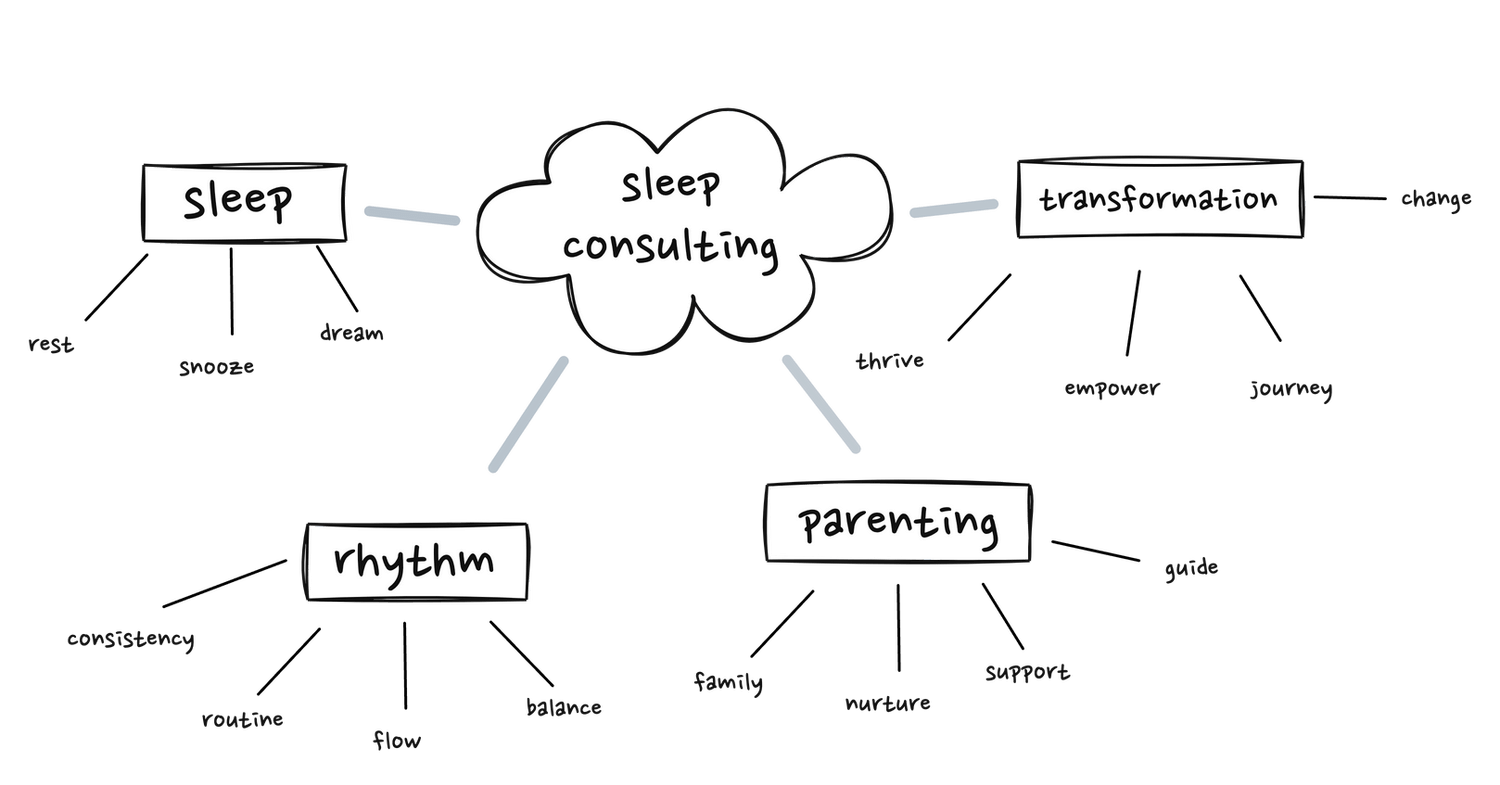
Add your own words that feel true to you and your approach. Then set a timer for 10 to 15 minutes and write down every combination that comes to mind without filtering. This is about quantity, not quality. The silly names and the obvious names both belong on the list. Sometimes a name you'd initially dismiss leads you to the one that's actually right.
Once you have a long list, highlight the three to five names that feel most aligned with your vision and your ideal client. Then do this: say them out loud. Imagine them on a logo, on a business card, in an Instagram bio. Does "Restful Beginnings Sleep Consulting" sound right when you introduce yourself at a baby shower? Would a tired parent feel reassured or intrigued when they hear it for the first time? Trust that response. It's data.
Four Checks to Run Before You Commit
Before you fall in love with a name, check it's actually available. There is nothing worse than designing a logo, writing your website copy, and then discovering someone else is already using the name, or worse, has trademarked it. Run these four checks on each name you're seriously considering.
Check 1: Domain name
Your domain name is your website address, so it's one of the most important checks. Search on GoDaddy or Namecheap to see if your chosen name is available as a .com. The .com extension is still the most trusted and widely recognised, so try to secure it if you can. If the exact .com isn't available, try simple variations: adding your location (RestfulBeginningsNZ.com), adding "consulting" or "sleep" (RestfulBeginningsSleep.com), or slightly adjusting the name rather than adding long strings of words. If the domain is too awkward to say or type, the name probably needs to change.
Check 2: Social media handles
Consistency across platforms makes it easier for parents to find you wherever they're looking. Search your chosen name on Instagram, Facebook, and any other platform you plan to use. Ideally the same handle is available across all of them. If the exact name is taken on one platform, a close variation (adding an underscore, your location, or "official") is fine, but avoid anything that makes you look like a knockoff of yourself. A tool like Namechk lets you check multiple platforms at once.
Check 3: Business registry
Search your local business registry to confirm no one has already legally registered the name. In the US, search your state's Secretary of State business name database. In the UK, check Companies House. In Australia, use the ASIC business name register. In New Zealand, use the Companies Office register. Always use official government websites (ending in .gov or equivalent) rather than third-party sites that may charge unnecessary fees.
Check 4: Google it
A quick Google search tells you whether there's an existing business using a very similar name, especially another sleep consultant. If someone with the same name is ranking well, it creates confusion for potential clients trying to find you, and it may create legal friction down the road. Your local chamber of commerce can also help you check for overlap in your immediate area.
Run all four checks on each name before you get attached to it, not after you've already made a decision. It takes twenty minutes and can save you weeks of backtracking. A name that passes all four checks without modification is rare. Most names need a small adjustment. Build that into your process rather than treating it as a setback.
Securing Your Domain Name and Professional Email
Once you've chosen your name, register the domain immediately. Even if your website isn't ready yet. Even if you're weeks away from launching. Domains are cheap ($10 to $30 a year) and losing a name you've committed to because someone else registered it in the meantime is a genuinely painful experience you can avoid for the cost of a coffee.
Go for .com if you can get it. If you're focusing on a local market and not planning to expand internationally, a country-specific extension (.co.uk, .com.au, .co.nz, .nl) is a perfectly credible option. Avoid unusual extensions unless you have a very specific reason for using them. The .biz and .info extensions don't signal professionalism in the same way.
Set up a professional email address tied to your domain at the same time. This one makes a bigger difference than most new sleep consultants expect. "crystal@restfulbeginnings.com" signals a real, established business. "sleepconsultant123@gmail.com" signals someone who started yesterday. Your email is often the first direct contact a potential client has with you. Make it look like the business you want to run, not the one you're still building.
Registering Your Business Name Officially
If you're using your own personal name to operate (Sarah Mitchell Consulting), many jurisdictions don't require a separate business name registration. But if you're using a unique brand name, you'll typically need to register it as a DBA (Doing Business As) in the US, a Trading Name in the UK and Australia, or the equivalent in your country. This is what allows you to legally operate under that name, open a business bank account in that name, and be recognised as a legitimate business.
The registration process is usually straightforward and something you can handle yourself without a lawyer or accountant. Search for "[your state or country] business name registration" and stick to official government websites. Registration fees typically range from $50 to a few hundred dollars, paid once.
What about trademarks? Trademarking your business name gives you legal protection against others using it, but it's expensive to register and even more expensive to enforce if challenged. For most newly certified sleep consultants, trademarking is not a priority in the early years. The money is better invested in building the business. If and when your brand reaches a point where protecting it feels necessary, a trademark attorney can walk you through the process. For now, register the name and move forward.
Common Naming Mistakes Sleep Consultants Make
Waiting months for the perfect name
There is no perfect name. There are good names and less good names, and the difference matters far less than whether you're actually out there working with clients. Pick a name you like, check it's available, register it, and move on. You can always rebrand later once you know your business better. Most sleep consultants who have been in the industry for a few years have changed their name or positioning at least once. That's normal. Don't let naming be the reason you don't start.
Choosing something too generic
"Baby Sleep Solutions" or "Sleep Well Consulting" are fine names, but they blend into a sea of similar names. They're hard to search for, hard to rank for, and don't give a potential client any reason to remember you specifically. A name with a little more character (even if it's subtle) is more memorable and easier to build a distinctive brand around.
Going too clever or too complicated
If the name requires explanation, it's not working. Puns that don't land, unusual spellings designed to be unique, or names that are only meaningful if you already know the backstory. All of these create friction. The test is simple: can you say it out loud and have someone write it down correctly without asking how to spell it? If not, simplify.
Skipping the availability checks
Getting attached to a name before checking that it's actually available is one of the most common and most avoidable mistakes. Run all four checks (domain, social handles, business registry, Google) before you make any decisions, not after. It takes twenty minutes now and could save you weeks of work later.
Letting other people's opinions derail you
Get feedback from people you trust, but then make the decision yourself. Your partner, your friends, your family will all have opinions, and some of those opinions will contradict each other. At the end of the day, the name needs to resonate with your ideal clients, not with the people in your life who will never hire a sleep consultant. Trust your gut. This is your business.
Frequently Asked Questions
Should I include "sleep consultant" in my business name?
You don't have to, but it can help with clarity and searchability in the early days. A name like "Restful Beginnings Sleep Consulting" tells a parent exactly what you do before they've read anything else about you. As you build brand recognition, the descriptive element matters less. But for a newly certified consultant without an established reputation yet, clarity in the name is rarely a bad thing.
What if the .com domain isn't available but the .co or .net is?
It depends on your market. If you're working primarily in a specific country (UK, Australia, New Zealand, Netherlands), a country-specific extension is completely credible and often preferred by local clients. If you're aiming for international clients, a .co or .net is a reasonable alternative to .com, but be aware that some people will automatically type .com by habit and end up on someone else's site. In that case, try a simple variation of the name that gets you the .com rather than settling for a different extension on your first-choice name.
Can I change my business name later if I want to?
Yes, and it's more common than you'd think. Rebranding involves updating your business registration, your domain (and redirecting the old one), your social media handles, your website, and your marketing materials. It takes a few days of administrative work and a brief period of communicating the change to clients. It's not painless, but it's completely manageable. More importantly, the fear of a future rebrand should not stop you from choosing a good name today and starting to build.
Does my business name need to include my niche or specialty?
Not necessarily. A name like "Twin Dreams Sleep Studio" is very specific and works well if twins will always be your focus. But if you're starting with a general sleep consulting practice and plan to specialise later (or change your niche as you discover what you love most), a slightly broader name gives you more room to evolve. Avoid names so niche-specific that they'd require a rebrand if your focus ever shifts.
How do I know if a name is trademarked?
In the US, search the USPTO (United States Patent and Trademark Office) database at uspto.gov. In the UK, use the IPO (Intellectual Property Office) at gov.uk/search-for-trademark. In Australia, use IP Australia. In Canada, search the Canadian Intellectual Property Office. A basic Google search for the name alongside "trademark" will also surface any obvious conflicts. If you're unsure, a quick consultation with an IP attorney is worth the hour.
What if my chosen name is already used by a sleep consultant in another country?
If it's not trademarked and you're in a different market, it's usually fine, especially if you're primarily serving clients locally or within your own country. That said, if you have global ambitions or plan to sell digital products internationally, a name that's already in use in other major markets could create confusion. Use your judgment and check whether the other business has an international presence or only serves their local market.
Key Takeaways
- Simple, memorable, and easy to say out loud. If people have to ask how to spell it, simplify it.
- Start with your audience. What tone resonates with the parents you most want to work with? The name sets that expectation before they read anything else.
- Use the word bank method to brainstorm freely, then narrow to three to five options. Say them out loud. Imagine them on a logo. Trust your gut response.
- Run four checks before committing: domain, social handles, business registry, and Google. Do this before you get attached, not after.
- Register the domain immediately once you've chosen. A professional email tied to that domain is one of the simplest trust signals you can put in place.
- Don't let naming become a reason to delay. A good name you can use right now is worth far more than a perfect name you're still deciding on next month.
Start today: open a notebook, write down your word bank across the four categories, set a 15-minute timer, and go. Aim for at least ten names on the page before you filter anything. Your business name is in that list somewhere.
Next Article: Business Structures for Sleep Consultants
Disclaimer: The information shared in these articles is for educational and informational purposes only. It does not constitute legal, financial, or professional advice. Always consult with a qualified professional regarding your specific situation.

Rianna Hijlkema
Certified Pediatric Sleep Consultant, Certified Postpartum Doula, Former Teacher & School Director, Founder of Sleep Consultant Design & Sleep Consultant Business and the author of The Sleep Consultant Playbook (available on Amazon).
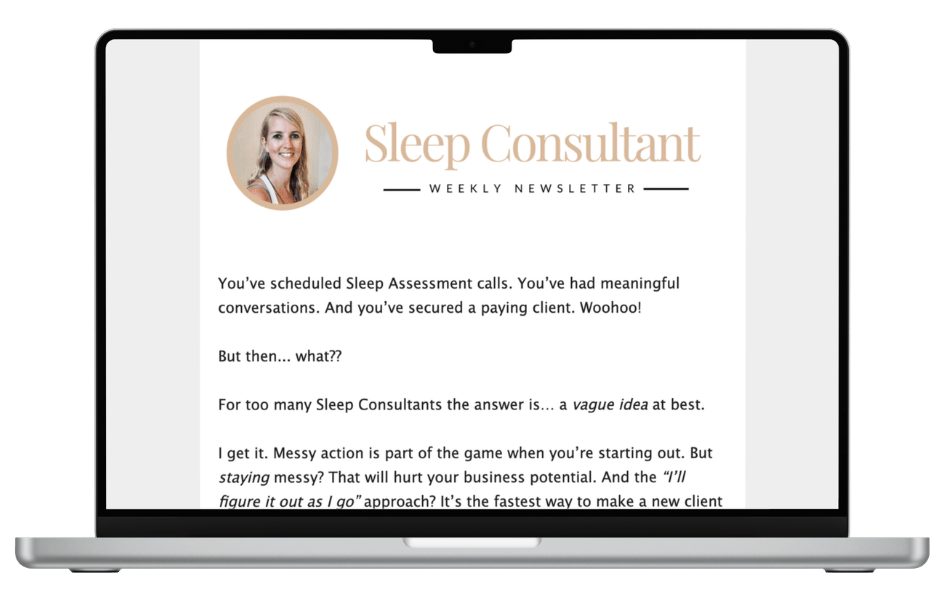
The Sleep Consultant Newsletter
Weekly tips, strategies and marketing ideas for sleep consultants written by a fellow sleep consultant. 1500+ active subscribers!
I’ll only send helpful emails, and you can unsubscribe anytime with one click.
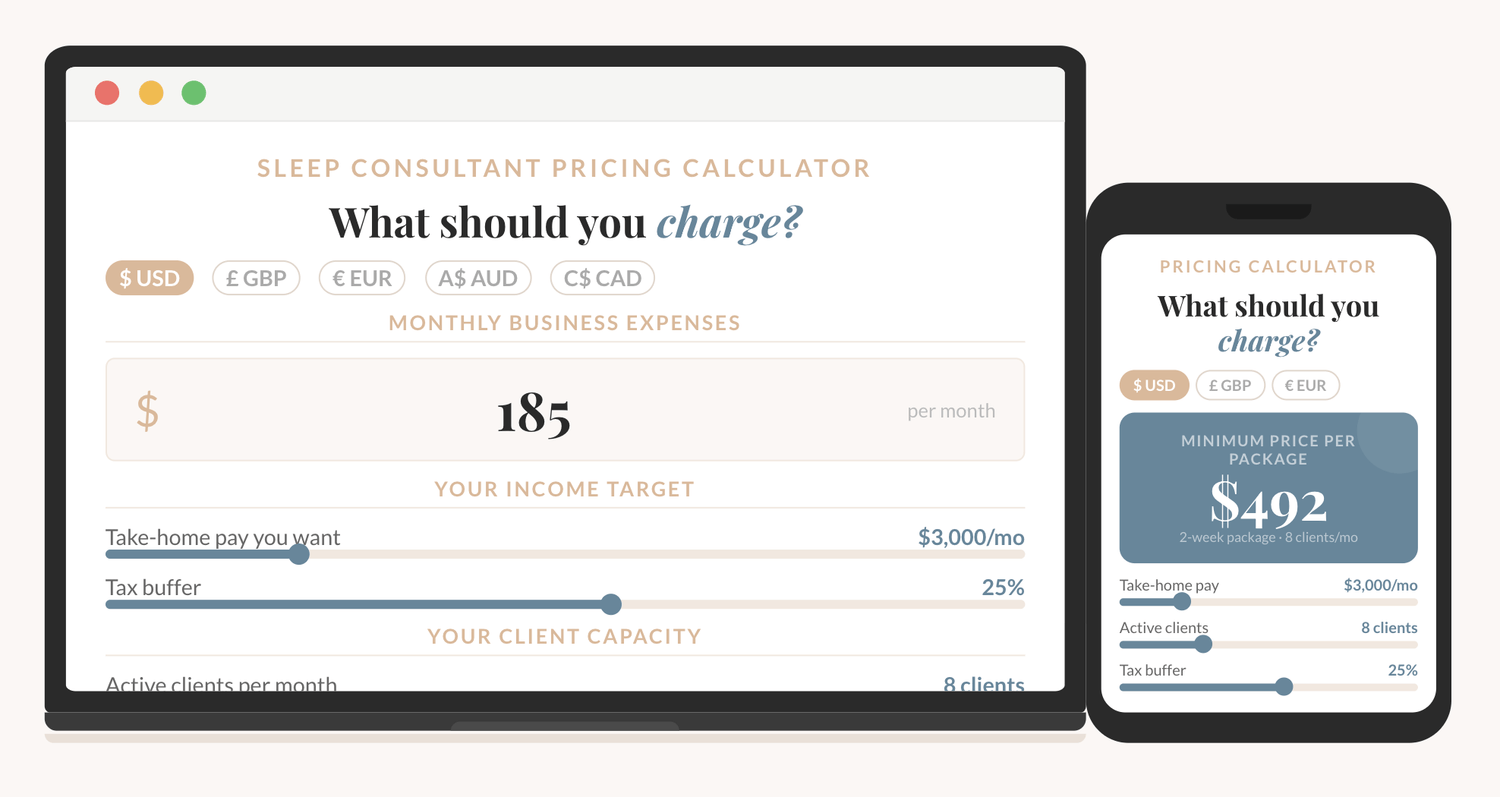
How to price your sleep consulting services?
The Sleep Consultant Pricing Calculator shows you exactly what to charge, based on your real expenses, your income goal, and how many clients you want to take on.
I'm thrilled to offer you an exclusive preview of what’s inside!
You can read the first 22 pages of The Sleep Consultant Playbook and get a taste of the value, insights, and actionable strategies that are waiting for you.
Other articles you might be interested in:
© 2021-2026 Sleep Consultant Business. All Rights Reserved.